
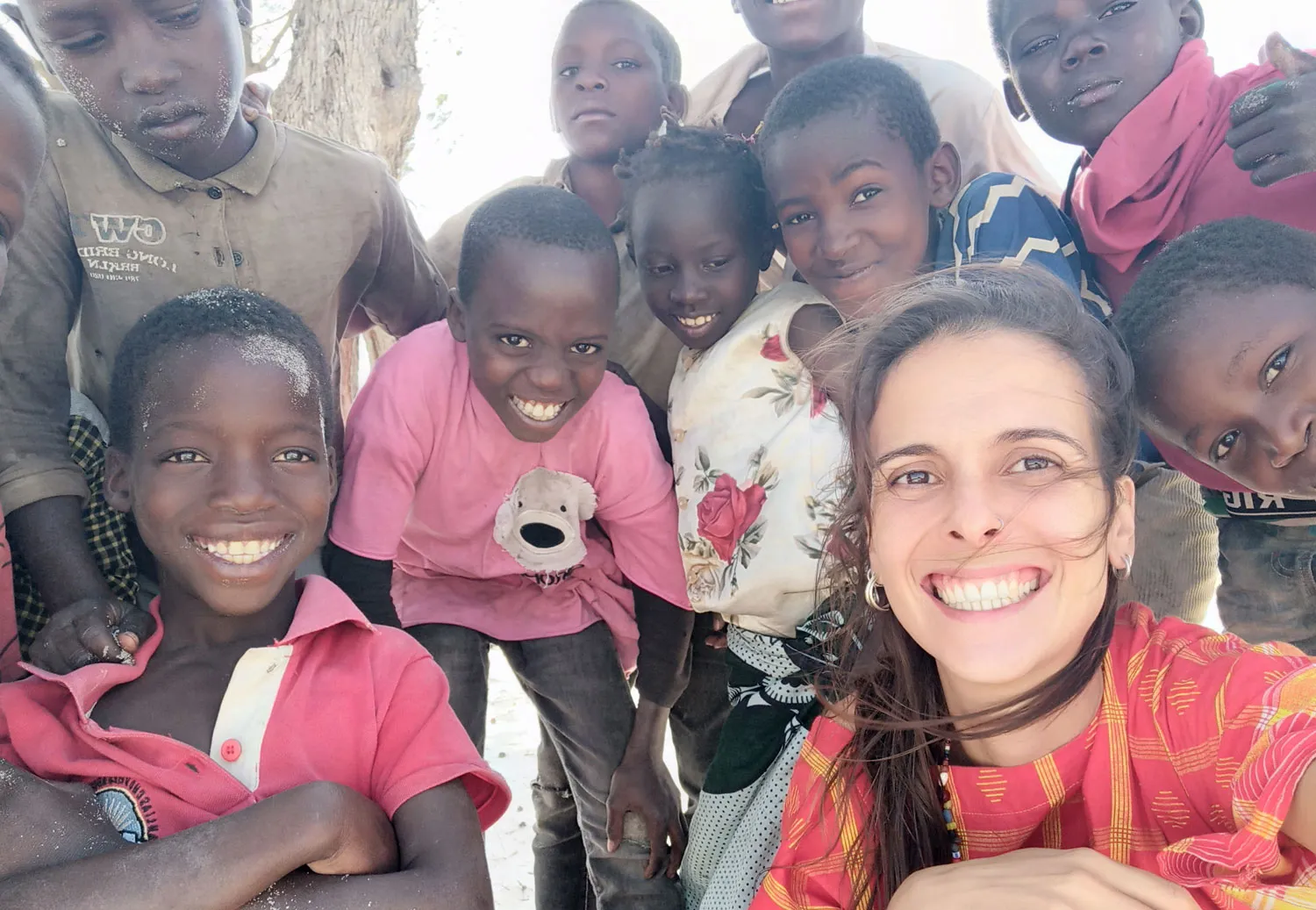
There are places where childhood has no room for distractions, where it grows up fast and learns early the weight of the world. On Mozambique Island, amid fragile routines and affection built day by day, Heartseed was born — not as a ready-made answer, but as a persistent attempt to be present. In this conversation, Juliana Lamares, the project's founder, speaks of what does not fit into reports, of the moment when an idea stops being enough, of the instant when staying becomes a choice, and of the responsibility that acquires a face, a name and time.
Heartseed was born from an idea, but ideas do not get far on their own. At what point did you feel that this had to move from a dream to a responsibility?
In the beginning, Heartseed was just a restlessness inside me. A constant feeling that I could not walk past those children every day and pretend not to see. I came from a world where everything seemed organised, with plans, timetables, security, and suddenly I was in a place where childhood happened on the street, exposed to everything. The turning point came when I stopped seeing only children begging on the street and came to know their stories, their names, their routines. When I realised that many of them were not there by choice, but through abandonment, poverty, lack of protection, and the influence of a system that, unintentionally, pushes them into begging. When a child trusts you, when they look at you as a safe harbour, when they start to prefer being in a protected space rather than on the street, it is no longer possible to treat it as a one-off project. At that moment, I realised it was no longer a beautiful dream. It was a daily, emotional and human responsibility. That was when I understood that I could not simply leave when things got difficult. That it was no longer about me, but about them.
For Juliana, there was no exact day or isolated moment that marked the turning point. There were many small, almost silent moments, accumulating. One of them stayed with her: on a day when she did not turn up, a group of children knocked on her door looking for answers. In that simple gesture, she realised she would no longer be able to truly leave. It was from this unexpected permanence that Heartseed took shape. A project made of care and patience, but also of a hardness that is rarely spoken of. Because love does not solve everything quickly. Some children arrive withdrawn, marked by abandonment, violence or neglect, and there are days when you give everything and nothing seems to change. Planting seeds is staying when they push you away. It is accepting that transformation is slow and that some wounds are not healed by food or school alone. There is tiredness, doubt and frustration. But there are also small, silent miracles. And it is these, almost invisible, that make it all worthwhile.
What brought you to Mozambique Island, and what made you stay, even when it would have been easier to leave?
I arrived in Mozambique almost by chance, through a close Mozambican friend, without knowing much about the country. The idea was to stay just a month and travel from Maputo to the north. When I reached the Island, at night, I felt an immediate and very strong connection, a sense of home. I grew up in Trás-os-Montes, with a great deal of freedom, playing in the street, barefoot, with families always close by. The Island brought me that same energy of community and simplicity. But what made me stay was the people, especially the children, and the realisation that I could build something there with real impact. I understood that I could leave and carry on with my comfortable life, but I also understood that I would never be the same person again if I did. Staying became a conscious choice.
Before starting this project, Juliana thought vulnerability meant hunger, cold and a lack of schooling. In time, she realised that the greater wound is invisible: the absence of love, of security, of someone who stays. She learned that, before teaching a child to read, you must teach them to trust, and that no rule is worth anything if love disappears when a mistake is made.
A way of being, caring and educating of its own has grown up with Heartseed. How would you describe this way of being in everyday life?
Heartseed is not just a centre, it is an emotional home, and that is why we have focused on developing an educational methodology perfectly adapted to the child's needs and to the local reality. Here, children find routine, but also cuddles. They find rules, but also understanding. The children have routines, meals, hygiene, education and activities. But, above all, they have constant adults in their lives. Here we blend discipline with a great deal of affection, structure with room to play and create. Each child is seen as a unique individual, with their own talents and needs, and not as a number.
There were children who forced her to rethink everything she believed about education, boundaries and love. They arrived hardened, aggressive, unable to trust. With them, Juliana realised that true love is not only tenderness, it is constancy, boundaries and presence when it is hardest to stay. Some children test before they believe, because they have been left too many times. And to love, there, is to remain even in the face of rejection. This same exercise is repeated in the daily running of the project. Wanting to do more with limited resources demands resilience. There are moments of worry, when it is unclear how to guarantee everything that is needed. Even so, scarcity turns into creativity, partnerships and clear goals. Not as a blockage, but as challenges to be overcome for a greater good.
What kind of help truly makes a difference in your day-to-day life, the kind that is almost never seen from the outside?
The help that truly transforms is the kind that goes beyond the impulse of the moment. For a long time we believed, and many people still believe, that giving money, food or a ball to a child on the street is a gesture of love. The intention comes from compassion and a wish to relieve immediate suffering. But, most of the time, it does not help, it perpetuates the problem. Every coin given on the street keeps the child trapped in that place, away from school, from play, from childhood. Child begging does not exist by choice. It exists because we, as adults and as a society, are not protecting them. Many are pushed onto the street through lack of care or by families who also live in great vulnerability. And, once inside that cycle, getting out becomes extremely difficult. Helping properly is more work. It takes time, involvement, getting to know the child, the family, the context, and empowering the adults so that they can care for and protect. It is a long process, often invisible, but it is the only one that generates real change. At Heartseed, this means taking children off the street and offering a safe space, routine, food, education, activities and support for the family, treating not only the symptom but the root of the problem. For all this to be possible, the most important help is ongoing help. It is not only large one-off donations that make the difference, but regular commitment, sponsorships, partnerships that last. It is this constancy that ensures a child eats every day, is in school and has adults who are present.
When someone decides to support Heartseed, what are they actually sustaining, rather than merely funding?
They are sustaining protection, education and daily care. When someone supports Heartseed, they are not just funding a project, they are sustaining lives day to day. They are making it possible for there to be stable routines where there used to be the street, protection where there used to be abandonment, care where there used to be absence. They are guaranteeing that a child knows they will eat, learn, play and be cared for every day. To support Heartseed is to give back something that should never have been taken away: the right to a safe childhood. More than supporting a structure, it is creating real choices, the choice to go to school instead of begging on the street, to dream instead of merely surviving, to build a future with opportunities. And this transformation affects not only the child, but also the family and the whole community.
At Heartseed, the vegetable garden, the kitchen, the carpentry workshop and the theatre are more than activities. They are education and preparation for life. In every experience, more than a technique is learned. Values, confidence and autonomy are cultivated. They are seeds planted in the present so that, in the future, each child can choose their own path with dignity and freedom.
Where do you feel you still fall short, even with the best intentions?
We still feel that we often fall short where change is most urgent. We do not always manage to make visitors and tourists understand that giving on the street does not help a child, and that the real responsibility is ours, as adults, to protect and to safeguard childhood. We do not always manage to reach every child who needs us, nor to offer the psychological support that would be vital for some of them. We know we could do much more, transform even more lives, if we had enough resources, infrastructure and means. But even within that limitation, every day is an opportunity to learn, adjust, grow and make a difference where we can.
What future do you imagine for these children when they leave the centre, and what fears do you carry about that future?
We dream of young people who grow up with education, self-esteem, solid values and real opportunities, capable of becoming examples of integrity, kindness and character for their families and for the whole community. We dream that they can live a structured and organised life, in which they have the freedom to choose, to dream and to build their own path. We carry a constant fear of the difficult context that surrounds them: poverty, the scarcity of opportunities, the negative influences that may try to lead them astray. That is why all our work focuses on emotional development and the transmission of values, so that each child has the strength, awareness and courage to make different decisions, break cycles and create a future they can truly choose.


