
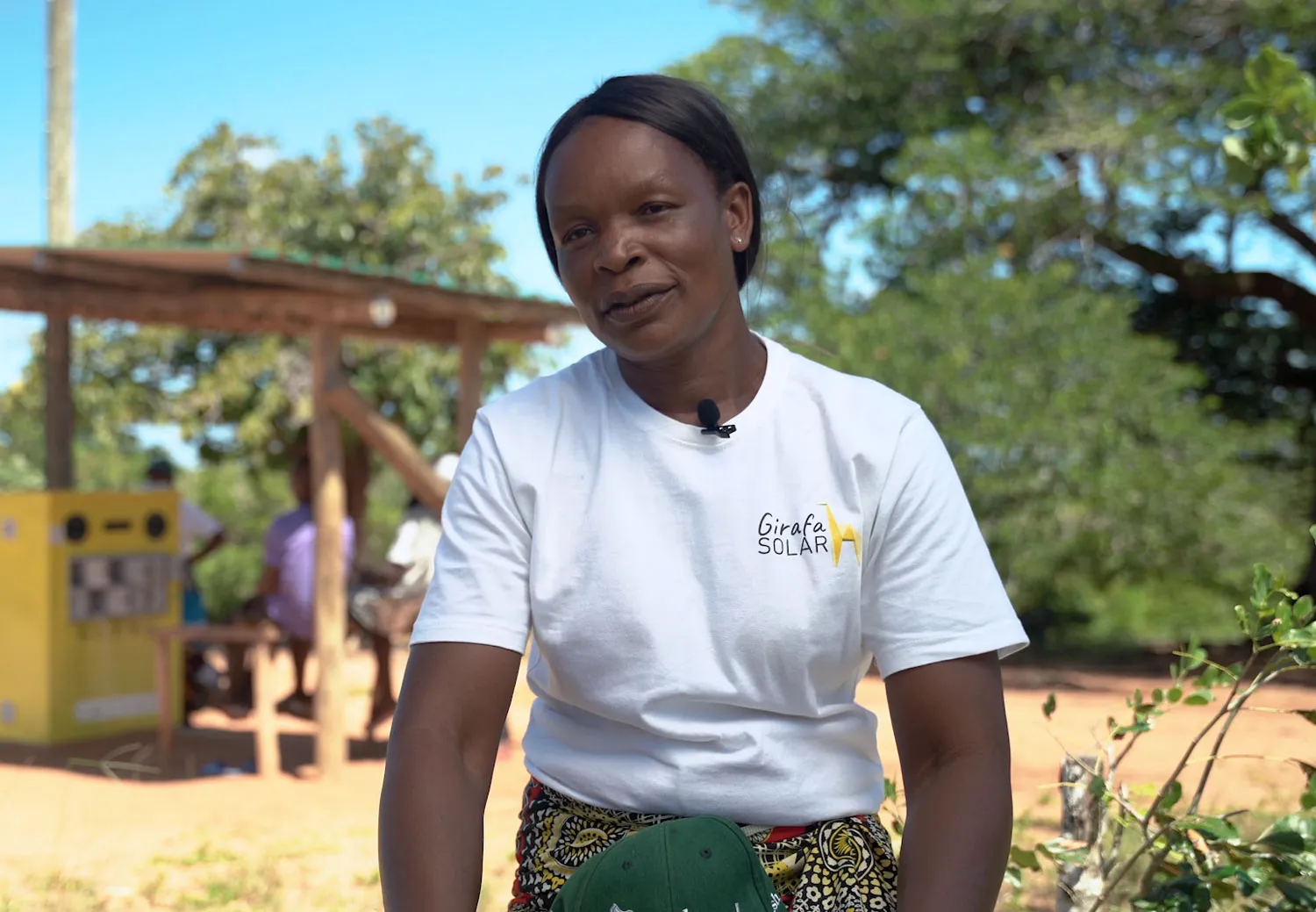
Although electricity may be very close by, the years go by without it reaching everyone, which is why many members of rural communities use solar panels to produce the household energy they need. As not everyone can afford to buy these panels, they end up depending on neighbours and on paying high fees to charge their devices. From constant discussions with a local partner and with the community of Mangunze, a solution emerged: the installation of the Solar Giraffe.
“Our research also identified the inherent value of communication, specifically by mobile phone, in rural areas, where it is fundamental to the socioeconomic growth of communities. We concluded that mobile phones, by expanding and strengthening social networks, contribute to improving rural livelihoods and, consequently, to reducing poverty; increase people’s ability to deal with emergencies; reduce travel costs; maximise the results of necessary journeys; increase temporal accessibility; and enhance the efficiency of rural activities. The use of mobile phones also reduces the costs of developing businesses and increases productivity, helping rural traders and farmers to secure better markets and prices by quickly communicating information related to their businesses.” – say the entrepreneurs.
Based on the suggestions received, the project was redesigned and the panels were raised, and it quickly became apparent that, because of the side elevation, a giraffe had been designed, a “Solar Giraffe”
The shape of a giraffe was chosen because of the design associated with it. The project, at first merely a shelter with solar panels on top, was initially called a solar charger. As soon as it was presented, it drew criticism from the community, which advised that the panels be raised. Based on the suggestions received, the project was redesigned and the panels were raised, and it quickly became apparent that, because of the side elevation, a giraffe had been designed, a “Solar Giraffe”.
Both the project’s promoter – the Carlos Morgado Foundation – and its partners, the Embassy of Ireland, as funder, and Mozambique Women of Energy (MWE), believe that the project is beneficial for the whole country, especially for rural communities. The local implementer is the Nykani Mavoko Association.
According to the World Bank, Mozambique has 7.9% access to electricity in rural areas, areas in which – it has been proven – the mobile phone is a socioeconomic tool of great value, not only because of its capacity as a means of communication, but also because of the ease with which it can be carried. The first big step is to define a basic solution with a consolidated cost and defined benefits.
As regards new information solutions, the Solar Giraffe’s immediate intention is to offer a digital device (a tablet) that allows access to more information, such as that provided by Portuguese-language Wikipedia, as well as games, videos and other educational material. The installation of a television is also being considered. Other versions of the Solar Giraffe are being developed, and some potential uses have already been identified, such as water pumping and storage and agricultural refrigeration. For this, solutions need to be developed with an impact at an acceptable cost-benefit ratio. Achievable solutions do not always bring the expected benefit, in which case the solution has to be redesigned, which delays the mitigation of the problem identified.


