
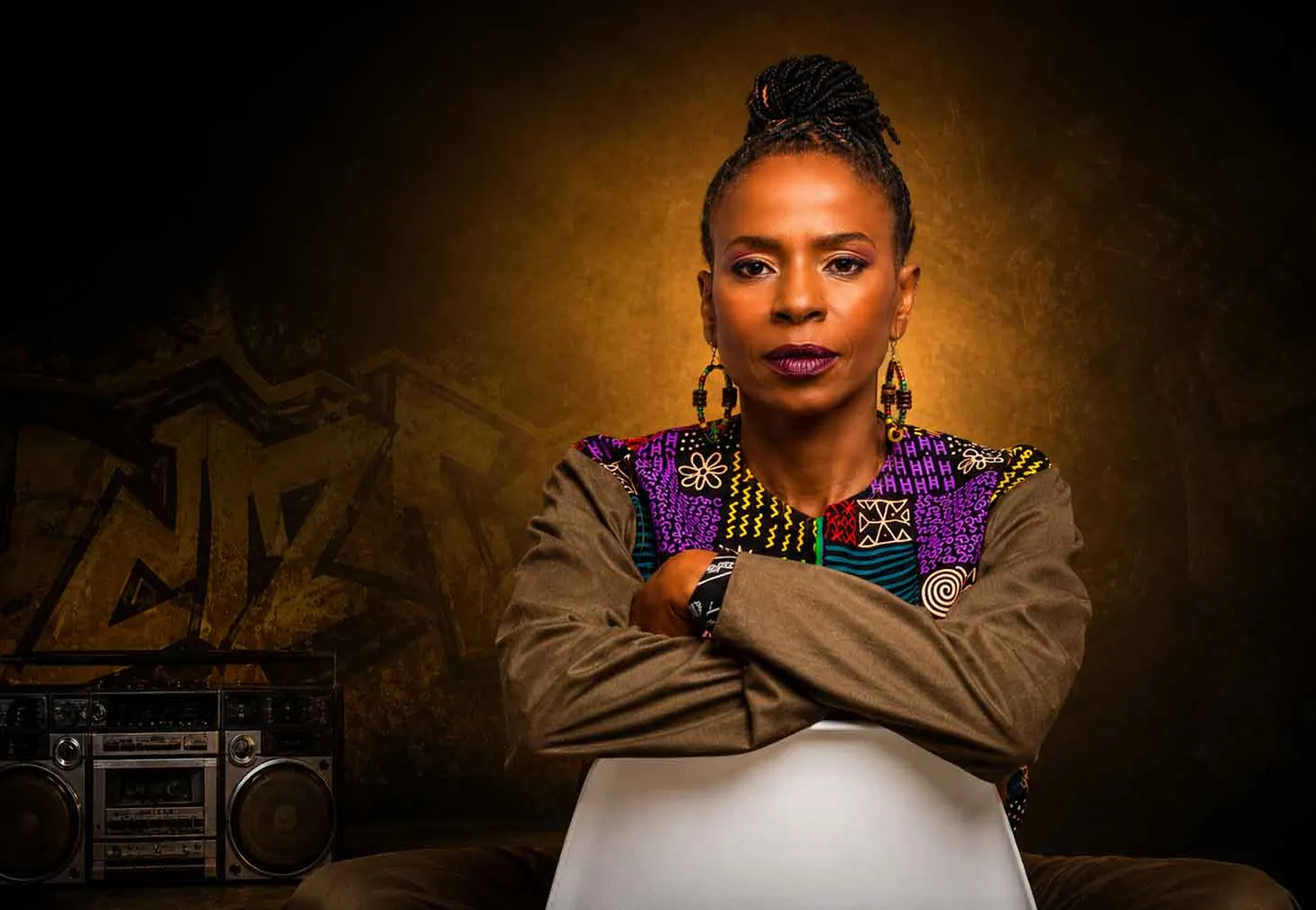
Long before social media, streaming and an industry that saw rap as a product, there were young people who took over streets, corners and dance floors, driven only by their passion for hip-hop culture. Among them was Gina Pepa, one of the first women to win a place in a scene dominated by men and marked by prejudice, resistance and improvisation. In this conversation with Xonguila, she revisits the early years of rap in Mozambique, talks about the pressures she faced, the influences that shaped her and the way she now sees music, not merely as entertainment, but also as a tool for influence and social transformation.
When you started, hip-hop in Mozambique was still taking shape. What memories do you keep of that beginning, before everything had a name and a structure?
I have many memories of the beginnings of rap in Mozambique. Rappers Unit were a group of young people, friends and neighbours, who did a great deal for rap in Maputo. We all had a great love for the art and, besides recording music, we organised various events such as hip-hop parties and shows at the Long Beach club, on the site of what is now the SNJ; we formed partnerships with national basketball and created a fusion of basketball and rap show. We also took part in international shows with artists such as Black Company and Boss AC. There was a lot of youth activity at weekends on the streets of Maputo, in rap-related events. Young people dressed in a distinctive way, in baggy trousers, big T-shirts and cassette radios, because we hadn’t even reached the CD era yet, would gather ‘on the corner of the neighbourhood’ and hold the famous freestyle circles. I remember that, at that time, we were already interacting with young people from practically all over the country through radio programmes such as Hip Hop Time on Rádio Cidade, and even television ones, such as Ritmo Vivo on TVM. They were young people very committed to rap, and that was lovely to see.
You moved from dance to rap at a time when there were almost no female role models. What made you take that step?
My transition from dance to rap happened because the dance group broke up. I had the bug for art inside me and I needed to do something; I couldn’t let the art die inside me. Then a neighbour of mine, Nitó MC, who used to hear me singing from the first-floor balcony of my house, invited me to go to the Long Beach club to enjoy a rap dance afternoon. That is where my musical career began, on a Sunday afternoon in 1994. The biggest challenge of the time was discrimination, because there were practically no female role models in the market.
Being a woman in a space dominated by men brings its own challenges. What was the subtlest prejudice you felt along the way?
The subtlest prejudice I went through, as the only woman in a male environment, was the vulgar names they called me. Society criticised me a lot, thinking I wasn’t fulfilling a girl’s duties at home, because I was always ‘out on the streets’ surrounded by boys. There were people who thought I was involved with those boys or that I used alcohol and drugs to find the courage to get on stage and enchant a crowd with ‘the bars I spat’. I confess that the pressure became so great that, several times, I thought of giving up. Fortunately I had a lot of moral support from my friends, and that is what stopped me from abandoning rap.
The hip-hop of the 1990s had a very particular energy. Today, looking at the current scene, what do you feel has changed most deeply?
Hip-hop is a culture. And that culture includes the DJ, the MC, the B-Boy and graffiti. In that universe there was also a whole way of dressing, the dress code of the rappers of the 1990s, the baggy jeans and that characteristic style. I feel that this visual culture has been lost over time. There are still some underground acts, such as Drácula, who remain faithful to that essence, but they are few.
The name ‘Pepa’ comes from an international reference. How do you now see the balance between outside influences and Mozambican identity in rap?
Today you can still see some outside influence, especially among the newcomers who make trap. But, generally speaking, the Old School are very creative and are building an identity of their own for Portuguese-Mozambican rap, which is lovely to see. For a while there were rumours that Mozambican rap was dying. Many groups broke up, many things lost strength. But now we are seeing groups emerging again, young people full of feeling and with an impressive vocabulary. We are at a stage where Mozambican rap already has an identity of its own and energies that are a pleasure to hear and feel.
Was there a moment when you thought of stepping away from music? What made you carry on?
There were times when I not only thought about it but literally stepped away from music. Largely because of my professional commitments and my responsibilities as a mother and homemaker. What brought me back was definitely the love I have for this art.
Throughout your career, which women have played a significant role in the way you think and create, inside or outside music?
My late mother, Alzira Fernando, played a fundamental role in shaping the human being I became, in my principles, my conduct, my modesty and my work ethic. Musically, my strong influences were Rah Digga and Lauryn Hill. I am not very political, but as a teenager I had the privilege of spending a little time with Graça Machel, when she was Minister of Education, and I admired her greatly.
Recognition within the culture came with time. Do you remember the moment when you felt you no longer needed to earn respect?
I think that, even after we have earned respect, we always have to find ways to keep it, because earning it alone is not enough. I kept that respect through hard work, in every performance and every song I recorded. I can’t pinpoint the exact moment, but it was when I began to pursue my solo career, after Rappers Unit and Track Records. Before, it was we ourselves who organised the shows just to have fun. Later, promoters began to organise events and I started to receive invitations to perform for paid fees.
At 50, what has changed most in you as an artist, not in technique, but in the way you look at music and at the world?
At 50, I no longer look at music merely as a good sound or a good melody to dance and sing to. Today I see music as a powerful educational instrument and even as a means of conflict resolution through the messages we can convey. With the freedom of expression we have, we can positively influence young people, not only within our society, but worldwide. ‘Listen to the lies of the truth… listen, people in power, and tell me… How many thousands of young people are still following these lines by Mano Aza to this day?’ That is how I see rap today. As a tool capable of helping resolve the conflicts of our society. With the legacy we have left over more than 30 years of career, I sincerely believe it is possible to save a generation of young people through music.
If you could speak directly to a young woman starting out in the world of rap today, without romanticising the path, what would you say to her?
The first thing I would say is: ‘Don’t expect to find any gentlemen in this rap game.’ You will have to fight with all your strength to stand firm in the game, toe to toe with men who will compete with you as equals. We need to forget, for a moment, that we are women and go after things for ourselves.


