
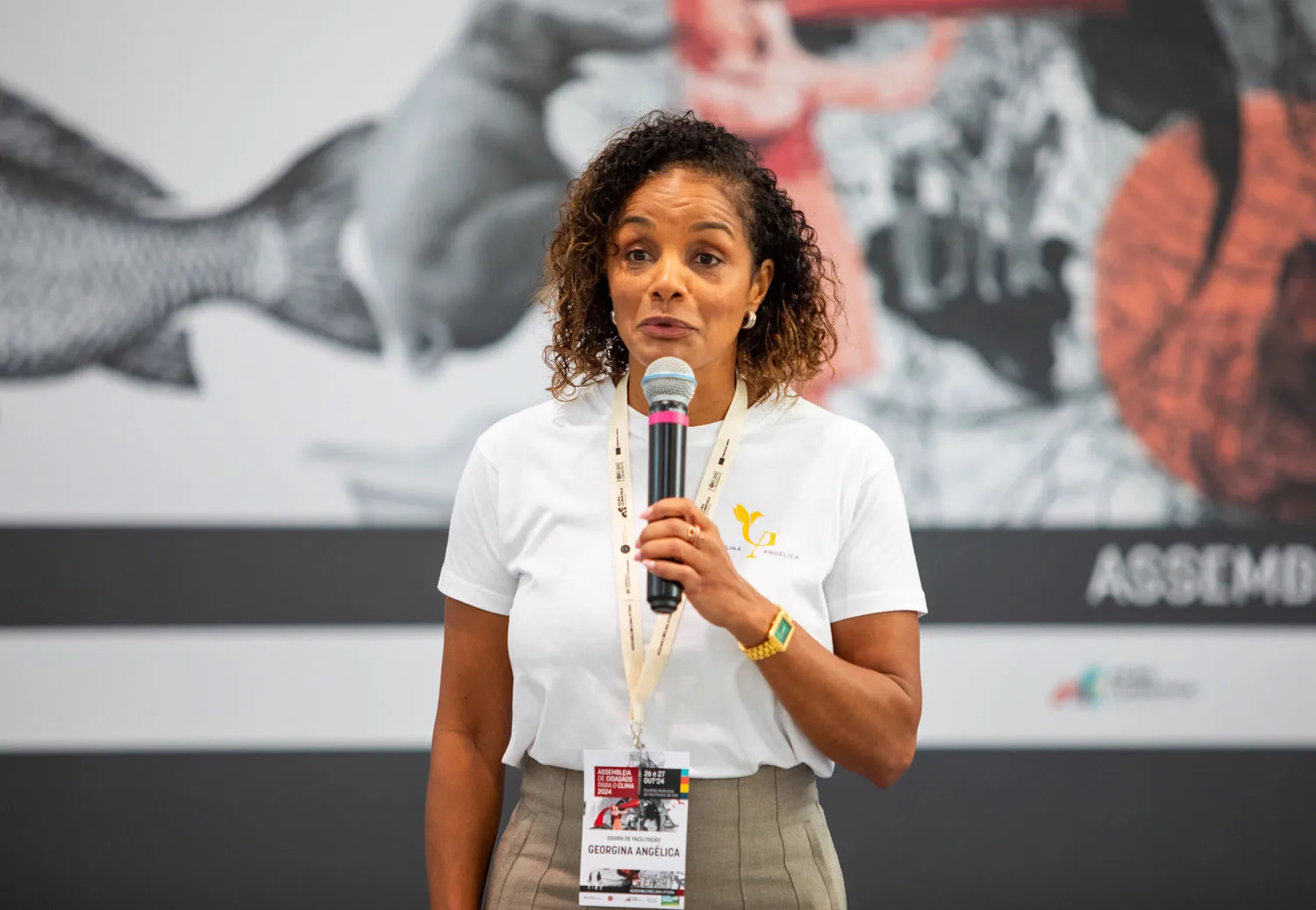
Educator, consultant and trainer Georgina Angélica created the Educating with Love and Awareness method, built on four pillars — awareness, communication, organisation and leadership — and applied in schools, families and teams in Portugal, Cape Verde, Angola and other territories. With experience in England and Angola, she continues to build bridges with Africa, a source of challenges and inspiration, from Portugal, where she lives. Since 2023, she has been giving voice to new narratives through O Tal Podcast, co-created with Paula Cardoso and Yuri Lopes Pereira and distributed by Expresso. Every week, the programme hosts authentic conversations about identity, culture, African descent, art and affection. Between education and the microphones, her conviction remains: caring for those who educate is caring for the future.
When you think about your origins, which moments sparked the desire to dedicate your life to education?
When I think about my Cape Verdean origins, I remember growing up surrounded by deeply caring women — mothers, grandmothers, aunts — who gave everything of themselves to others, but who rarely made themselves a priority in their own lives. It was from this observation that my first unease was born: those who care also need to be cared for. In time, I realised that I myself was repeating that pattern. And it was that recognition — that mirror — that sparked in me the desire to look at education not only as a practice focused on the child, but as a space of transformation for those who educate. I worked in nurseries in England and, later, at the International School of Luanda. In both settings, I came across professionals who were exhausted, often emotionally drained. That was when I realised, with clarity, that caring for those who educate is caring for childhood.
In more than 20 years of career, what was the most visible transformation you have witnessed in children?
Over the years, I have seen children who initially expressed aggression, fear or withdrawal blossom when they were offered a space of listening, respect and presence. I remember a child who, for weeks, avoided any eye contact and refused to take part in group activities. Rather than forcing integration, I created routines of quiet presence, respecting their pace. In time, they began to approach spontaneously — first with their gaze, then with small gestures, until they felt comfortable enough to play, communicate and belong. These changes do not happen overnight. They are processes that demand consistency, empathy and genuine attention. What I have learned — and continue to learn — is that when we look after the emotional and relational environment, children show us who they are and what they need in order to grow.
For Georgina Angélica, “I feel it has improved” is only the beginning. The results of her method are measured in healthier relationships between adults and children, active participation, fewer conflicts and the well-being of teams. She also sees more involved families, professionals with greater emotional balance, and more independent and confident children. Because caring for those who educate always translates into more balanced environments.
How do you ensure that the method adapts to different cultural contexts, from Lisbon to Luanda or Praia?
Adaptability is part of the very DNA of the Love and Awareness method. The four pillars — awareness, communication, organisation and leadership — are universal, but the way they manifest always depends on listening deeply to each reality. Before proposing any intervention, I observe and listen carefully: how do people communicate in this community? What practices already exist and work well? What specific challenges do these families, these children and this team face? Only then is the method implemented, in a way that is sensitive to the context and always in dialogue with those on the ground. For example, what works in an urban school in Lisbon may make no sense in a community nursery in Praia. But what all of them have in common is the desire to care better — for children, for families and for those who educate. It is from this shared desire that we build bridges and adapt strategies, always with respect for cultures, local knowledge and the identity of each community.
When you train teams, what resistance do you encounter most often, and what argument opens doors?
The most frequent resistance is the belief that there is no time to care for those who educate. Many professionals are so absorbed by the demands of day-to-day life that they consider self-care an impossible priority — or even a luxury. There are also those who look with suspicion on more human or emotional approaches, as if they were incompatible with effectiveness. What I tend to bring, first of all, is empathy: I acknowledge the exhaustion, the accumulated tiredness and the lack of recognition that so many educators face. And, from there, I present data and experiences that show the opposite: when we care for those who educate, everything improves — the environment, the children’s behaviour, the relationship with families, the team’s motivation. The argument that opens the most doors is simple but powerful: it is not about doing more, but about doing with more awareness. And that does not require more time — it only requires a new way of seeing.
What projects would you like to see born in Mozambique that could directly benefit children and educators?
Although I have not yet had the opportunity to work directly with educators and institutions in Mozambique, I follow closely what is being done in the field of early childhood education, and I recognise the country’s enormous human and cultural potential. I would very much like to see initiatives emerge, in Mozambique and in other African contexts, that value the well-being of those who educate, offering not only continuing training but also spaces for listening, care and recognition of pedagogical work as a transformative practice. Naturally, my wish is to take the Educating with Love and Awareness method to more African territories, including Mozambique, always with an approach that starts from listening and respect for local realities. I believe that, through dialogue with Mozambican professionals and local partners, it would be possible to adapt the method to the country’s specific needs and to co-create projects that are truly relevant and sustainable. Educating with Love and Awareness is a proposal that does not arrive with answers, but with questions, availability and presence — and I believe Mozambique could be fertile ground for that encounter.
Looking at the continent, Georgina Angélica sees inspiring practices that place the child at the centre as a communal and cultural being. In South Africa, curricula incorporate oral stories, songs and local languages; in Ghana, the storytelling tradition nurtures literacy and the bond between generations; in Kenya and Tanzania, Maasai knowledge enters the classroom. For her, African excellence is born from this reconnection with ancestral roots — a path along which she also hopes to see her Educating with Love and Awareness method grow.
How can families in neighbourhoods with few resources be involved without blaming those who are already exhausted?
The first condition for involving families in contexts of greater vulnerability is to acknowledge their reality with respect and without judgement. Many parents and carers live under enormous pressure: long working days, financial difficulties, lack of institutional support and, at times, accumulated trauma. Blaming these families is not only unfair, but ineffective. Whenever I work with communities in contexts of greater scarcity, I start from listening: what are these families already doing? What informal support networks exist? What knowledge and experience can be valued? Often, there is a deep care — even if silent — that only needs to be legitimised and recognised. The most effective strategies are always those that begin from closeness and simplicity. Short meetings, at accessible times. Clear, warm, non-academic language. Activities that also welcome the children, so that taking part does not demand more logistical effort. And above all, an approach that reinforces this idea: we are not here to teach families anything, but to build together.
O Tal Podcast was born from the shared unease of Georgina Angélica and Paula Cardoso: the absence of deep and representative conversations about African-descendant identity and culture in the Portuguese media. With the arrival of Yuri Lopes Pereira, the project took shape and became a space of affectionate listening and new narratives. For Georgina, it is also an extension of her educational mission: educating through the spoken word, giving visibility to silenced voices and caring through listening.
Do you already feel that O Tal Podcast is filling a gap in the Portuguese media regarding African-descendant culture?
Yes, I feel with conviction that O Tal Podcast has come to occupy a space that, for far too long, was empty. By opening up space for people of African descent to speak for themselves, without a script, with freedom and depth, we are not only giving visibility, but legitimising ways of being, thinking and feeling that were historically marginalised. And this has a powerful educational impact — because it broadens references, combats silencing and contributes to building a more plural society. The podcast does not claim to be the only answer, but it is certainly a fundamental piece in a broader movement. And for me, as an educator, it is a privilege to take part in this collective construction, where the word is used to care, inspire and transform.
If she had only ten minutes with an African minister of education, Georgina Angélica would not hesitate: she would ask that those who educate be better cared for, that curricula give voice to local culture, and that families find in their communities the support they need. Because, she believes, investing in early childhood is investing in the future.
Where will we see you working in Africa over the next two years?
Over the next two years, I hope to see the Educating with Love and Awareness method reach more African contexts, through partnerships with schools, nurseries, social organisations and companies that share a vision of a more humane, rooted and conscious education. Mozambique is at the heart of that wish. I have been making contacts, listening to the context and preparing the ground with responsibility and respect. I believe there is enormous potential to build bridges between what already exists in the country and the tools I have developed over the years. Although each step is taken with caution and in dialogue with local partners, I can say with confidence that I see myself collaborating actively in Mozambique, Cape Verde and Angola — countries with which I maintain deep emotional and professional ties. More than “bringing” a project, my purpose is to build with. To listen, adapt, and contribute practices that value those who educate and strengthen communities from early childhood.


