
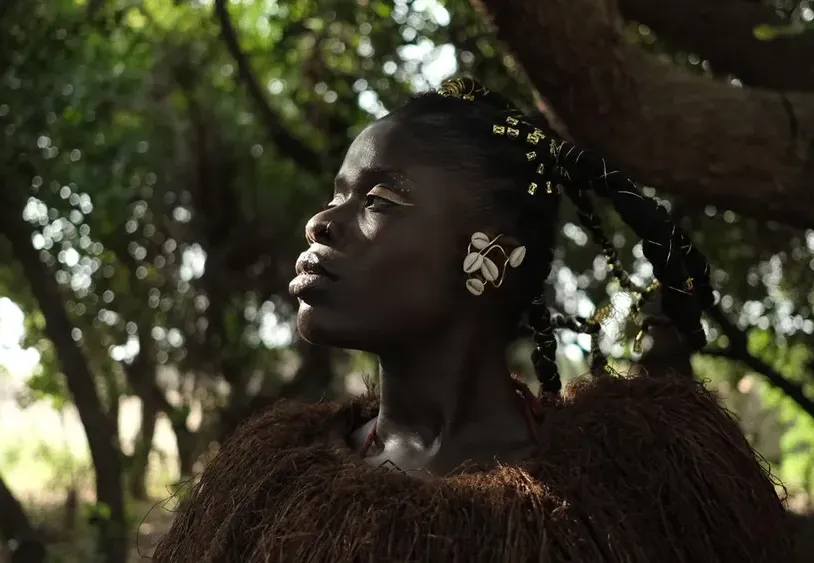
There are presences that cross us before the very first word — they invoke, open the way, tear through the silence. Fattú Djakité is one of those rarities. A daughter of Guinea-Bissau, raised in Cape Verde, she carries the marks of the crossing in her body and the weight of memory in her song. Her music is not merely sound: it is resistance turned into language, a gesture of care, shield and seed. Fattú sings what many do not dare to name. She speaks of forced marriage, of genital mutilation, of a stolen childhood. She survived silence — that of others and her own — and today turns wounds into cries of alarm. At this defining moment in her life, when motherhood, struggle and creation intertwine without asking permission, we sat down with her to listen to the woman behind the voice.
Your presence makes itself felt before the very first note, and it carries memories, rage, hopes and old wounds. When did you realise that your way of being in the world was, in itself, a language of resistance?
I think always, even without knowing it was an act of resistance. I resisted from the very first day I left Guinea-Bissau, a child of five. I went to Cape Verde and I resisted adapting, I resisted every time I suffered racism — because of my colour, because of my country’s political situation, because of the place I came from. At school, they said I was the one who defended the weak. I have always seen myself that way, not only because of the place I came from, but also because of who raised me. My grandmother gave me that spirit. I grew up in a house that was not mine, where I had to clean and work from an early age to be accepted. I had to give my best at school to be noticed — or try to be invisible. I think I have always been resilient.
What did only Guinea-Bissau give you — that you take to every stage in the world?
Wow, what a question… What did Guinea-Bissau give me? It gave me my Guinean-ness, which never left me. Never, never at all. I left Guinea-Bissau at the age of five, but I can say this: Guinean Creole… is something resilient. I say it with great pride, because I have been living in Cape Verde for thirty years and I can still speak Guinean Creole very well, sing in Guinean Creole. I think that Creole, Guinean culture, Guinean food, the Guinean way of being — all of that never leaves us. And I express it all the time: when I am more annoyed or happier, I let out some Guinean Creole. I think that is it.
You grew up between islands and roots. When did you feel you were more than a “visitor” to your own identity?
I think it took time until I realised that I was not just a visitor to my identity. It was when I accepted my two identities, because I always grew up hearing: do you like Guinea or Cape Verde more? Do you feel more Guinean or Cape Verdean? Today I can answer. But I had to do a lot of work on self-esteem and self-love to be able to say: I am not just a visitor here. This is also part of me. It is impossible to talk about me without talking about these two countries. I feel Cape Verdean through lived experience — I got to know every island through music. A Badia woman raised me, my grandmother. She is not related by blood, but she went to live in Guinea-Bissau and stayed there for 25 years. She adopted my mother, and we became her children. Then her husband died, she returned to Cape Verde and sent for us. I went through several phases: not knowing who I was, feeling ashamed… and accepting who I am. Today, when I say I am Guinean and Cape Verdean, I feel it truly. I have carried a Cape Verdean in my womb, my husband is Cape Verdean, I grew up in Cape Verde with my grandmother. I feel an enormous, eternal love for this country where I live — but without losing the essence of my country, which is Guinea. That root is in my soul and cannot be erased.
Between Bissau and Mindelo, what never fitted in the suitcase?
Oh, well, perhaps the better question would be between Bissau and Praia, because I lived most of my life in the city of Praia and I have been in Mindelo for less than five years. I think what never fitted in the suitcase was my whole family. If I could, I would take them all with me, especially those in Guinea-Bissau. It is what I miss most, what I long for most. There is also the absence of childhood, of not really living where you were born. That was very strong and hard for me to digest. So that is it: I wished I could fit my whole family into a suitcase and take them with me wherever I went.
If your grandparents could hear your latest single, what do you think they would say?
Wow. I think they would be proud of me, proud to have someone in the family who touches that wound, who not only shakes up my family a little, but also many families in Guinea-Bissau who are going through, or have gone through, this situation of forced child marriage. It is something that happened in my family. I found out about it after I had sung the song, when I went to record it in Guinea-Bissau. My father then told me the story of an aunt who was forced to marry, taken to another country, and ended up dying in that country. They never knew exactly what happened to her. So I think they could feel proud to have someone who touches this wound.
Your music is a manifesto in the form of melody. Have you ever been afraid of silence — your own, or that of others?
Yes, I have. I was very afraid of my own silence, because I often felt drowned, suffocated by it. I suffered a great deal in silence. And there is also the silence of others. For me, silence is a form of violence. I grew up in an environment where silence was used to settle things. When you did something wrong, there was no conversation — there was silence. And that is disturbing. Dealing with that brought me serious problems. But today I feel I can scream. I have spent too long in silence.
You recorded an album while you were a new mother. How do you write songs with a child in your arms and the world on your back?
In fact, when I recorded the album, in 2017, I was six months pregnant with my first child. I remember feeling that I was not alone. There were two bodies, two hearts in one person recording that. I felt a strength. Even with the baby in the womb, in my arms or on my back, I felt that I was a mother to the world. I did not know what that child would be, nor the sex — and a boy came. But the feeling was very strong. Perhaps even to this day I cannot explain well what it is to record an album with a baby in your arms. With this second single, I did not have a baby in my arms, but two children. And I was thinking of their future. Because, when you have a child, you want to pass on a better message to the world. The responsibility is different. You no longer throw just any word just anywhere.
Which lyric was the hardest to finish? And which one have you not yet had the courage to write?
It is a lyric about genital mutilation, which is already prohibited in Guinea-Bissau, but still needs a great deal of awareness-raising. It continues to happen in various tabancas, far from people’s eyes. I have started writing it several times, but I have not yet managed to finish it. And the one I have not yet had the courage to write is about what happened to me when I was a child — I suffered sexual abuse. Today I can already talk about it. I even have a broadcast channel on Instagram, Previne Abuso Sexual, where I share this subject. I have done podcasts. But writing about it, not yet. Perhaps I need to think more, because I do not want it to be merely shocking — I want it to educate, to serve as prevention.
Your creation is body, voice, memory, struggle. When a song begins to be born, what moves you first — anger, tenderness, silence, impulse?
I think it depends a lot on the context. But I have written a lot on impulse. Complete lyrics have also been born in silence — when I feel something strong and need to put it into music. When I am alone, in my world of reset, of hibernation, the best songs, the best poems come out. Anger… sometimes I avoid writing in that state. Many lyrics that I wrote in anger, I never sang. I did not have the courage to give them a voice. But they are part of it. And I am glad I managed to put them on paper.
Your aesthetic is political. Do you think that hair, clothes, the body are still battlefields?
Absolutely. I say this as a Black woman. My skin is already a championship — as Nene said, “my skin colour is a championship”. To be here today, free to speak, to show my hairstyles, my clothing, my dancing — took a great deal of resistance. I once hated myself so much, so much… my hair, my body, my colour, my features. But today I accept everything about myself with a force so striking that I cannot even explain it. I do it as an act of resistance and so that girls, especially children, feel represented. Because often I did not see women like me in power. When I am on stage, I want to show a queen. And when a girl says to me: “Fattú, I like you very much. I am the Fattú Djakité who has fire for me” — that is already war. And we are winning. Little by little, we are winning the battle.
What hurt you more — recognising that ‘Badja Tina’ needed to exist, or finding the strength to turn it into a firm cry, in a place where so many still choose silence?
I think it was finding the strength to turn it into a firm cry, because this has been happening for a long time. From an early age, I saw cases of forced child marriage. I remember my grandmother saying: “It is a good thing you live in Cape Verde, because in Guinea-Bissau, from your first period, they give you a year or two and then marry you off.” It was terrifying to think that, on returning, I could be married to any old man. It was always my fear — not only for myself, but for other girls. I have sisters and nieces who still live there, where you hear things like: “Look, go and see your husband.” This opens the door to violence — not only forced marriage, but also sexual violence. It is very sad. Writing about Badja Tina was difficult. It was hard to think about. But the music came out fluidly. I had help from colleagues, I wrote, I recorded the video, and I managed to show this reality. Today I feel happy to be able to talk about it. People are listening. And many people come close — not only because of the song, but because of the cause. So, wow! Today I feel happy to be able to talk about it. People around the world are listening, they are opening doors and many, many, many people come close not only because of the song, but also because of the cause.
The Mozambican public has walked alongside you, song after song, with attentive listening and an open heart. What would you like to say to them — not as an artist, but as a woman who feels seen and welcomed from that side of the stage?
Thank you very much to the Mozambican public. Mozambique is one of my dreams. I have several friends in Mozambique and I would very much, very much, very much like to visit. What I have to say is: be faithful to what you feel, faithful to your ideals, to what you believe in. Be faithful to your conscience and run after your dream, after what you believe in, without fear.


