
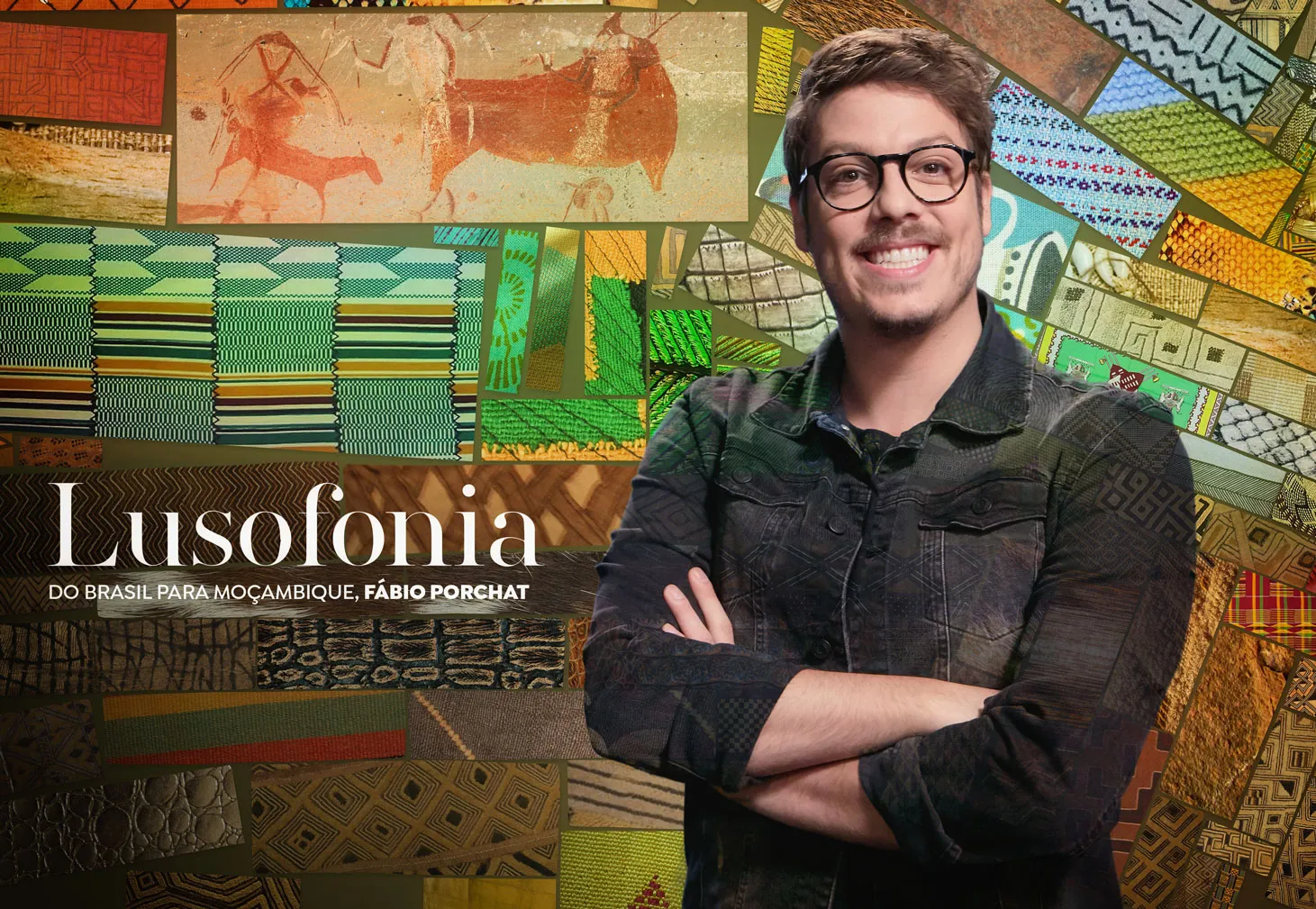
In an exclusive interview with Xonguila, the famous Brazilian comedian Fábio Porchat talks about himself, revealing that he already has a show in Mozambique in his sights.
Tell us about your youth. What led you to choose this path? Do you believe you are born a comedian?
Look, curiously, I never wanted to be an actor, I never had that dream as a kid, although since I was a child I always really liked theatre, not just going to the theatre but doing theatre, theatre courses, performing in front of people. I had a puppet theatre that my grandfather gave me, I created stories, I got all my cousins to perform. So, looking at it today, obviously I wanted to be one, right? It was there in me, I was already that kind of person, I was a real show-off, I loved being seen, loved being the centre of attention.
I don't think you're born a comedian, but I understand that your surroundings gradually turn your outlook towards humour. And I noticed, when I was a child, that the more I made jokes, told a story that was funny, the more the adults paid attention to me, the more so in teenage circles. Whenever my story, or my tale, had some kind of comedy in it, people would listen to me for longer, watch me, and want to know more. So I believe I used humour to my advantage because of that. As I was a show-off and really wanted people to pay attention to me, I realised that with humour I could do that. And I always really liked watching comedy things, comedy series, comedy films, I read comedy things. I loved the joke books by Casseta & Planeta, by Ary Toledo, I always read all of that a lot, from when I was tiny through to adolescence. I read the books by Obrigado Esparro, which is a group here in Brazil. So I always consumed humour, so humour was in my life, and I think it ended up that I only realised at 19, but better late than never, right?
“I would never have imagined that Mozambique would know who I am, and I'm very happy to be able to speak to you now, to speak to the Mozambican public and to already put Mozambique in my sights for a show.”
Fábio, you are a success in Brazil, Mozambique, Portugal and the other Portuguese-speaking countries. How do you view this link that the Portuguese language makes possible all over the world?
The first time I went to do a show in Portugal, in 2013, I went terrified; I didn't know whether they would like it, whether they would know who I was, whether they would understand my kind of humour, and then I got a shock when I found out that Porta dos Fundos was widely watched there and they loved it. And more and more I keep getting shocks and learning that, in Angola, in Mozambique, in Cape Verde, there are people who like it, who watch, who listen, more and more. Especially because of the TV programmes that air in all these countries, I'm realising how strong it is. So I would never have imagined that Mozambique would know who I am, and I'm very happy to be able to speak to you now, to speak to the Mozambican public and to already put Mozambique in my sights for a show. Because, at the end of the day, it's a lot of people, we are many Portuguese speakers, and just as Globo's soap operas – and Globo's content has always arrived, and even Record's, now with Record in Africa – also arrived very strongly for that audience abroad...
Brazil does not consume the culture of Mozambique, Angola and Portugal, but those countries consume Brazilian culture. I think we actually need to listen more, read more and watch more. Of course, fine, we read Mia Couto, and other authors, but not the humour, for example. It doesn't reach us, does it?
What has your experience in Africa been like? Can we count on a visit to Mozambique soon?
I've been to Africa a few times, not only to the north, to Muslim Africa, Arab Africa, but I also went to Kenya, Tanzania, Rwanda, I went a lot on safaris, I went to South Africa, and I've always wanted to go to Mozambique, especially because people say the beaches are the most beautiful things there are. Now, knowing that the people of Mozambique watch, see, consume and understand my kind of humour, I'm super excited to do a show in Mozambique, and I'm already drawing up plans to perform in Mozambique and take the opportunity to have a holiday, right? Why not?
Is intelligence essential to making quality comedy?
I think that to make quality humour, more than intelligence – and of course intelligence is good for everything, not just humour – it's good to be connected to what is happening around you. I think that's the most important thing: to keep a very attentive eye on everything that is influencing, informing and cutting across your daily life, your society, and you, knowing what the issues, problems and difficulties of your audience are, you can hit them with much more force, so the most essential thing is to be connected.
Is it possible to make humour about every subject, even the most sensitive ones? Considering the power humour has, what responsibilities does it carry for society?
Humour has a lot of power, so much so that, if you swear at someone, maybe that person will walk away, but if you ridicule them, they want to hit you, because humour goes to places and arrives more powerfully in harder places, and so I think yes, you have to make humour about every subject, including the most sensitive ones. Of course I'm saying this, but nothing that is criminal, nothing that is forbidden by the Constitution. Apart from every sensitive, difficult and complicated subject, jokes have to be made, because nothing can be made sacred, because if something becomes sacred, it becomes law, becomes a rule and becomes a monster, and that monster will swallow us all. I think one of the functions of humour is, first, to make people laugh, obviously, but after that, to unsettle all the truths, the taboos and what we believe to be untouchable, and I think it's humour that has to touch on all these subjects.
Have you ever thought of creating a party? Entering political life?
God forbid I enter politics, God forbid I create a party. I think I'm political just by being who I am, speaking out, giving my opinions, both on the internet and in my comedy or in my content. I think doing politics is also about taking a stand, even more so nowadays in today's Brazil. With the thing we have in the Presidency, we need to fight against people who have not the slightest respect or empathy for others, not the slightest attempt to make everyone feel good. On the contrary, it's a person who takes revenge on others, who has hatred, rage, and a person like that cannot govern any country, least of all a country of 220 million people so different from one another, right?
We know that theatre and cinema are important parts of your career. Which of these activities do you most enjoy doing? And how do you spend your free time?
Look, the truth is that I really like what I do, and I do a lot of what I like, so cinema, theatre, television and the internet… I keep having ideas; I'm a person whose head never stops working. So I start having lots of ideas, not necessarily good ideas, but I have lots of ideas and I like to put them into practice. What I like most is theatre, because theatre is live, the audience is right there, it's warm. It responds immediately, you have contact with people, and I like people, but, at the end of the day, each idea can fit into a different format, can mean something different. And, at the end of the day, I end up spending my free time travelling, which, at the end of the day, is more material for my stories, my plays and so on. And everything that is watching films, series, reading books, for me, in the end, is half work, because I work with that, I can't disconnect. When I'm watching a film, I'm analysing the script, I'm looking at the direction, I'm watching those actors act, I'm looking at how a series is constructed, how it works… So, what is fun for everyone is also fun for me, but it's also work.
Do you think laughter is still the best medicine?
We always need to laugh; laughing is what we have left; at the end of the day, laughing is something we can do alone, we can do in a group, it's free, it saves us from all the misfortune that life is, from all the sadnesses and injustices that 99% of the world's population face. So, at the end of the day, laughing is something that cleanses the soul, as we say in Brazil. It's something that comes from within, that makes you, in that second, forget everything around you, all the problems that are making our lives so hard. So laughing is certainly a great goal and a great strength that we all have inside us.
Would you like to leave a message for the Mozambican people?
The message I leave for the public is: “I'm coming, you know! Hello Mozambique! And I'll be there very soon, with my new stand-up show, and I hope you'll be as warm as I'm already imagining. And I hope you'll welcome me with open arms, as you welcome me on the internet, in the comments, in the messages. And I already want to see all of Mozambique; will you help me? Will you take me to see everything? To eat the good food, to go to the beach, to see every little corner of the place? I'll be there very soon, folks.
In this interview, the Brazilian Portuguese variant is retained in Fábio Porchat's answers.
Porta dos Fundos is a creative collective founded in 2012 by Antonio Tabet, Fábio Porchat, Gregorio Duvivier, João Vicente de Castro and Ian SBF. What began unpretentiously, with a group of friends in search of creative freedom, is today an established production company, winner of the International Emmy for Comedy in 2019, for the Christmas Special made for Netflix. It is one of the biggest YouTube channels in Brazil, surpassing 5 billion views and 16 million subscribers. In April 2019, it also arrived in Mexico with the channel "Backdoor - Humor por donde no lo esperas", already with more than 3 million subscribers. Porta dos Fundos has become a reference in multiplatform entertainment, working on series, films, branded content, among other productions, establishing partnerships with companies, TV channels and streaming platforms. (https://www.youtube.com/c/PortadosFundos/about)


