
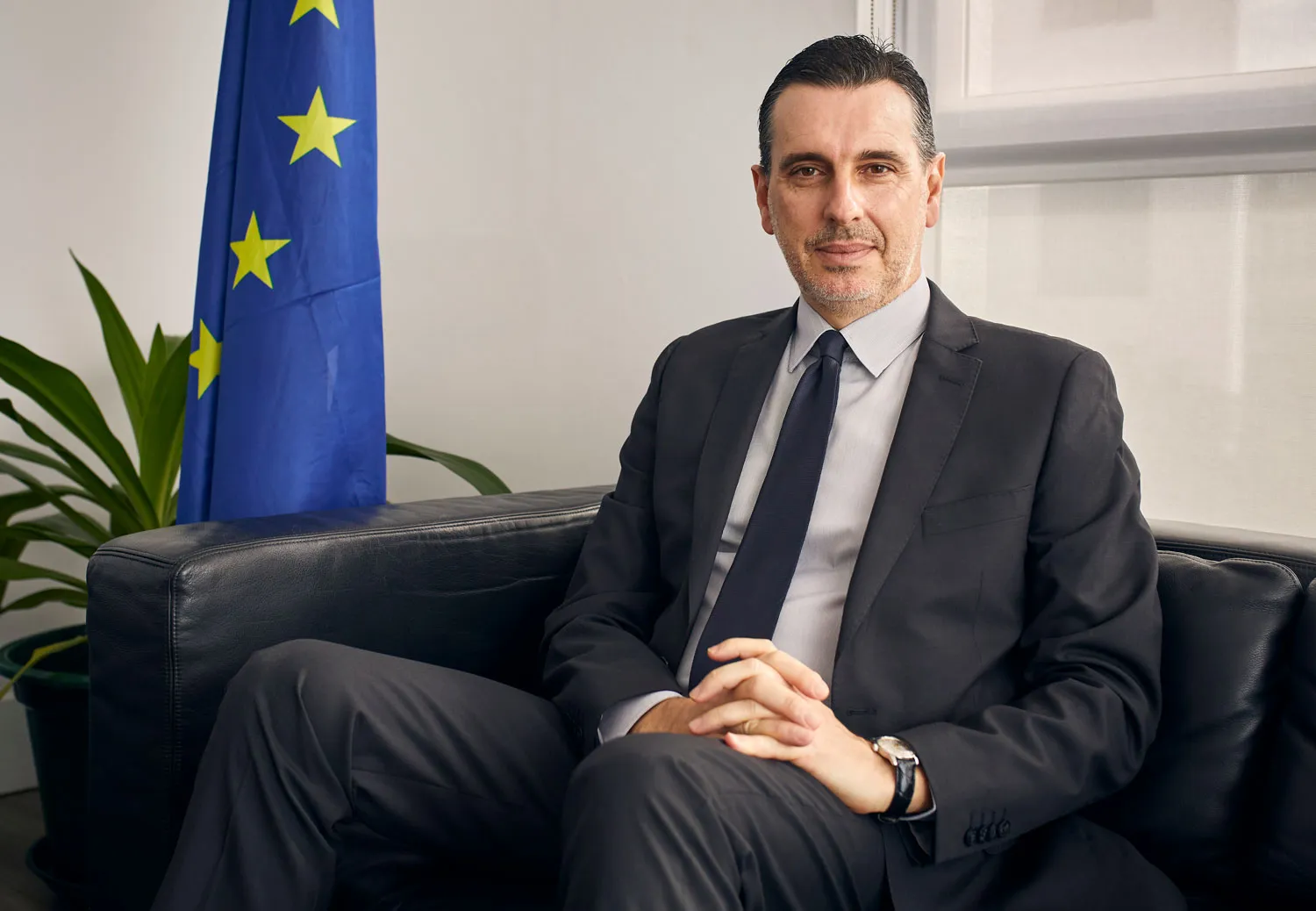
Interview with the European Union Ambassador to Mozambique, Antonio Sánchez-Benedito Gaspar, on the occasion of the celebration of Europe Day, 9 May, and the activities of Europe Week 2021
What is Europe Day?
“Europe Day” was born at the European Council in Milan, held in June 1985, and was celebrated for the first time on 9 May 1986. Europe Day is one of the symbols of the European Union (EU). The date goes back to 1950, when Robert Schuman, then French Minister for Foreign Affairs, presented a proposal setting out the founding principles of what is today the EU. Europe Day is thus marked every year to commemorate the presentation of this Declaration, which highlighted the values of peace, solidarity, economic and social development, and environmental and regional balance, and included the creation of a European institution to manage certain raw materials of central importance that had led to the conflicts of the two world wars: coal and steel. Seventy-one years on, peace continues to be a reality in the countries of the European Union. We are also committed to promoting peace beyond our borders. The EU upholds a vision of society supported by the majority of citizens, with respect for human rights, with solidarity, diversity and harmony between tradition and progress. These are also the values that guide our ties with partner countries such as Mozambique, and with international organisations such as the African Union, the United Nations or SADC.
And Europe Week, for the second year running in times of pandemic…
The range of scheduled activities aimed to bring people and institutions closer together, albeit with limitations owing to the Covid-19 pandemic. This year we had activities essentially in digital format, given the limits on gatherings: the round tables on higher education and on trade and the economy, and the interactions with civil society, were events that were both virtual and in person. The film festival, the performance of the anthems, the interaction between volunteers, as well as our central message from the Ambassadors of the European Union member states, and the greeting message from the Government of Mozambique for Europe Day, were virtual events, presented on social media, which attracted the attention of a significant audience.
What were your expectations for the 2021 edition? Did you manage to achieve the Week’s objectives?
From the outset we wanted to show the public what Europe is, the Union and its Member States, and our engagement in Mozambique and with partners in the country. Adaptation and innovation were key in all the initiatives held. Something different that we did for the first time was the Supplement published in the newspaper Notícias on 10 May, which brought together accounts of cooperation between Mozambique and the EU, and with Team Europe, in diverse areas such as education, climate change, the response to Covid-19, the fight against terrorism and the promotion of stability in Cabo Delgado. We had a Europe Menu throughout May at the Sal & Grafia Restaurant, at the Fernando Leite Couto Foundation, to show that gastronomy was also important in our celebration. We awarded prizes to three works in the Photography Competition that we launched precisely to celebrate Europe Day and to engage with the younger generation. The photographic exhibition “Homo Urbanus Europeanus”, which shows the distinctive ways in which European people interact with their city, is still running at Camões – Portuguese Cultural Centre until 11 June. The interaction with government authorities, civil society, the private sector and cultural players was also positive, and that is the essence of Europe Week!
“From the outset we wanted to show the public what Europe is, the Union and its Member States, and our engagement in Mozambique and with partners in the country”Antonio Sánchez-Benedito Gaspar - European Union Ambassador to Mozambique
How do you assess the previous editions?
As in all 140 European Union delegations around the world, celebrating Europe Day is a tradition, and in Mozambique we have followed this line, consistently organising annual editions of Europe Week in recent years. The pandemic did not change that; on the contrary, it led us to diversify the way we celebrate Europe – we went digital. In 2020 and this year we did not have the Film Festival and the Concert for Europe in person, but we mobilised with the Member States around the idea of Europe in Mozambique. Last year we had the anthems “Ode to Joy” and “Pátria Amada” sung by the Mozambican singer Stella Mendonça in an excellent performance, and we were able to achieve something similar this year too, with Xiquitsi performing the anthems. We hope to do it live and in person in 2022, provided the health situation allows.
The events sector was one of the hardest hit by the pandemic. How are you dealing with the adversity and what measures have you taken to tackle these difficulties?
The European Union has always been aware of the difficulties faced by the world of the arts. The pandemic made the situation even harder, because, as art by its nature brings people together, restrictions on gatherings meant little room for free cultural expression. In the meantime, our agenda of support for the creative industries sector has not stopped. An important example of this was our support, in 2020, for the Gala-Gala Festival, which brought together various artistic and cultural forms of expression, such as music, visual arts, theatre, dance, literature, audiovisual and multimedia, with the involvement of almost 10 cultural centres in the capital, Maputo. We continue to support artists so that they can expand their work through artistic residencies and mobility; through support for projects such as Cantate, by Kulungwana; and through grants – the most recent of which were signed on 10 May with cultural players – from DIVERSIDADE, a financial instrument supporting cultural diversity, citizenship and identity, under our PROCULTURA programme.
Could you tell us a little about the relationship and cooperation between the EU and Mozambique: past, present and future.
The partnership between the European Union and Mozambique is deep and long-standing: we are talking about almost four decades of intense cooperation. At the same time, 11 of the EU’s 27 Member States have diplomatic missions here. Our partnership is based on an agenda of fighting poverty through the promotion of sustainable development, peace and stability, democratic consolidation and human rights, as well as addressing regional objectives of economic and trade integration and tackling crucial global challenges, such as climate change and terrorism.
The EU and its Member States are Mozambique’s largest development partner. Between 2014 and 2020 alone, through various cooperation instruments, the EU supported Mozambique with more than a billion euros, for the benefit of the country’s people and institutions. The EU and the Member States also provided significant humanitarian aid to Mozambique following the devastating cyclones in 2019, and in response to the multifaceted challenges in the north of the country. For Cabo Delgado, the EU’s response has combined humanitarian aid, development, and peace and security. The +Emprego project, which the EU funds and Camões IP is implementing in Cabo Delgado, focused on training and creating jobs for young people, is an example of this.
The EU is a firm supporter of the peace process in Mozambique…
With numerous projects and initiatives that link economic and social development to peace. Since the outbreak of the Covid-19 pandemic and the first cases in Mozambique, we have demonstrated European solidarity, helping Mozambique to deal with the social and economic impact of the pandemic, from the immediate response to prevent the collapse of the health system to efforts to mobilise more than 2 million doses of the Covid-19 vaccine, the first batch of which, 384,000 doses, has arrived and is being administered in the country.
Another important sector of our cooperation is post-cyclone reconstruction and the strengthening of resilience so that there is a more effective response to future natural disasters. On the trade front, the Economic Partnership Agreement between the EU and the SADC countries has consolidated the EU’s position as a major trading partner of Mozambique, and not only that – the EU is the largest export destination for Mozambican goods without tariffs or quotas and is the second-largest partner in terms of imports. We are also strengthening our cooperation by supporting the Ministry of Industry and Trade in guiding the implementation of the African Continental Free Trade Area, which, as we discussed at the Economic Round Table on 12 May, will be a factor of change and opportunity for Mozambique.
Looking at the new cycle of cooperation between the EU and Mozambique – under the post-Cotonou framework – we are still at a stage of clarifying priorities, but youth, the green transition, and peace and good governance will receive special emphasis in this programme, which runs from 2021 to 2027. It is the start of a new phase of cooperation, with common approaches to global problems, at continental level and also in Mozambique.
The sculpture “Harmony of Difference” is installed at the Ambassador’s official residence. Can you tell us a little about this work?
Yes, “Harmony of Difference” is the name of the sculpture by the Mozambican artist Gonçalo Mabunda installed at the official residence of the European Union in Maputo. It symbolises the European Union’s commitment and partnership for peace in Mozambique. We unveiled this work as part of the activities celebrating Europe Day in Mozambique. The idea for the sculpture came to me precisely to celebrate and solidify our cooperation for peace and stability and our engagement and dialogue with civil society. This work therefore represents a spirit of hope, a call for peace and harmony even amid differences. The artist Mabunda himself said, “every bullet destroyed and transformed means a life saved”, and that is how we move towards the consolidation of peace.
The sculpture “Harmony of Difference” is a metal structure, weighing around 200 kilograms, made up essentially of pieces of weaponry that have been transformed and reused, in keeping with the artistic approach of turning weaponry into art. At the front and centre it symbolises the 11 Mozambican provinces and, on the opposite side, the 11 European Union Member States with diplomatic representation in Mozambique. “Love” is also represented in the sculpture, through the figure of a heart set at the top.


