
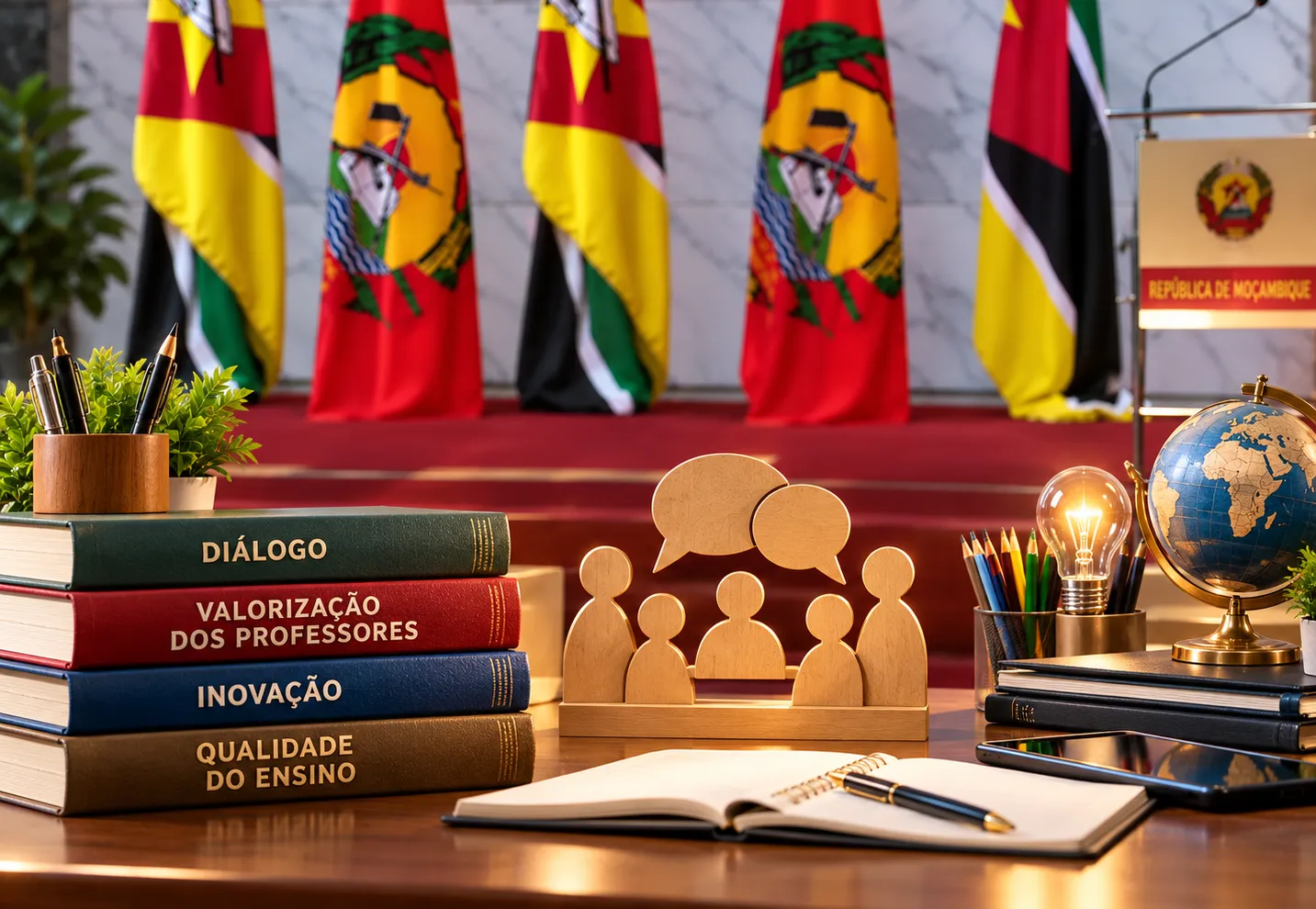
Improving the quality of education in Mozambique requires more than investment in infrastructure and material resources. It calls for a transformation in the way the education system engages with teachers, students and families, alongside a sustained commitment to science, technological innovation and education from the earliest years of life.
This is the vision advocated by the new Minister of Education and Culture, Edson Macuácua, and the Secretary of State for Science and Higher Education, Isaú Menezes, who have outlined complementary approaches to addressing the structural challenges facing education in the country.
For Edson Macuácua, transforming the sector must begin with strengthening dialogue among the various stakeholders involved in the educational process. The minister believes it is essential to build closer relationships with teachers, students and parents and guardians, based on respect for human dignity and recognition of the role played by education professionals.
Recognising and valuing teachers is therefore one of the fundamental pillars of the minister's proposed strategy. He believes it is necessary to create conditions that enable teachers to carry out their duties with the recognition and dignity their profession demands.
Macuácua also reaffirmed the Government's commitment to keeping education among the country's top national priorities. In his view, resources allocated to the sector should not be regarded simply as public expenditure, but as a strategic investment in building the future, promoting economic and social development and consolidating national sovereignty.
Technological modernisation is another key element of this vision. The minister advocated the responsible integration of information and communication technologies into the education system, with particular attention to the growing use of artificial intelligence.
He explained that the Government intends to establish regulatory mechanisms to ensure the ethical use of these tools while simultaneously strengthening Mozambicans' capacity to develop their own digital content.
The aim, he stressed, is to move beyond a situation in which the country merely consumes technologies and knowledge produced abroad, encouraging more active participation in the creation and development of digital solutions.
From early childhood to university
In the fields of science and higher education, Isaú Menezes advocates a strategy that places scientific research at the service of the population's practical needs.
The Secretary of State considers it a priority to mobilise additional resources to strengthen higher education institutions, improve the quality of academic training and expand the country's capacity to generate scientific knowledge.
In his view, universities and research centres should play a more active role in society, helping to find solutions to the problems affecting communities and the challenges facing the country's development.
However, Menezes warns that the quality of higher education cannot be assessed in isolation from the other stages of the educational journey.
He maintains that the development of qualified professionals begins long before students enter university. For this reason, he considers a coordinated approach essential, starting in early childhood, continuing through the various levels of education and extending to the completion of higher education.
This approach requires an integrated vision of the education system, supported by sustained investment and strategies capable of ensuring that students progressively acquire knowledge and skills suited to national needs.
For Menezes, improving academic outcomes therefore depends on the quality of the entire learning journey, rather than solely on the conditions students encounter at universities.
The positions expressed by the two officials converge around a shared commitment to an education system that is more inclusive, modern and responsive to the challenges of national development.
On the one hand, Edson Macuácua identifies the recognition and appreciation of teachers, institutional dialogue and the responsible use of new technologies as essential instruments for transforming education. On the other, Isaú Menezes emphasises the importance of continuous education and training, underpinned by scientific research and investment that supports students from their earliest years of learning.
Taken together, these approaches point towards a strategy for strengthening Mozambique's education system, in which teaching quality, knowledge generation and the preparation of future generations play a central role in the country's development.


