
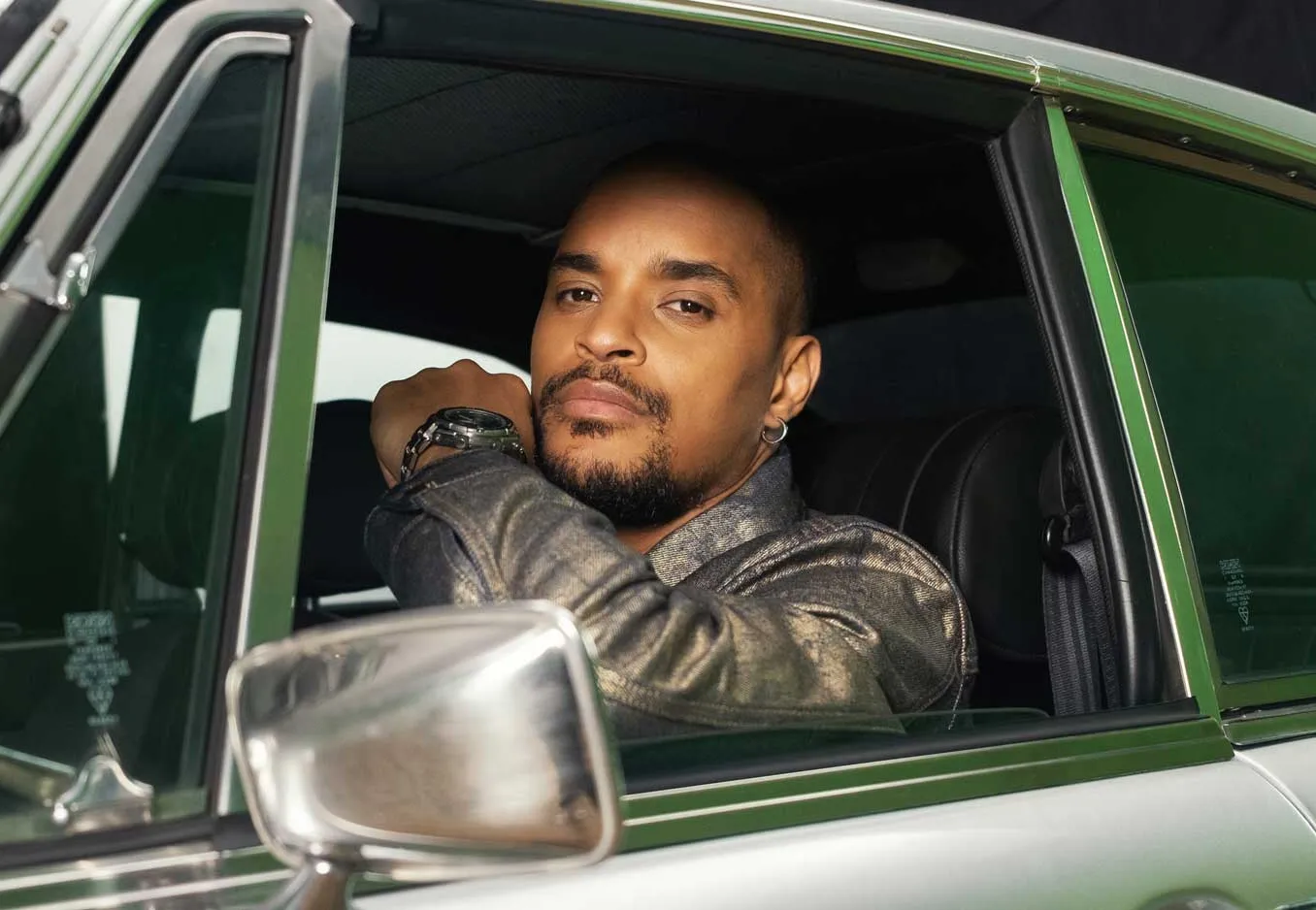
He is more than a voice. He is a bridge. Between generations, between continents, between what is said and what is still to be sung. At 36, Djodje carries in his melodies the rhythm of Cape Verde and the pulse of a diaspora that dances without asking permission. Composer, performer and producer, he is a name that has made itself heard without noise — with elegance, consistency and authenticity. In this conversation with Xonguila, we go back to his childhood, delve behind the scenes of his label, Broda Music, question the limits of fame and art, and celebrate his emotional bond with Mozambique. Here, Djodje answers not as a star — but as a man, a creator and a brother of a culture written in Creole, batuque and memory.
"Mininu di Oru" is born not only of talent — it is born of struggle too. Looking now at your most recent work, such as the EP Elements or songs like "Tentason" and "Nu Ka Gosta Poku", do you feel those wounds still sing with you? Or are you living through a lighter phase, more given over to pleasure and love, without forgetting what formed you?
In every song I make, my whole story is with me. So, whether a song is more festive or sadder, so to speak, they are moments and they are parts of me. So "Tentason", or "Nu Ka Gosta Poku", or the album "Mininu di Oru", are, are parts of me and they are, are pieces of my story. Because, for me, the essential thing is to have truth in every song — the truth about the moment, about who the artist Djodje is — and that is what I have to carry over into my music.
Is there a sound from your childhood that still echoes in your music today?
Certainly, the sound that echoes in me to this day is the backyard parties, where my uncles and my family would gather to play and sing — what we call, in Cape Verde, tocatinas.
And is there anything you have not sung, out of fear, respect, or because you were not yet ready?
If I have not yet sung something, it is because I did not feel it was time, not out of fear. Everything I sing is because I feel it. So, if I have not yet sung something, it is perhaps because the moment has not yet come.
In a world saturated with "viral" artists, how does Djodje stay authentic? And what would you never allow to be changed in you?
My secret, in inverted commas, for authenticity — and it is even a bit redundant — is to stay true to my essence, that is, to be genuinely authentic. So, that is the biggest secret. And I am not saying there is nothing I would allow to change in me, because we are constantly changing, you know? But, certainly, I would not allow them to take away my essence. That, no.
Behind the scenes of your career, there are decisions that are not always visible. Has there been a collaboration that taught you more than you expected, even if it was difficult?
Collaborations are always moments of great learning. So, yes, there are moments when things have not gone so well, but it was a learning experience. And when it goes very well, that is also a learning experience. So, I think that is why I enjoy collaborating so much.
You founded Broda Music. Have you ever thought about giving up singing to be just a producer and mentor? What are you more passionate about: the stage or behind the scenes?
I like the stage and the behind-the-scenes equally. So, the work of producer and mentor is something I enjoy doing, but I do not think of giving up singing to do only that — or vice versa. I think the two things can go hand in hand, and that is what has happened until now.
And do you feel there is any part of your journey that the public has not yet properly understood?
The part of my journey that I think the public has not quite understood yet is, perhaps, the "Mininu di Oru" phase. But I am sure that, over the course of my career, that phase will be far, far more valued and understood. Yes.
Is Kriol Kings a movement or a moment? Is there room for a new generation within that concept?
Kriol Kings is, certainly, a movement. Kriol Kings is — it is the meeting of two artists who already have established careers and who want to leave a legacy for the new generations. And, certainly, there is room for the new generation. So much so that, in the concerts we give as Kriol Kings, and which we have already given, there is always room both for more established artists and for artists of the new generation. So, yes, it is a movement.
Do you have a secret playlist that nobody would expect from you? What is in it?
I do not have a secret playlist, but, certainly, people would be very surprised to hear my playlist (laughs), because it is a very eclectic playlist — it has everything from traditional Cape Verdean music to hip-hop, R&B, kizomba, music from the PALOP countries, Brazilian music such as Djavan's, Sting... So, it is a very eclectic playlist, and I think that also helps a great deal with my musical creation.
You have already accustomed us to albums with a strong identity and striking evolutions. What can you reveal now about what is coming? Titles, collaborations, genres, new languages… what can we expect, or not expect at all?
At the moment, I am preparing new songs. Certainly, this year I will have several releases, and I really want to focus on that, on having plenty of content, releasing new music, releasing new formats, giving concerts. I am at a stage where I feel I want to give more to the public, in terms of my artistic content. That is essentially it.
If your career ended tomorrow, what personal legacy would you want to be sure remained for Cape Verde and for the Lusophone world?
The greatest legacy I think I leave for Cape Verde and for the Lusophone world is, certainly, that dreams come true through work, focus and determination. Any dream can come true, and I think that is the greatest legacy I end up leaving and representing.
How do you see the future of Lusophone music?
Honestly, I am hopeful about the path of Lusophone music. I think we still have a great deal to achieve, generally speaking, and what I hope and wish for is that there will be more collaborations between artists from the Lusophone world, from the PALOP countries, you know? And I think that will make our music reach much, much, much more distant places, and also allow us to explore the potential of PALOP music, of Lusophone music.
You have already trodden Mozambican stages and felt the warmth of a people who dance with soul. What does Mozambique represent to you as an artist, and what message would you like to leave for those who listen to you here — not only as a singer, but as a brother of a culture that is also yours?
From very early in my career, even before going to Mozambique, I always felt a very strong love from the people of Mozambique. When I finally got to perform there for the first time, that love was felt too, and it is reciprocal. And Mozambique has increasingly been a country of great significance in my life, not only professionally but also personally. I have Mozambican friends and brothers, so to speak, and I want to be closer to Mozambican culture, I want to be closer to Mozambique. I adore Mozambique — it is one of my family's favourite countries. My son loves it too. So, I want to thank Mozambique for the affection and the love, and know that, here, you also have an artist who loves Mozambique very much and wants to be closer.


