
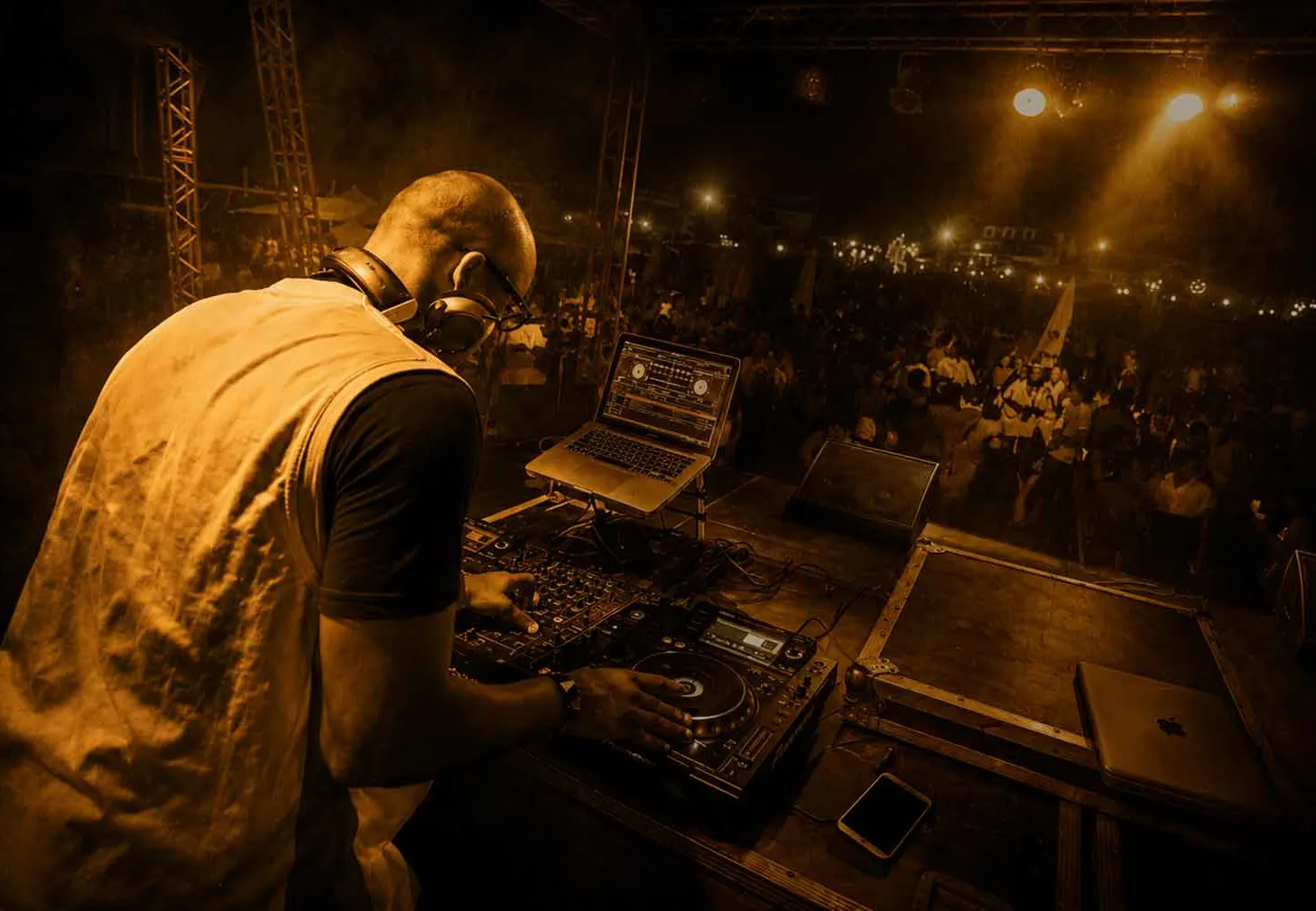
Some artists follow trends. Others help to create them. Over more than two decades of career, DJ Faya has built a path marked by consistency, adaptability and a deep connection to African music. What began at family parties has grown into an international career that has already taken him to perform in sixteen countries, from the stages of Mozambique to the United States, by way of Europe, Asia and various parts of the African continent. Recognised as a DJ, producer and trainer, he was also one of the names that helped consolidate the professionalisation of the art of DJing in Mozambique. With nominations and awards at the Mozambique Music Awards, hits that have defined dance floors and a school dedicated to training new talent, DJ Faya continues to look to the future without forgetting his roots. In this conversation with Xonguila, he talks about the challenges of his early career, the evolution of Mozambican music, the dreams he still hopes to realise and the legacy he is already building.
How did your connection with music begin, and when did you decide to become a DJ?
Like any young person who loves music, I started at family parties, often being the one chosen to liven up the occasion. The fact that my father started a nightclub in the district of Marracuene boosted my passion even further.
Do you remember the first time you performed in front of an audience? What was that experience like?
The first time I played may be a little hard to remember precisely, but it was certainly at a private event, a birthday or a wedding. As the kid I was, I believe it was an exciting experience and one that taught me many lessons.
When you started out, did you imagine reaching the level of recognition you have today?
I never imagined I would reach this level. I was aware of my talent and I felt a response on the dance floor, even among family, but nothing like the level I ended up reaching.
What moment do you consider to have truly changed your career?
I think I had several moments that helped my career, but when I received five nominations at the Mozambique Music Awards (MMA) as a DJ, and won two important awards, that gave me the certainty that I was on the right path.
As both a DJ and a producer, which of the two areas challenges you more at present?
Both areas challenge me constantly, because times change every day and we must always be alert and ready to learn new trends.
What do you feel when you see one of your tracks become a real hit and start to be heard everywhere?
It is the greatest recognition of the effort, the investment in research and the creativity we put into our work. Knowing that our songs are chosen to open rooms and to mark the start of many moments and relationships is very gratifying.
What difficulties did you face at the start of your career that the public may never have imagined?
My father did not accept my wish to be a DJ and did not make things easy. Today I give him some credit, because for any father, given the stereotypes associated with people who worked at night, it was natural to prefer that I pursue sport and my studies.
How do you see the music market in Mozambique at present? Do you think artists can already make a sustainable living from music? What is still missing for Mozambican music?
I think we have many examples of artists with more than 20 years of career who have already proved that it is possible to make a living from music. Even so, I am of the opinion that artists should not live from live shows alone. As for our music, I believe what we lack is a true cultural industry, capable of strengthening every area of culture and exporting our talent beyond our borders.
Today many young people are entering the world of music quickly because of social media. Does that help talent, or does it create artists who are too hasty?
Technology makes access easier, but it does not replace creativity, musical knowledge, the ability to read an audience or the experience acquired over time.
How would you define your musical identity? What sets DJ Faya apart from other artists?
I am an African music DJ. Although I am versatile and work in open format, what sets me apart from other artists is my vision and my positioning in the market.
Does any of your tracks have a more personal or special meaning for you?
The song “Bondoro”. Although it is a dance created and developed in Beira, with my song the word “Bondoro” and the style of beat gained strength in the market and ended up being adopted by many artists.
Nightlife can be intense and draining. How do you look after your mental health and your balance away from the stage?
I take great care of my health. I practise martial arts, football and go to the gym. I try to eat well and to control the information around me so that I do not lose focus or energy.
What is the most memorable or unexpected moment you have experienced because of music?
Reaching major stages, performing in countries I dreamt of visiting and being a pleasant surprise at events attended by people of different cultures are, without doubt, some of the most memorable moments of my career.


