
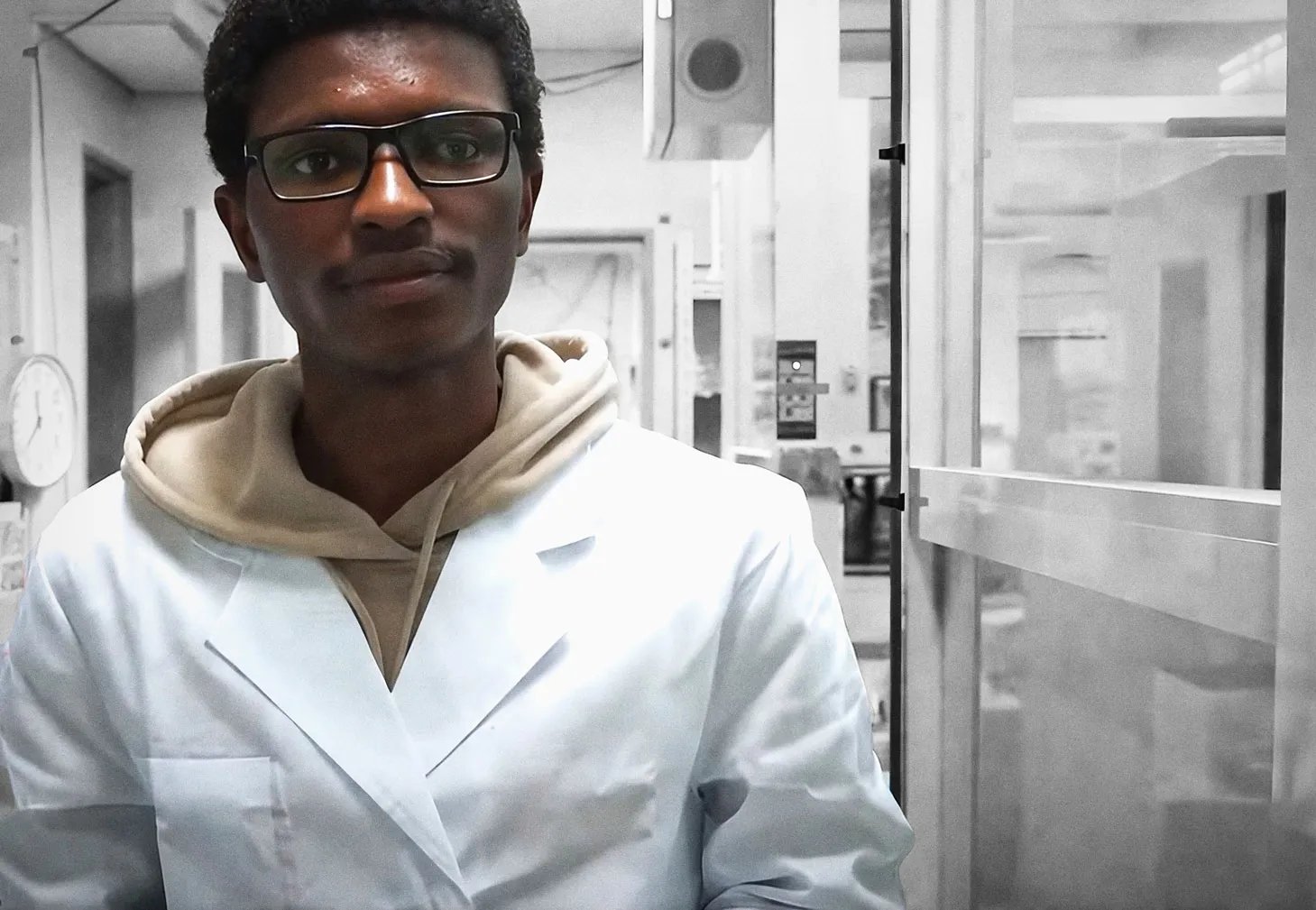
From Eduardo Mondlane University to research laboratories in Japan, Amade Sambo is an example of the new generation of Mozambicans taking talent, curiosity and scientific ambition beyond their borders. At Osaka University he carried out research linked to an experimental vaccine against pancreatic cancer, work that underlines the potential of science done by the country's young researchers. In this conversation with Xonguila, he shares his journey, the challenges of research and the way Mozambique remains present along his path.
You grew up in Mozambique and today you carry out cutting-edge research in Japan. Which memories or reference points from your early years are still present in the laboratory?
Growing up in Mozambique taught me, from an early age, the value of curiosity and persistence. We did not always have access to all the laboratory resources I find in Japan, but that ended up developing in me a mindset of solving problems creatively. In the laboratory I still carry that memory: the idea that science does not depend only on sophisticated equipment, but above all on critical thinking and dedication. I often remember the classes and laboratories at Eduardo Mondlane University, which were fundamental in awakening my deep interest in chemistry.
Before we talk about the vaccine that is the subject of your work, I would like to understand the man behind the scientist. Who is Amade Sambo away from the research bench?
Away from the research bench, I am someone who is very curious about life. I really enjoy walking and exploring new places. I also like talking to people from different cultures, listening to their stories and learning how they see the world.
What fascinated you about chemistry to the point of making it your life's field? Was there a moment of discovery that left its mark on you?
Chemistry fascinated me because it is the science that explains how the world works at the molecular level. The idea that tiny, invisible structures can determine the properties of matter, or even complex biological processes, has always impressed me. A defining moment was when I started working with organic synthesis and realised that it was possible to build specific molecules for a scientific or medical purpose.
Developing an experimental vaccine against pancreatic cancer during a master's degree is a rare achievement. How did this line of research come about?
This line of research arose within an academic project focused on the synthesis of molecules with potential immunological applications. During my master's I had the opportunity to work on the synthesis of peptides and glycans, which are important components in antigen engineering. From there, together with my professors, the idea began to develop of building a molecule capable of stimulating the immune system to recognise specific cancer cells.
For those outside the scientific field, how would you explain the logic of your vaccine and what makes it innovative?
Put simply, the idea of the vaccine is to teach the immune system to recognise cancer cells. That is, to synthesise molecules that mimic certain structures present in tumour cells. When the immune system comes into contact with these molecules in a controlled formulation, it learns to identify them as something that must be fought. The innovation lies in the way these molecules are chemically designed and presented to the immune system, using strategies from synthetic chemistry and nanoparticle engineering.
Working with such an aggressive disease also carries an emotional weight. How do you cope with the awareness that your work could mean hope for thousands of people?
It is a great responsibility, but it is also an enormous motivation. Science is a long and often uncertain process. I try to keep a balanced perspective at all times, to focus on doing the best scientific work possible and to respect every small step forward.
The academic excellence you achieved at Osaka University does not happen by chance. What personal discipline sustains that level of performance?
I believe very much in consistency. Science demands patience, attention to detail and the ability to keep learning. I try to organise my time well, to keep a disciplined routine of study and laboratory work and, above all, to cultivate scientific curiosity. I also consider it very important to collaborate with and learn from colleagues and supervisors, because research is rarely an individual effort.
What differences did you find between the Japanese scientific environment and the Mozambican academic context? What could we learn from that experience?
Japan has a very strong scientific infrastructure and a great deal of investment in research. The laboratories are well equipped and there is a very strong culture of precision, planning and experimental rigour. In Mozambique, although there are fewer resources, I also found great human potential and a real eagerness to learn. I believe that one of the important paths for the future is to strengthen investment in research and to create more opportunities for young scientists.
Have you ever felt the conflict between building a career abroad and the desire to contribute directly to Mozambique's scientific development? How do you weigh up that balance?
Learning in advanced scientific environments allows me to acquire knowledge, collaboration networks and skills that can be very useful in supporting Mozambique's scientific development later on. The ideal is to find ways of maintaining that connection and contributing to the growth of science in the country.
Science requires time, funding and patience. In a world that demands immediate results, how do you stay true to the long pace of research?
To be honest, I am still learning to deal with this pace. I have only just begun my deeper journey in research and I am discovering over time how it really works. In the beginning, it is natural to want quick results, but as you work in the laboratory, you realise that research is a gradual process, made up of many attempts, mistakes and small discoveries.
Beyond oncology, which other scientific areas interest you at the moment? Are there new projects in the pipeline?
I have a growing interest in areas such as nanomedicine and molecular engineering applied to medicine. I am also very interested in the interface between chemistry and biology, especially in the design of molecules capable of interacting with biological systems in a precise way.
If you could imagine Mozambique twenty years from now in the field of science and innovation, how would you like the country to be positioned, and what role do you aspire to have in that future?
I would like to see Mozambique with strong universities, well-equipped research centres and a generation of young scientists able to contribute to local and global solutions. Personally, I would like to contribute to that future through research, through training new scientists and through building scientific bridges between Mozambique and the rest of the world.
Science often begins with a simple question and the courage to follow it to the end. In the laboratories where he works today, Amade Sambo continues to do exactly that: searching for answers that do not yet exist. And, in that quiet search, there also lives the promise of a future in which more young Mozambicans can turn curiosity into discovery.


