
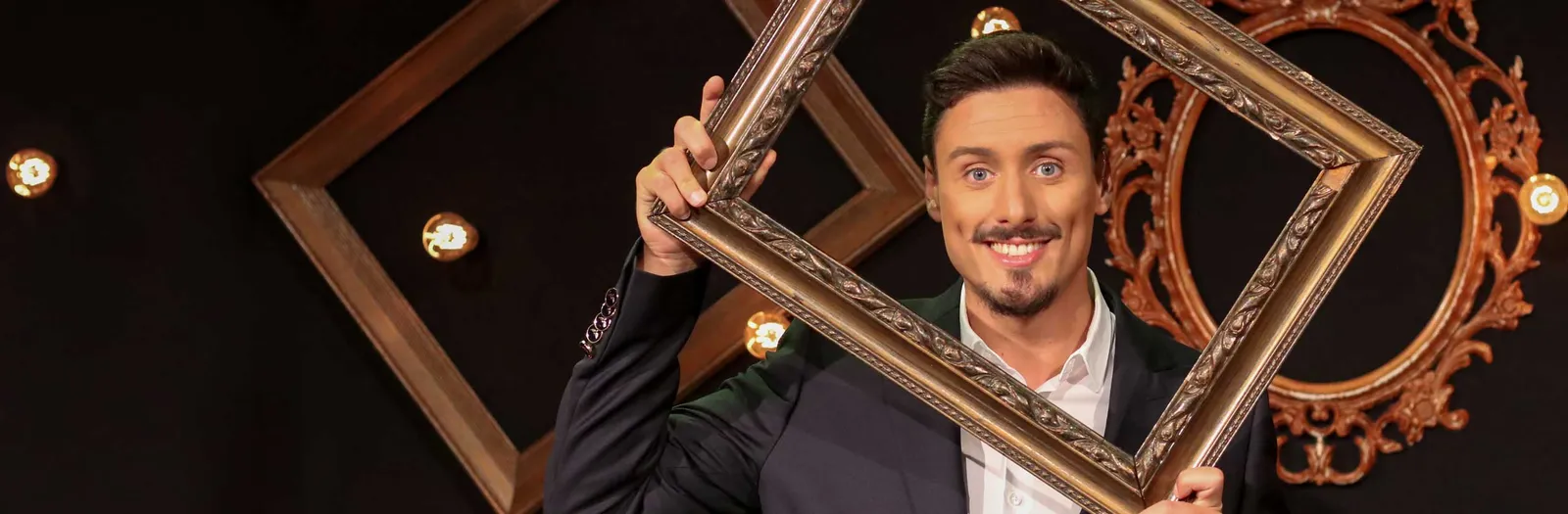
David Dias, a presenter much loved here
Who is David Dias? Tell us a little about yourself and your path to RTP?
Talking about myself is always a thankless task; we always tend to overvalue our qualities and play down our faults. But the truth is that both the positive and the negative traits shape my personality. I am persistent, demanding, dedicated and resilient, which can be both good and bad, but which has been important for my professional path. As a boy, I would grab the video camera my father had bought, to give vent to my creativity, and I would only put it down when my batteries ran out at the end of the day (So many reports and programmes made! Those were my first real hours of television, since, once recorded, I made the whole family watch... They suffered!). The truth is that from then on the magic of television appeared and never left me, nor did I leave it. Studies followed, and I confess that I did them with immense eagerness and a love of learning how this basic act of communicating actually works. And it was during my degree that the opportunity came to do a placement in radio, at Antena 1 – “Oh, no, radio!”, I thought. Once the placement was done, the fascination came. After all, it was not television that gave me wings. What I really enjoyed was meeting people and being able to share with the world the stories that each of them has to tell. And I could do that on radio, on television, on the Internet, wherever I wanted. As a result of that drive, and of a once-in-a-lifetime stroke of luck, they liked my work and I was placed on the team of a programme created by Jaime Fernandes – a legendary name in radio and television – who was won over by my desire to do more and to do it well. Just a few months later came an invitation to work in television. From radio to television, the taste for meeting people and introducing them to others continued. The desire to ask questions, the question itself. And perhaps because of all that energy the second invitation came, from someone I did not know and who surprised me. José Arantes, in an act of colossal generosity, invited me to present a talk show with a noble and genuine mission: to unite shores, to celebrate differences and, above all, to look at the world and try to change it. I could not have been happier. Eight years after the first episode, I am just as thrilled, with the same enthusiasm every week. Because there is nothing better than meeting people and being able to share that moment with the world.
How did the idea for the programme Conversas ao Sul come about?
Conversas ao Sul was born of the ingenuity of necessity, from the need to bring closer what was too far apart. Audiences asked for a space for sharing, for union, a bridge between distant shores. We have one of the greatest assets in the world: our language – the fruit of an abject and traumatic colonial past, but one from which we should draw the greatest possible benefit, as a way of celebrating our cultural differences and similarities as human beings. That space did not exist on television, and it is still insufficient, inequitable and unrepresentative in Portuguese-language television today. My dream is for there to be a thousand more Conversas ao Sul around the world, so that everyone with talent, intellect, ingenuity and thought has a stage on which to share their ideals with the world.
We are all different, and that alone is incredible. And as I am not much given to generalisations, I will say that the Mozambicans I have met are resilient – even in the face of the cruellest adversity – and optimistic
What has surprised you most since the programme was launched?
Every week is surprising. That is no exaggeration. It really is. What has surprised me most since the first episode is the life stories of the guests. The capacity of human beings for overcoming, for creativity, for resilience is absolutely overwhelming. Being able to listen to such different and powerful testimonies is always something new, always surprising. It is a privilege.
Conversations with people from all the PALOP countries. Has it been enriching to meet people from so many different cultures, yet with a language in common?
We are all different, and that alone is fantastic. And it is precisely those differences that must be celebrated. It is what enriches us as a humanity. I believe that diversity is the key to global happiness. Let us celebrate it!
Every country is different; how would you describe the Mozambican people?
We are all different, and that alone is incredible. And as I am not much given to generalisations, I will say that the Mozambicans I have met are resilient – even in the face of the cruellest adversity – and optimistic, believing that Mozambique will establish itself as a country that promotes human development and peace, the growth of individual and collective incomes, and guarantees the happiness of its citizens – a conviction I share.
After so many interviewees, is there any moment or guest that has marked you in particular?
It is impossible to pick out one moment or one guest. They all end up leaving a mark on me, and I take a little bit of each of them into my life. There are life experiences that are surprising, hardships we cannot imagine and that are almost impossible to overcome, but which were overcome by the person we are looking at there, eye to eye, or incredible lives at the highest level in the world, which take nothing away from the humility of a particular guest. Human beings fascinate me.
The format of your programme is quite relaxed, and it has been warmly embraced by Lusophone Africa. How special is this achievement for you, and how would you describe the feeling of being a point of union for all these communities?
The other day I read a book about migration across the Americas towards the United States of America, written by a North American woman from the point of view of a Mexican family. The author (Jeanine Cummins) said, in the book’s closing note, that she understood the criticism she might face for being the one to tell that story and that she had had many doubts while writing the book, but that, encouraged by a friend, she decided to go ahead. After all, she could be a bridge so that the story could be told, and what mattered there was the story. Conversas ao Sul is also that: a bridge that has to be built. And the best thing about bridges is that they join the two shores equally, and the middle is exactly in the middle for both sides. It is very rewarding to be part of a team that, imbued with this spirit, likes to build bridges and shorten distances.
We know you like to play pranks and set challenges for your guests. Has anyone ever played a prank on you live?
That is a constant thought within the team! I confess I am a happy target of frequent pranks. And I have had some surprises that moved me, such as a birthday full of messages from generous colleagues and friends who joined me that day, or some games they prepare without my knowledge that make me show my best sportsmanship (which, given the number of defeats I already have, is, it must be said, extremely generous).
Name 3 people you admire in Mozambique, and why.
A difficult question because of the limit on numbers. I will therefore choose to answer with people I have not yet had the opportunity to interview – consider this an invitation. First of all, although the order is merely indicative, I would say Graça Machel. For her legacy, her energy and, above all, her strength. She is an extraordinary woman, with a public and private life full of events, and I would like to put several questions to her. Then, in letters, Luís Bernardo Honwana, both for his path as an author, featuring on the list of the greatest names in the country’s writing, side by side with Mia Couto or Paulina Chiziane (I have already had the privilege of interviewing both), and for his public career. He held posts at the highest level in various bodies, about which there will certainly be interesting stories. And, to complete this panel, the scientist Raquel Matavele – recently honoured by UNESCO for her research in the fight against COVID-19. She is an example of how the new generations of Mozambicans also wish to contribute to the country, if they are given that podium.
Plans for the future? Are you thinking of visiting our country soon?
As soon as it is possible, given how the pandemic evolves. I will certainly be glad to be in Mozambique to host a special edition of Conversas ao Sul and to get to know the country better – which, given its size and diversity, will certainly call for many more visits.


