
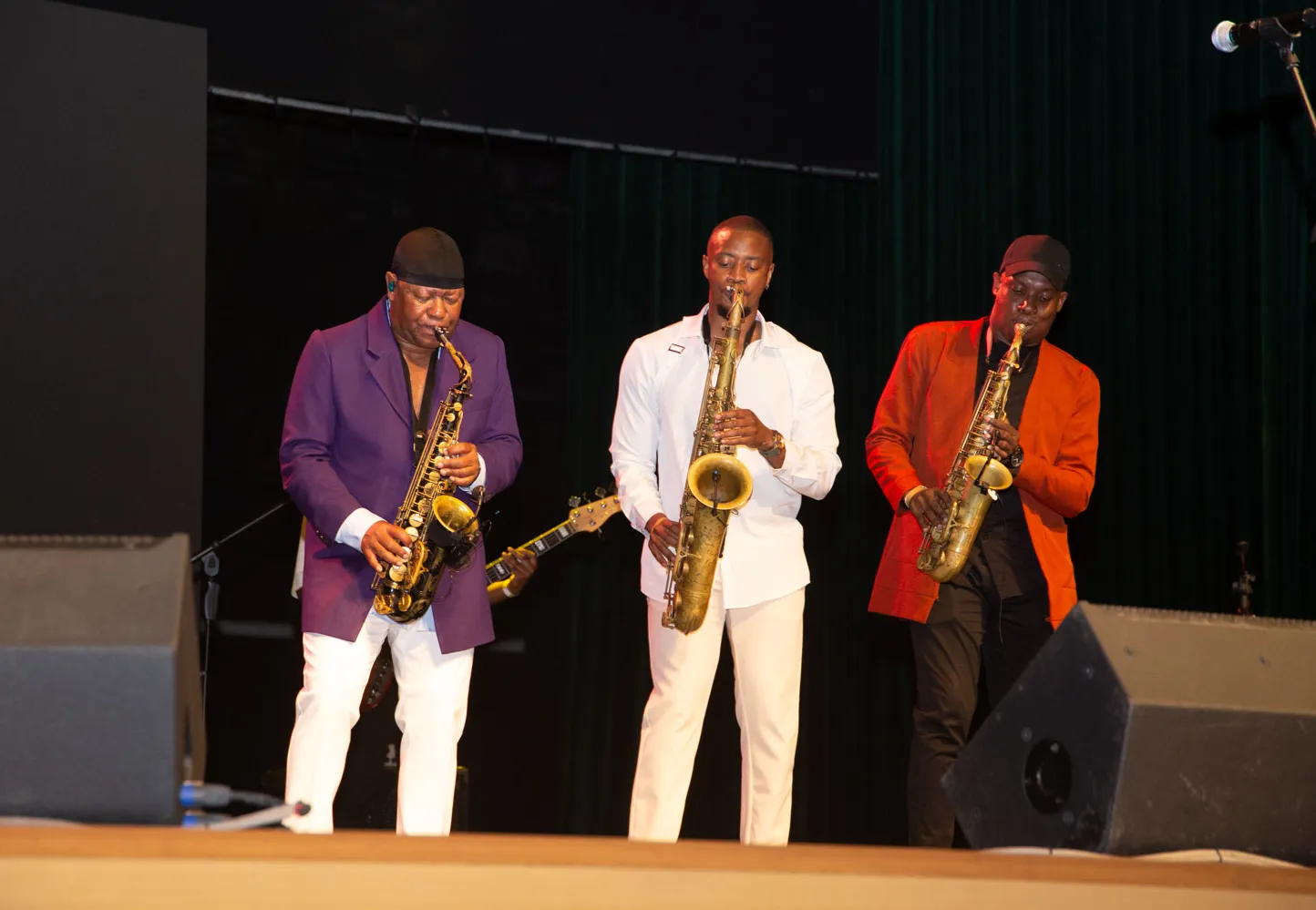
On 10 October 2025, the Mozambique-China Cultural Centre hosted a celebration of music, friendship and identity: the Otis & Friends II concert. Conceived by Mozambican saxophonist Otis Sax, the event brought together artists of different styles and generations on the same stage, fostering a rich dialogue between tradition and modernity, between roots and experimentation.
Before the show, the organisers presented, at a press conference at the Hotel Rovuma, the motivations behind this second edition, stressing the importance of creating spaces where musicians can grow together and audiences can reconnect with what is most authentic in the nation’s culture. “The central aim of this event is to promote new talent and, above all, to celebrate Mozambican culture, proving that by bringing generations together we can achieve surprisingly positive results,” explained one of those responsible.
The concept stems from the conviction that diversity is the driving force of artistic creation. “Working with artists of different styles can only enrich the final product. Each one applies their knowledge in their own way and, on stage, you simply have to see it,” said the organisers, highlighting names such as Aniano Tamele, Dua Maciel, Celso Durão, Valter Mabas, Sarmento and Mahu, as well as Otis himself.
More than music, the event also included gastronomy and crafts, reinforcing the idea that “culture is the mirror of a people”. The audience was thus able to enjoy a complete sensory experience — a true portrait of Mozambique’s creative vitality.
Another highlight was the presence of artists from the diaspora, whose participation, according to the organisers, “plays a crucial role in redefining and broadening national cultural identity”. For the promoters, the Mozambican diaspora represents a bridge between the local and the global, capable of showing that “being Mozambican is also a transnational experience — shaped by migration, intercultural dialogue and memory”.
Otis & Friends II is seen as a seed for future collaborations. The organisers revealed that the creation of artistic residencies and exchange projects is under discussion, in order to consolidate the initiative as a permanent platform for cultural dialogue. “Culture wins and Mozambique wins,” they conclude.
Interview with Otis Sax
Otis & Friends II emerges as a meeting place for different voices and styles. What inspired you to continue with this format?
Otis & Friends began with the production of my most recent album of the same name. It was released in Maputo in 2019. My friends, the “friends”, have accompanied me throughout my career, directly or indirectly, and for that reason I brought them together so that we could make a timeless work. With the Otis & Friends 2 concert, I bring together on stage different generations with immense talent. The youngest, namely Mahu and Sarmento, in my opinion, represent the future. Just as Miles Davis did, I now do the same: I work with the new generation. We always learn from one another.
Having begun your journey in Inhambane and lived much of your career in Portugal, how has distance influenced your relationship with Mozambique and with your music?
Distance allowed me to “drink” from other waters and, in doing so, to enrich my skills. My relationship with Mozambique has always been present, whether in my work, in my frequent visits and, above all, in contact with friends, at both corporate and institutional level. I feel that the affection for me and for what I do has endured over the years. Mind you, my music is not at all commercial. My first album, released more than 20 years ago, is still current.
Your career includes collaborations with leading names from the Lusophone world. What lessons from those experiences do you bring today to the Mozambican stage?
Each of the artists I have collaborated with taught me a great deal. Each one is unique, and that has influenced the way I am artistically, not to mention the fact that those collaborations gave me the privilege of seeing half the world. The greatest lesson from these iconic figures was to realise that, in everything we do, we must remain genuine. We do not need to be the best, but rather unique in what we do. That is the lesson I carry with me every day.
Your music blends jazz, Afro soul, marrabenta and urban sounds. How do you define your place within the current Mozambican and African music scene?
I believe that my genuineness allows my place on the music scene to have the prominence and recognition it deserves. My music is timeless. Although I am far away, I have followed the rising quality of the music produced in Mozambique, and I must acknowledge that the new generation is much better prepared than we were in the 1980s.
The event celebrated diversity and dialogue between cultures. What personal meaning do you find in this crossing of tradition and modernity?
Very simple. We must always be aware of where we come from, of our origins. That has been my formula. My discography always has some element that connects us to Africa and to Mozambique in particular. Modernity changes every day; authenticity must be firm so that we do not lose our essence.
After so many years of career and nine albums released, how do you look at the evolution of your journey, and what continues to drive you artistically?
Each record is like a child we bring into the world. Each album is unique and I feel the same bond with all of them. I live the sound of the saxophone day and night, and that is the reason to wake up every day. Artistically, I cannot see myself with any other motivation than to keep creating for as long as I have my health.
What message would you like the audience to take away at the end of the concert?
This event promoted new talent and cultural diversity but, above all, it was a voice for peace and reconciliation among us Mozambicans. Music has the power to convey messages, and we use it to influence citizenship, the well-being of Mozambicans and lasting peace.
Otis & Friends II reaffirmed Otis Sax’s standing as one of the great ambassadors of contemporary Mozambican music. Born in Inhambane, the artist — the stage name of Alípio Cruz, in homage to Otis Redding — built a career that took him from Mozambique to Lisbon, collaborating with figures such as Roberto Leal, Rui Veloso, Mariza, Bonga and Tito Paris. In 2025, he also stood out alongside Calema, in a historic concert that filled the Estádio da Luz. With this return to Maputo, Otis brought with him the same spirit that has always accompanied him: that of making music an act of sharing, identity and unity.


