
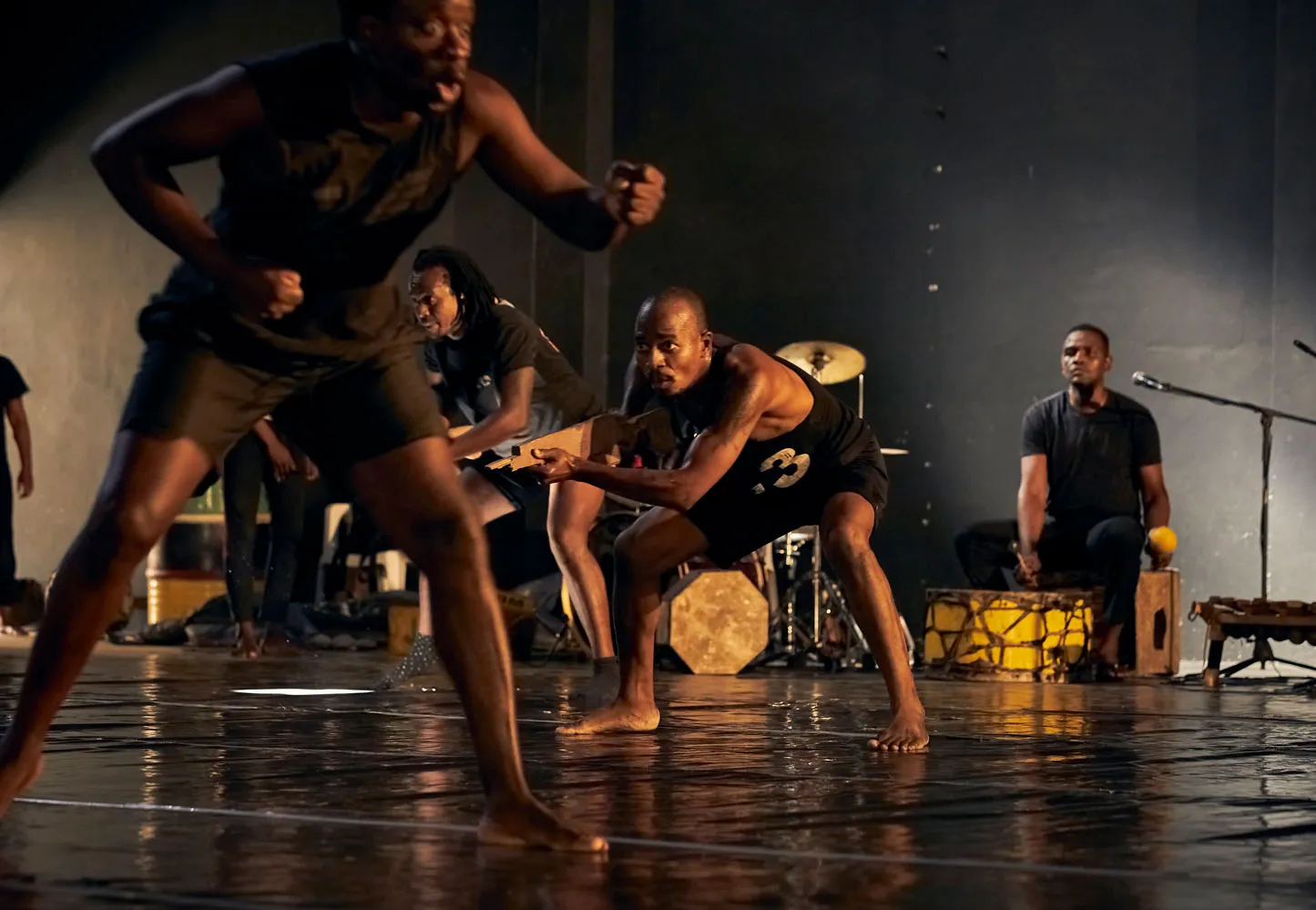
When independence was still a wish shared among Mozambicans, culture helped to strengthen bonds through the union of the country’s different regions. Song and dance always sought a way of helping to commemorate the victories and sorrows of a people who never lacked reasons to celebrate. Orderly movements and rhythms that made Mozambique resound in the “liberated zones” tentatively announced the emergence of the Companhia Nacional de Canto e Dança (National Song and Dance Company, CNCD). “The National Song and Dance Company was born not from someone’s simple wish, but from the dynamics of history itself and the existence of the Mozambique Liberation Front. It arose from the experiences of the cultural group that was beginning to represent Mozambique, though not yet independent, at festivals in some countries that supported the national liberation struggle,” said the Company’s Director-General, André Salvador Mabasso.
Created in 1979 with 30 members, the great majority of the group’s first members came from what was then the Guard of Honour Battalion of the Popular Forces for the Liberation of Mozambique, from veterans of the national liberation struggle, from companies and schools, and from the Democratic Mass Organisations. Later, final-year students of the National School of Dance and former workers of the National Film Institute attached to the Cine-Teatro África were brought in, at the time when the latter passed to the management of the CNCD. While the rhythms and dances were performed, Mozambican cultural richness was taken to international stages.
“At one of our meetings with the CNCD, President Chissano told us of the importance the Company had in the recognition of Mozambique after national independence. We took the name of Mozambique to every continent,” said André Mabasso. In 1996 it was legally constituted as a public-law legal entity, enjoying administrative and financial autonomy.
Taking on the mission of researching the dances of the whole country, the CNCD investigates and brings together all knowledge and cultures, synthesises them and puts them on stage in the form of ballets. Its work has already earned prizes and distinctions that fly the national flag. Such is the case with the Medal of Honour at the World Festival of Youth and Students (Cuba), the Honourable Mention at the International Festival in Bulgaria, and Best Presence and Group at the Kizomba International Festival of Black Arts (Brazil).
The CNCD investigates and brings together all the knowledge and cultures of Mozambique, synthesises them and puts them on stage in the form of ballets. Its work has already earned prizes and distinctions that fly the national flag
More than 40 years on, the mission of taking Mozambique to the world is growing ever stronger, and the Company’s participation in “Expo Dubai 2020” is living proof of this. On 14 February it set off for the United Arab Emirates to perform at the world’s largest exhibition, in Dubai, with the main aim of “winning over the largest possible number of people interested in working with the CNCD on commercial shows”. “For Expo Dubai 2020 we are taking the works “O planeta azul” (The Blue Planet) and “Em Moçambique o sol nasceu” (In Mozambique the Sun Rose) and a little traditional music played on typical national instruments,” said the Director-General. The ballet “O planeta azul” draws attention to the use of resources and responsibility in the use of the planet, while the work “Em Moçambique o sol nasceu” is a rhapsody of the country’s most representative dances.
With its eyes on the future, the CNCD wants to keep bringing joy to Mozambicans. And it already knows how to do it… “For the future we have great prospects. First we would like to “renew” our dancers. We have dancers who need to leave the stage and enter in another way: creating choreographies. Another prospect is the rehabilitation of the Cine-Teatro África and its transformation into a national theatre. With the rehabilitation of the África, shows will be able to flow, and we will win back our audience, to reach the world’s stages even more," concluded André Mabasso.


