
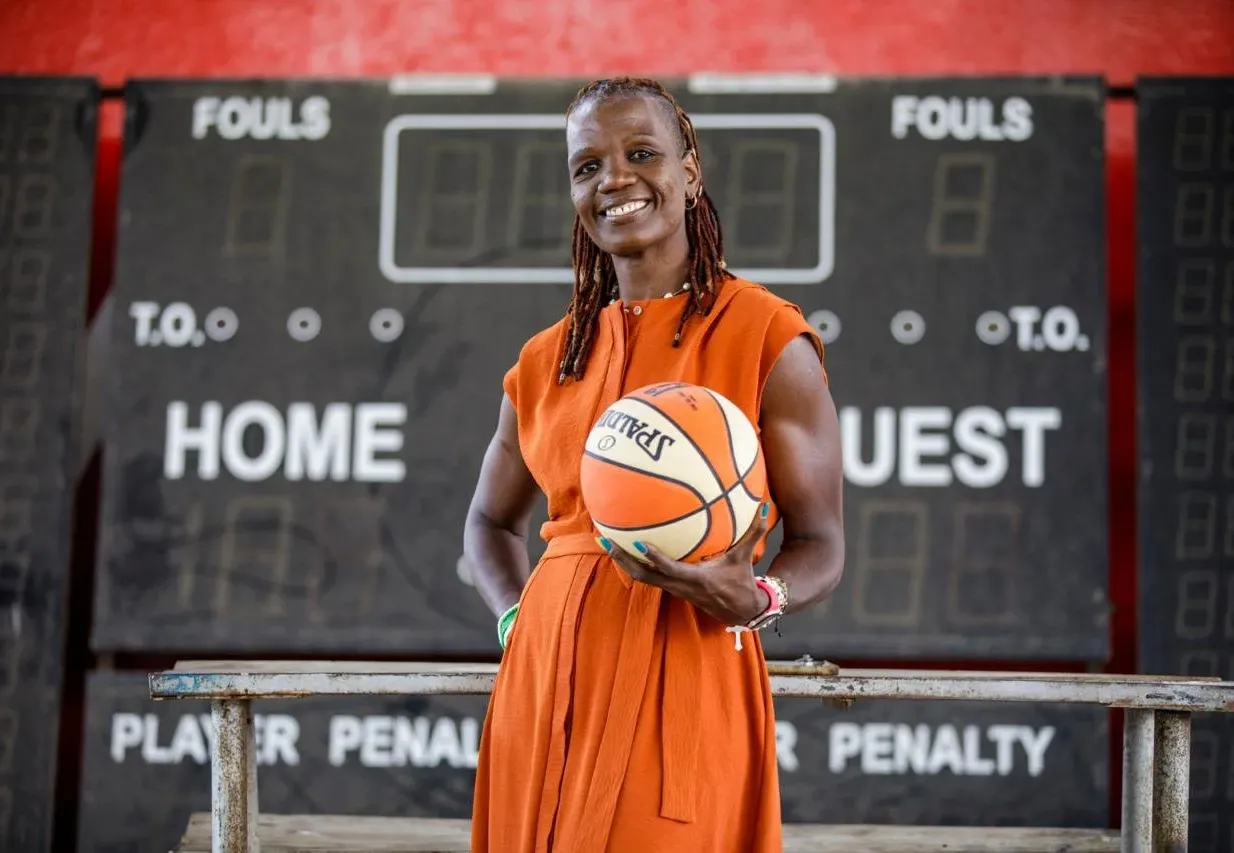
Some names outgrow their achievements and become a point of reference. But there are people who, when the applause fades, choose to carry on. They choose to work, often far from the noise. Clarisse Machanguana could have lived on the memory of a career that opened doors and inspired generations. She was away, and she chose to come back. She chose to build. Today, her field is different: it is communities, young women searching for a horizon, structures in need of change. Between visibility and responsibility, between public expectation and the woman who exists beyond it, there is a story that is still being written. We spoke to her about mission, difficult decisions, leadership, youth and legacy. Without nostalgia. With awareness.
Which part of your childhood still quietly guides the woman you are today?
Curiosity. I grew up in Maputo at a time when opportunities for girls like me were few, but I was always a child who observed the world around her and asked questions. Basketball came into my life when I was six, and from an early age I understood that sport was not just a game — it was a language, a way of learning discipline, of surpassing myself, of belonging. That child who used to "bounce the ball" at Costa do Sol, and who later made herself known to the world beyond Mozambique, is still inside me. She is the one who reminds me, on the hardest days, of where I came from and why I do what I do.
The Foundation you created – which bears your name – was it a natural step along the path you had been following, or a restlessness that no longer fitted inside you?
It was both, honestly. When I returned to Mozambique, after more than two decades playing around the world, local people and organisations began asking me to represent them — because of the visibility my name had. And in doing that work, I discovered realities I had not known in depth: the impact of HIV, the barriers a girl faces simply to stay in school... There was a restlessness growing inside me. But what truly convinced me to create the Foundation was when I realised that girls were asking me, in a low voice, what "spell" I had used to succeed. I understood that the greatest obstacle was not a lack of talent — it was a lack of access and a lack of daring to dream. The Foundation was born to help dismantle that mental prison.
Some decisions stay with us for ever. Have you ever made one with fear in your hands and chosen to move forward all the same?
Yes. Returning to Mozambique. When I finished my career, I had options. I could have stayed in Europe or the United States, built a comfortable life, far from the day-to-day challenges at home. But I could not ignore what I saw whenever I came back. To return with everything I had learned and built, without a financial safety net, to set up an organisation from scratch in such a demanding context — that required a faith that you do not always feel, but that you choose. I do not regret it for a single day.
After the applause and the lights, what silence stayed with you?
The awareness that the path I had was not only for me. Every time I walked off a court after a victory, I looked at the place where I was — Barcelona, Los Angeles, Seoul — and thought of the girls in Marracuene, in Maputo, who would never have that opportunity if nobody opened a door for them. That silence turned into a responsibility. Not a burden, but a mission.
Have you ever turned down support or a partnership because you did not want to compromise your principles?
Yes. There are partnerships that bring money, but that charge something not written in the contracts: your voice, your agenda, your autonomy. I made it very clear, from the start of the Foundation, that fundraising would never be the centrepiece of our work. What guides the Foundation is principles, vision, coherence with the communities we serve. When I feel that a partnership would take us away from that, the answer is no. It is not easy, because resources are always scarce. But I prefer to do less with integrity than a great deal without it.
When you need to make difficult decisions, knowing that not everyone will understand them, how do you find the balance between firmness and listening?
I listen a great deal before I decide. Over the years I have learned that firmness is not stubbornness — it is clarity of values. That is why I am able to be firm after listening: because I know what is at stake and why. What helps me is separating the decision from the need for approval. People will not always understand at the time. Sometimes they understand years later. And there are decisions on which there will never be consensus — and they still have to be made.
When you look at Mozambican youth, what fills you with hope and what keeps you awake at night?
What fills me with hope is the energy that exists. Young Mozambicans have a creativity and a resilience that constantly surprise me. When I see the girls who went through the Foundation and who now study abroad, or are leading projects in their communities, I feel that the potential exists — it always has. What keeps me awake is the system. The quality of education, access to healthcare, the lack of structures that turn that potential into real opportunity. More than twenty years after we first spoke about these issues (when I was still small, these matters were already being discussed), we are still fighting the same basic battles. That worries me greatly.
There are words that keep recurring in the debate on youth and development. Does any of them trouble you because it sounds hollow?
"Capacity building". It is a phrase I hear in every report, at every event, in every partnership. But when I ask what remained — what concretely changed in people's lives — the answer is often vague. Capacity building without continuity, without follow-up, without a structure to sustain what was learned, is a workshop. And a workshop does not change a life. What changes lives is consistency.
Does the concept of female empowerment still inspire you as it did at the beginning, or do you feel it has lost force since it began to be used without real commitment?
The concept itself has never lost force for me — what has lost force is the superficial use made of it. When "female empowerment" becomes mere branding, when it appears in campaigns without being tied to any structural change, to any concrete policy, to any real access — that is when it is emptied of meaning. But when I see a girl who never had room to speak find her voice, when I see a young woman who believed she did not deserve to study go to university — that is when the concept is alive. For me, it exists only in the concrete.
In the international spaces you have moved through, what have you seen work that you still feel is missing in Mozambique?
The link between sport and education as national policy. In many countries, sport is formally recognised as a vehicle for social development — there is investment, there is structure, there is evaluation. In Mozambique we still treat sport as entertainment, not as a tool. The model exists. We already apply it, on our own scale, at the Foundation. What is missing is the will and the investment to scale it up nationally. I also see a big difference in the culture of philanthropy and corporate social responsibility. There is a great deal of room to grow in that area.
In a country where many feel they know you, how do you protect the part of your life that you do not want to turn into a stage?
By being very deliberate about what I share. There is a public Clarisse — the athlete, the founder, the activist — and there is a Clarisse who is a mother, a daughter, who has difficult days and real doubts. That second person does not need to be in every interview, or in social life, to be real. I have learned that I can be authentic without being exhaustive. Not everything that is true needs to be public.
Some battles are fought in silence. Which has been the most demanding for you at this stage of your life?
Earlier this year I lost my home in the floods that hit Mozambique. It was a very hard blow — material, but above all emotional. Standing outside, looking at what so many years of effort had built, with the water up to my waist, was one of the hardest things I have ever lived through. But it also taught me something I already knew, yet needed to feel again: nothing we accumulate defines us. What we are is what remains after all of that is gone. And my family is well. That was what mattered.
Is there anything you still want to build, something perhaps nobody expects to see come from your hands?
Yes. I have been thinking a lot about a permanent physical space — a centre that brings sport, health and education together in one place, serving communities continuously and not merely through projects. A place that exists independently of me, that survives and grows on its own. I also want to write more — not only about my own journey, but about what I have learned about female leadership in African contexts. There are stories that need to be told in our own language, in our own voice.
Between achievements and affections, what would you like to withstand the test of time, say, thirty years from now?
That the people whose paths crossed with the Foundation — the girls, the families, the communities — would have different lives because of it. Not because of me. Because of them. And that my children, Ester and Luca, would look at what their mother did and feel pride — not in the name, but in the coherence. That what I said and what I did would be one and the same. It is the most honest legacy I can imagine.


