
Deep water: the discovery
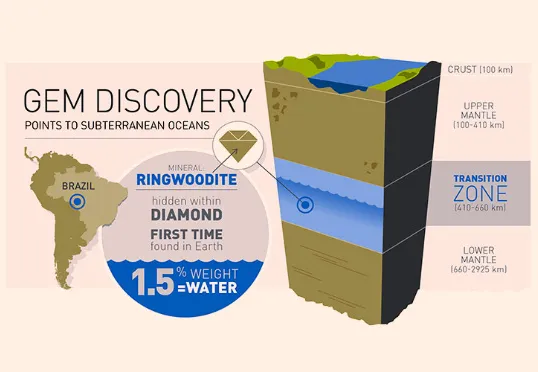
According to the scientific journal Nature, an international team of scientists, led by Graham Pearson of the University of Alberta, has identified the existence of a vast reserve of water trapped in the mineral ringwoodite, situated at a depth of approximately 700 km in the so-called “transition zone” of the Earth’s mantle. This discovery, made through analysis of a diamond extracted from deep volcanic rocks in Brazil, indicates that this zone may contain water in a volume comparable to that of the surface oceans, offering new perspectives on the origin of water on the planet.
The role of ringwoodite in retaining water
Ringwoodite, a mineral that forms exclusively under the high pressures present in the Earth’s mantle, plays a crucial role in this discovery. This rare mineral, endowed with a crystalline structure that allows it to retain water molecules, acts in a way similar to a sponge, absorbing up to 1.5% water by mass. This characteristic allows ringwoodite to accumulate large quantities of water which, owing to the extreme pressures and depths, remain trapped in the solid state or in saturated rocks.
The first sample of ringwoodite was collected by Pearson and his team in 2008, in the Mato Grosso region of Brazil, and the detailed study of that sample took years to be published. The analyses indicate the presence of highly hydrated regions between 410 and 660 km below the Earth’s crust, corroborating the existence of a water storage cycle at depth.
Techniques for identifying the underground "ocean"
To identify the presence of this underground “ocean”, the researchers used seismographs to track the seismic waves generated by more than 500 earthquakes. As they pass through water-enriched zones, these waves slow down, creating seismic anomalies that suggest the presence of highly saturated rocks. This method allowed scientists, including the geophysicist Steve Jacobsen, to map and confirm the existence of an internal water cycle in the Earth, which until then had been only a theoretical hypothesis.
Implications for theories on the origin of water
This discovery challenges the widely accepted theory that the Earth’s water arrived exclusively through comets and meteorites during the period of planetary formation. By contrast, it reinforces the hypothesis that the oceans may have emerged from the planet’s interior, suggesting that surface water would have been gradually expelled through tectonic and volcanic processes over geological ages. This internal water cycle has significant implications for the understanding of plate tectonics and the planet’s internal dynamics, affecting the way we visualise the processes of water recycling in the mantle.
Scientific impact and future prospects
The presence of water at such depths implies the existence of a hitherto unexplored water cycle and raises new possibilities for geological research and for astrobiology. The discovery of a large underground water reservoir opens up prospects not only for understanding the Earth’s internal dynamics, but also for the hypothesis that other celestial bodies with similar characteristics may contain water reserves in their deep layers. This evidence reinforces the idea that water plays a fundamental role in the Earth’s geological dynamics, influencing processes such as volcanism and the movement of tectonic plates, as well as offering new avenues for exploring potential water reservoirs on other planets.
This study, published in reputable sources such as Nature, New Scientist and Earth.com, constitutes a significant advance in the understanding of internal geological processes, challenging and expanding current knowledge about the water cycles and water reserves of our planet.
The study on the "underground ocean" of water trapped in the Earth’s mantle, led by the geologist Graham Pearson and published in the prestigious journal Nature, represents a milestone in knowledge of the planet’s internal composition. Entitled "Hydrous mantle transition zone indicated by ringwoodite included within diamond", the study was published in 2014 (Nature, volume 507, pages 221–224) and can be accessed via the DOI https://www.nature.com/articles/nature13080


