
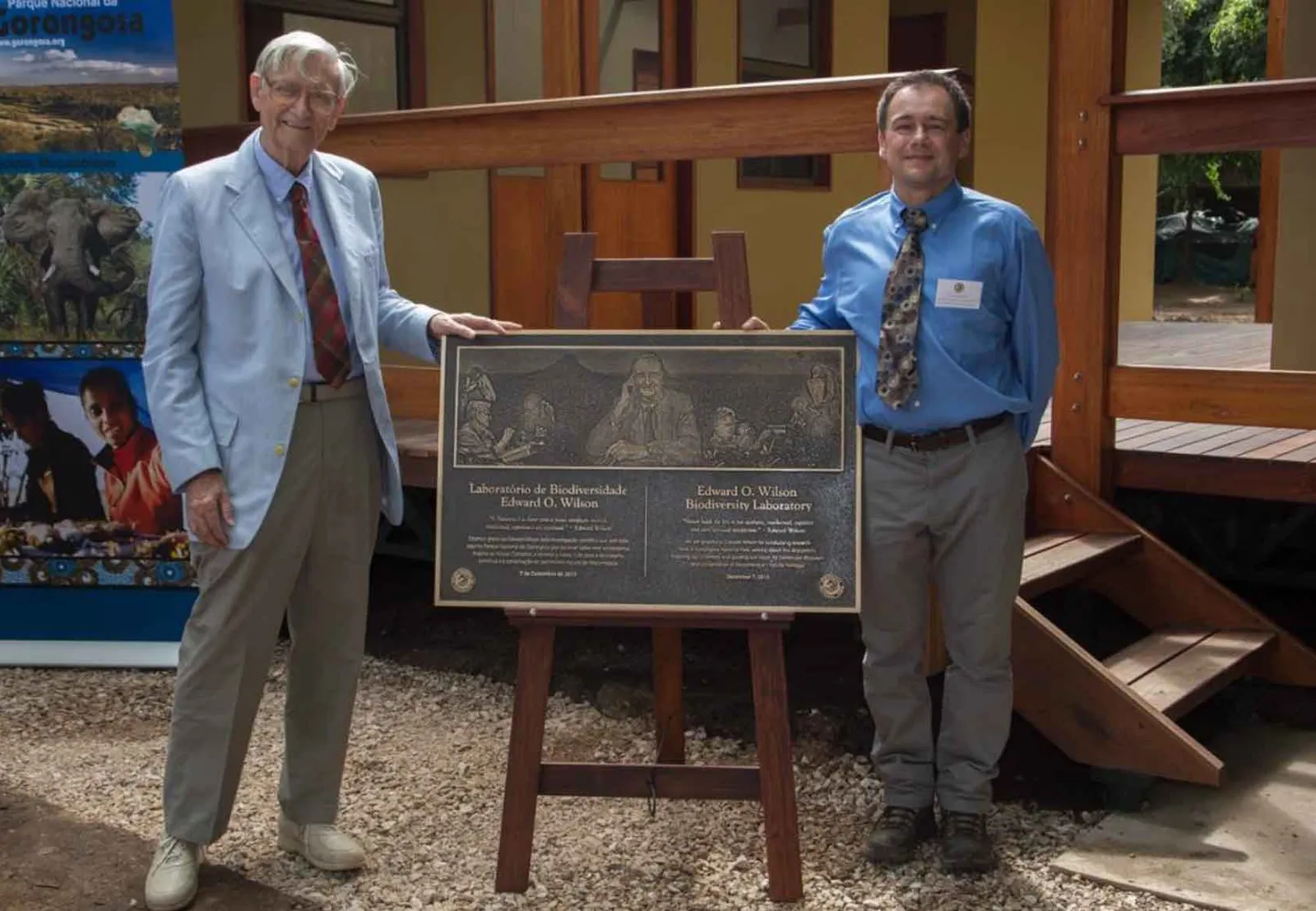
Gorongosa National Park has opened a new chapter in the history of conservation in Mozambique. The E.O. Wilson Biodiversity Laboratory announced on Tuesday a historic change in its leadership: Dr Piotr Naskrecki is stepping down as head of the laboratory, handing the post to Mozambican scientist Dr Jacinto Adriano Mathe, in a transition that symbolises the strengthened commitment to local leadership and to training national professionals.
The decision marks the culmination of a journey that began exactly a decade ago. It was in 2016 that Jacinto Mathe first entered the E.O. Wilson Biodiversity Laboratory as a young associate researcher, with Piotr Naskrecki as his first mentor. Ten years later, he returns to the same space as director, having recently completed his doctorate in Anthropological Biology at the University of Oxford, in the United Kingdom.
An internationally recognised entomologist and conservationist, Piotr Naskrecki will remain connected to Gorongosa as a consultant, while expanding his work in global biodiversity research and conservation initiatives.
During his time leading the laboratory, Naskrecki transformed the institution into one of the most dynamic and productive scientific centres among Africa's national parks. Under his guidance, the laboratory established itself as an international reference in biodiversity research, hosting scientists from several continents and deepening knowledge of Gorongosa's ecosystems — from insects and plants to large mammals.
Among the most significant milestones of his career is the co-founding of the Gorongosa Bioeducation Programme, an initiative considered innovative for combining hands-on scientific training with the capacity building of Mozambican students. The project eventually gave rise to the first master's degree in science carried out entirely within a protected area, placing the Gorongosa academic consortium among the most important global examples in conservation education.
The results accumulated over these years have redefined scientific knowledge about the Park's biodiversity. The laboratory team recorded and mapped more than 8,000 species of animals and plants, in unprecedented work that led to the discovery of more than 100 species new to science and improved international understanding of African tropical ecosystems.
In recognition of his contribution, considered exceptional, Gorongosa decided to name the laboratory's zoology scientific collection the “Naskrecki Collection”.
Jacinto Mathe's rise to the leadership of the laboratory is seen by the Park's management as a symbol of the success of a strategy based on local training. A graduate in Veterinary Medicine from Eduardo Mondlane University in 2017, and a master's graduate in Forensic Anthropology from the University of Coimbra in 2020, Mathe has maintained a continuous connection with Gorongosa since the earliest years of his scientific career.
After his initial stint at the E.O. Wilson Biodiversity Laboratory, in 2017 he joined the team of the Paleo-Primate Project, contributing to the advancement of knowledge about Mozambique's deep evolutionary history.
The Park's management considers that his appointment represents not just an individual achievement, but also the realisation of a conservation model that combines education, science and community development.
“Jacinto embodies the future of conservation in Mozambique,” said Piotr Naskrecki.
“His scientific training, his deep knowledge of Gorongosa and his commitment to the country position him ideally to make a significant contribution to the Laboratory's next chapter.”
Scientific research remains one of the central pillars of Gorongosa's ecological restoration strategy. Inaugurated in March 2014, the E.O. Wilson Biodiversity Laboratory has turned the Park into one of the most advanced research centres in Southern Africa, attracting scientists from more than seventy national and international institutions, including universities in Mozambique, Portugal, the United Kingdom and the United States.
Beyond scientific output, the laboratory maintains a strategic mission of training young Mozambicans from communities neighbouring the Park and from technical schools in the region, providing financial support to students pursuing careers in veterinary science, ecology and laboratory sciences.


