
Butcheca
Written by Mariano Silva
In the late 1970s, a small boy from Machava, Moisés Ernesto Mafuiane by name, was arousing the curiosity of the city's elders. That boy did things other children did not, and his skills, inventiveness and adaptability soon became the talk of the neighbourhoods around Malhangalene. “Bummmm (imitating the sound of an explosion), tcheca lá (´look closely´) at what this kid has done here!” These and similar comments were heard whenever the boy did something different from the rest, further cementing the individuality that already set him apart in the neighbourhood. Inevitably, the name stuck, such was the frequency of the amazement he caused in the community: Butcheca, as he is still known today, although at the time he did not like it: “I would find myself walking down the street and people I didn't even know would say: Look, there goes Butcheca. I didn't like it, but I couldn't stop them from calling me that.”
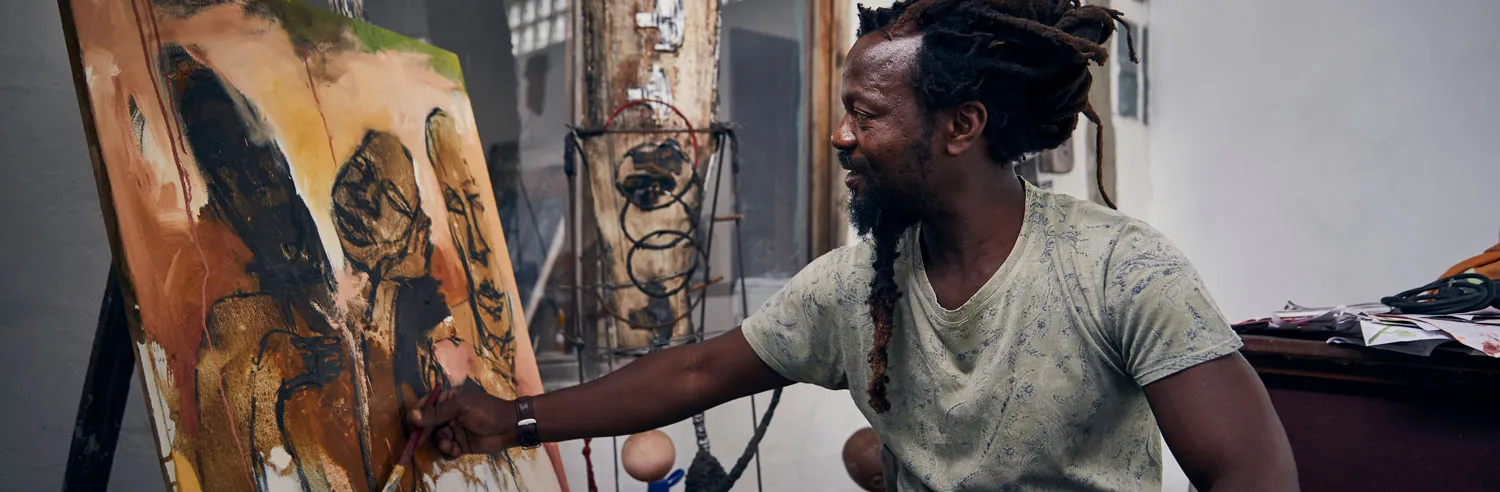
Recently, with 2020 almost at an end, we were received at the studio of the already acclaimed Mozambican artist Butcheca, in Katembe, the space where he produces his paintings and sculptures. Chatting in the yard, we could see that the pandemic had affected his life too, though not in the way one might expect: we noted that, over the past few months, he had taken to growing cabbages, lettuces and other vegetables so as to avoid leaving the house, eventually becoming self-sufficient in these products.
It was a return to memories of the past, when, as a very small boy, he lived in the “countryside”, in Machava-Socimol. At the age of five, he went to live in the city, in the Malhangalhene neighbourhood, at a time when he already showed an interest in expressing himself artistically through clay and charcoal pencil, and in making toys by hand from wire taken from fences that no longer served their purpose. In those days paper was not as readily available as it is to many children today, so, to give wings to his imagination, he would wield his pencil on the bedroom walls to draw, mainly little pigs. He reserved paper only for schoolwork, because he liked to keep his exercise book tidy. “I was very good at drawing little pigs, it was really my thing...”, said Butcheca, with a hearty laugh, describing the precision of line that already characterised him at a tender age.
As a young man, in the early 1990s, he began to take an interest in painting, on seeing works by Mozambican artists in magazines. Malangatana stood out at the time. In 1994, his drawing skills enabled him to work for an advertising company, where he designed and painted advertising billboards. He used the leftover paint for the painting experiments he did at home: “They weren't paints meant for painting canvases, they were enamel and plastic paints, but they served as a rehearsal for what would become my true passion.”
He painted for some time without his pictures ever seeing the light of day, keeping them confined to a corner of his bedroom. In 1996, through another passion, gymnastics, which he shared with the visual artist Kester, the latter came to know his work and encouraged him to enrol at the Núcleo de Arte, where he developed as a painter alongside other renowned artists of the time. His first appearances in exhibitions, still group shows, proved to be a challenge: one in 1997 at UNICEF, followed by another in 1998 at the Núcleo de Arte. “There was a critical movement that was very important for the development of artists. Without criticism, people just paint, and a painting has to be created with everything that the visual arts demand. It wasn't easy for us to hold exhibitions because the criticism was very sharp.”
Since then he has been carrying out research in the field of painting, having created a particular style whose definition, in his view, has not yet found a very clear direction: “My painting fits into surrealism, but then it tries to escape that mould – it is a style of its own, and I am still investigating which field it fits into best. My work is well defined, but not yet well classified.”
We visited the studio where Butcheca keeps some of his works, and there we were able to observe and appreciate the style he had told us about. As one might expect, the conversation turned to the creative process he uses. For him, paintings generally follow a path that is already planned and structured, although sometimes, “I like to paint freely, to have a canvas in a corner, available for me to get dirty, to create textures and things that you don't quite know where they come from. It's good to have a free canvas, to be free.
When you follow a well-defined plan for creating a canvas, the end result can turn out static.” In the series he creates, he generally follows the original ideas in the first canvases, which make up the basis of the theme, but from the fourth or fifth canvas onwards he likes to create freely, to escape rigidity of movement, creating variations on the initial ones. “Whoever sees one of my series will see that the first two or three canvases are closely linked to each other; they are doors that open the way to the rest, where I try to achieve what I couldn't achieve in the base canvases.”
The Mozambican artist reserves the night for finishing his works, when he can detach himself from everything around him. With a small light over the canvas, he isolates himself from the surrounding space, shutting out the visual information that would inevitably influence him when painting during the day. In this way he is able to channel his restlessness into the brush in a more focused manner, ensuring the best final results.
“Between 2000 and 2006, my line often represented everyday life. I wanted to understand the world around me. I depicted the daily struggle of bringing home a living. Nowadays everyday life still appears on my canvases, though in a more disguised and sporadic way. My foundation is movement and gesture. When I watch a contemporary dance performance, I absorb a great deal of the fluidity and dynamism of the bodies on stage.”
“We run the risk of losing the essence of what it is to smell paints and feel the texture of clay. Sooner or later, we will need to take a step back, so that the art of handicraft does not die into oblivion. If we lose the visual arts for ever, it will be as if we had amputated our own senses.”
Currently, Butcheca enjoys experimenting with bulls. The dust that rises between their hooves serves as inspiration for creating the base of his works. His trial drawings often emerge with bull-like lines, in his opinion perhaps also inspired by the star sign under which he was born. These are experiments he always likes to make. Sometimes he travels to nature reserves to observe buffalo. The movement of the horns and the hairs of the muzzle strongly influence the fluidity of the line across the canvas.
As in everything in life, one needs an outlet. Painting is a very absorbing creative process, so it sometimes requires a break to rejuvenate the mind. He turns to sculpture as a sort of “appetiser”, to free himself from painting when it becomes biased and creativity does not trace the path he wants. Wire, clay and, above all, wood channel his inspiration in other directions, which will bring him back to painting in a purified form. These sculptures can be seen at his studio in Katembe, a private collection that he rarely brings to the public.
The visual arts classes he teaches at the French School of Maputo have been a very constructive opportunity. According to the artist, besides teaching, he goes there to learn from the rawest and most
neutral of sources: “Children are very spontaneous when it comes to finishing a canvas, something adults no longer have, as they search so much to arrive at a result. Children finish their canvases with surprising results.”
Still on the subject of experiences, Butcheca shared with us how taking part in the Sukiyaky Meets the World festival in Japan, with the Mozambique Giant Puppets Group, brought him an unexpected outcome. Besides being a unique opportunity to represent our country at a festival of that scale, he was able to present a solo painting exhibition, which was greatly appreciated by the Japanese people. His presence was so inspiring and influential that, on his return, he was given small “Butcheca” dolls, which the students of the puppetry workshops had made at home as a token of gratitude for the exchange of experiences with the Mozambican artist.
Nearing the end of our visit, we talked a little about the world and the versatile way in which today's technology allows artists' work to be disseminated globally, and about the current trend of more and more artists turning exclusively to digital art. Butcheca highlighted what technology can gradually take from us without our realising it: the gift that creation has given us, the power to create with our hands. “We run the risk of losing the essence of what it is to smell paints and feel the texture of clay. Sooner or later, we will need to take a step back, to recover the art of handicraft, so that it does not die into oblivion. If we lose the visual arts for ever, it will be as if we had amputated our own senses.”


