
In a breakthrough that challenges current models of cosmic formation, an international team of astronomers, including Portuguese researchers, has identified a supermassive black hole in the early Universe that is growing at a rate 2.4 times higher than the limit previously considered possible for this type of object. The discovery, announced on Monday, 15 September, suggests that the first billion years of the cosmos were marked by significantly more intense activity than had been assumed.
The study, now published in the journal The Astrophysical Journal Letters, involved three researchers from the Institute of Astrophysics and Space Sciences (IA), among them José Afonso, president of the Portuguese Astronomical Society and a specialist in galaxies. The work focuses on observations of the quasar RACS J0320-35, whose light reaches us from a distance of 12.8 billion light-years, which is equivalent to observing it only 920 million years after the Big Bang.
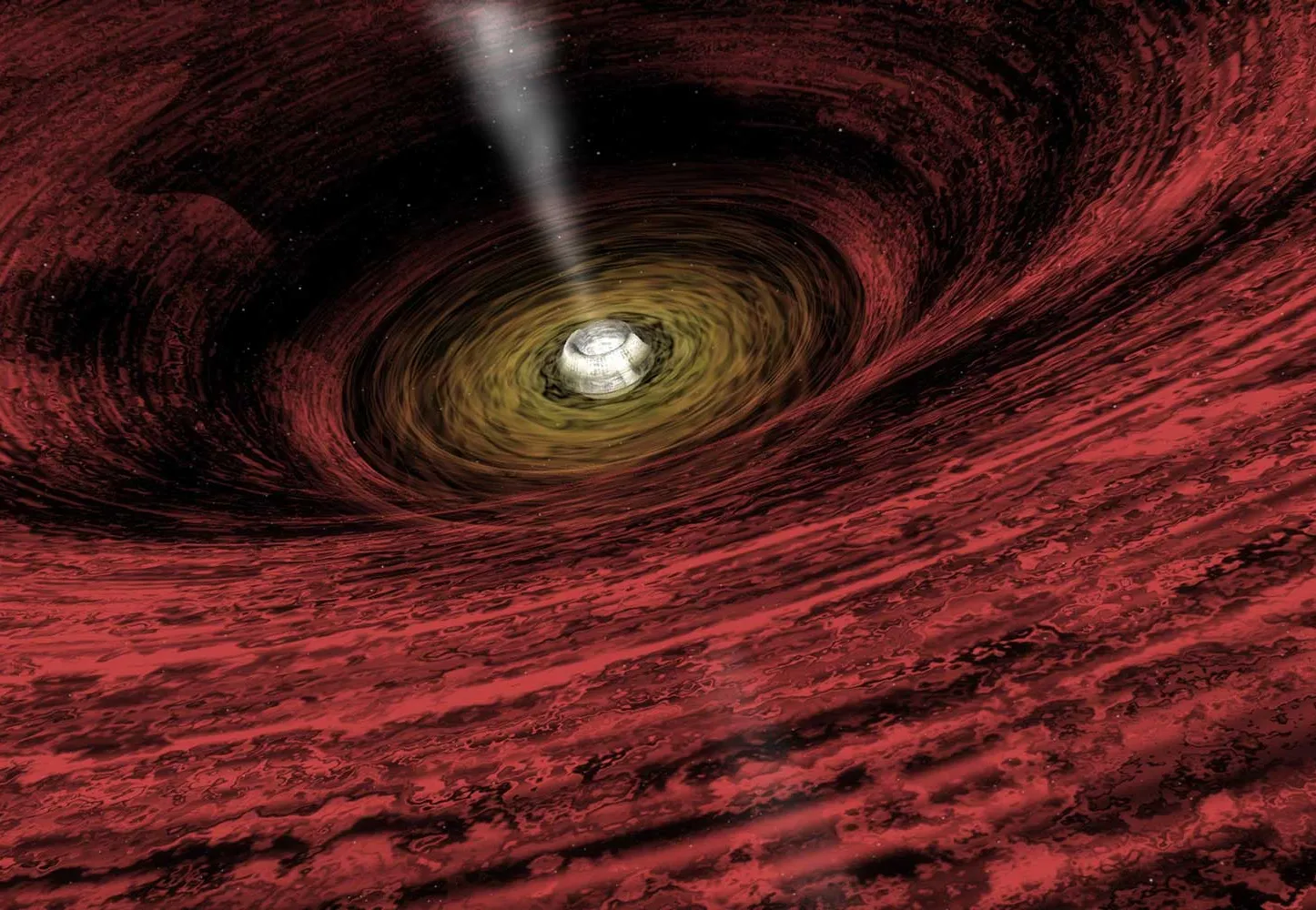
This quasar hosts a supermassive black hole with an estimated mass of about a billion times that of the Sun. It is one of the most extreme objects in the cosmos: an active galactic nucleus that releases enormous amounts of energy as matter spins and heats up around the black hole, emitting X-rays and visible light. The observation was made with the Chandra space telescope, which specialises in X-ray detection.
To measure the black hole’s growth rate — estimated at between 300 and 3,000 solar masses per year — scientists compared the observational data with computer models, identifying a strong match with scenarios that exceed the so-called Eddington limit, the theoretical point beyond which radiation pressure would prevent matter from continuing to fall onto the black hole.
"The first billion years of the Universe are proving increasingly enigmatic. Not only do we keep discovering these gigantic black holes, previously considered impossible, but we are also beginning to realise that even then they had extreme properties", said José Afonso. For the astronomer, these discoveries indicate that "the infancy of the Universe, when the first stars and galaxies appeared, was much more active and complex" than current models predicted.


