
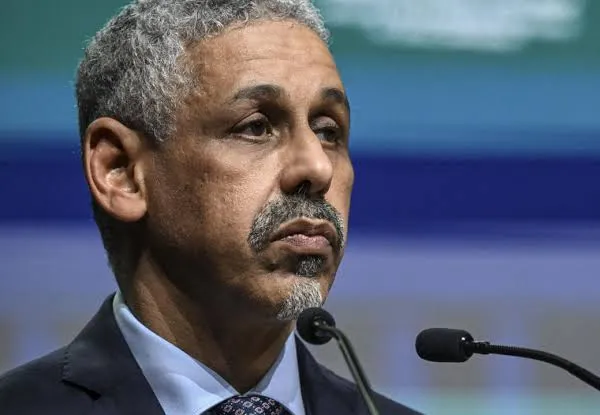
Africa has natural resources, savings and a growing population capable of sustaining an unprecedented economic transformation. Yet it continues to occupy a marginal position in the world economy. It was to break this cycle that the president of the African Development Bank Group (AfDB), Sidi Ould Tah, called in Banjul for a new African financial architecture based on mobilising domestic capital, reducing financial fragmentation and creating value chains that turn raw materials into wealth produced on the continent.
Addressing participants at the Africa Caucus Forum of the International Monetary Fund and the World Bank Group, he argued that the time has come for Africa to stop depending mainly on external financing to meet its development needs. Instead, he said, it is necessary to build mechanisms capable of channelling Africa's own savings into productive investment, de-risking projects, attracting private capital and strengthening the continent's industrial capacity.
The figures presented illustrate the scale of the challenge. Africa is home to about 18% of the world's population, holds more than 30% of known mineral reserves and has more than 60% of the world's uncultivated arable land. Despite this potential, it accounts for only about 3% of international trade and global Gross Domestic Product, revealing a profound mismatch between the resources available and the actual weight of its economy.
The four African paradoxes
In his address, Ould Tah identified four major paradoxes that continue to limit Africa's economic assertion.
The first lies in the discrepancy between the abundance of resources and the continent's limited economic influence. Although it has important demographic, agricultural and mineral assets, Africa remains distant from the main global production and value chains.
The second concerns financing. According to the AfDB president, Africa's structural transformation requires investment of more than 400 billion dollars a year. Even so, the continent has more than 4 trillion dollars spread across African banks, pension funds, insurers and sovereign wealth funds. The problem, he stressed, is not only the availability of capital, but the inability to convert it into long-term financing for strategic sectors such as infrastructure, energy, agriculture, industry and innovation.
The third paradox relates to private investment. Despite the opportunities in areas such as energy, infrastructure, agriculture and critical minerals, Africa attracts only about 6% of the world's foreign direct investment. For Ould Tah, this reality stems mainly from a shortage of financial instruments that reduce investment risk. The African Development Bank estimates that the continent faces a guarantee gap in the order of 50 billion dollars.
The fourth obstacle is economic fragmentation. Although it brings together approximately 1.4 billion inhabitants and an economy of more than 3 trillion dollars, only 16% of African trade takes place between countries on the continent itself. By comparison, this figure is around 60% in Asia and 70% in Europe. In this context, the African Continental Free Trade Area plays, in his view, a decisive role in integrating markets, driving industrialisation and strengthening regional competitiveness.
Financing Africa with African capital
Against this backdrop, the AfDB president presented a strategy structured around four priorities, which he called the "Four Cardinal Points".
The first is mobilising capital on a large scale, drawing simultaneously on domestic savings and international investment. Ould Tah argued that multilateral development banks can no longer limit themselves to direct financing, and should increasingly concentrate on structuring projects, providing guarantees and reducing risk, creating conditions in which every dollar of public investment mobilises multiples in private capital.
The proposal is especially relevant for countries such as Mozambique, where financing needs in sectors such as energy, logistics corridors, agriculture, industrialisation, urban infrastructure, human capital and climate change adaptation far exceed the State's financial capacity. The challenge is to turn national savings, revenue from natural resources and foreign investment into lasting instruments of economic development.
Stronger institutions for a more competitive continent
The second pillar of the strategy focuses on strengthening African financial institutions.
Although there are more than a hundred national and regional institutions dedicated to development finance, Ould Tah considered that their capacity remains insufficient given the continent's needs and the size of the major international financial institutions.
In this context, he highlighted the New African Financial Architecture for Development, framed by the Abidjan Consensus, as an opportunity to strengthen coordination between African institutions, improve the complementarity of their roles and increase their risk-management capacity.
The aim is not to replace international partners, but to build a more robust African financial system, capable of structuring large projects, offering guarantees, financing value chains and reducing the cost of capital for companies and governments.
Youth and SMEs as engines of growth
The third priority focuses on Africa's demographic dividend.
With around 60% of its population under 25, Africa has the youngest population on the planet. For Ould Tah, this reality could become the continent's greatest economic asset or pose a significant risk if it is not accompanied by investment in training, job creation, entrepreneurship and economic inclusion.
The issue is particularly important in Mozambique, where the growth of the young population demands a more diversified economy, less dependent on extractive sectors and capable of generating sustainable opportunities.
In this regard, the AfDB president also highlighted the role of small and medium-sized enterprises, which account for more than 90% of Africa's business landscape. Improving access to credit, productivity, digitalisation and the integration of SMEs into regional value chains will be decisive in turning demographic growth into a genuine engine of development.
Adding value before exporting
The fourth pillar of the strategy is built on industrialisation and the local processing of raw materials.
According to Ould Tah, Africa continues to export raw resources only to then import processed goods at far higher prices. Changing this model requires investment in reliable energy, infrastructure, logistics corridors, technical skills, regional markets and local content policies that allow value to be added within the continent itself.
More than an industrial strategy, he argued, it is a question of economic sovereignty, capable of generating jobs, increasing tax revenue, stimulating innovation and strengthening national economies.
For Mozambique, this vision fits into current discussions on adding local value to natural gas, minerals, agricultural products and marine resources, seeking to turn natural wealth into a more diversified and resilient productive base.
A call for a more ambitious international response
On the international front, the AfDB president called on the International Monetary Fund to provide greater financial flexibility, expand concessional resources and step up the channelling of Special Drawing Rights to African countries.
He argued that the succession of international crises — from the pandemic to the war in Ukraine, by way of tensions in the Strait of Hormuz — has significantly depleted the financial reserves of numerous African states.
To the World Bank Group, he acknowledged the contribution of the International Development Association and highlighted the joint initiatives under way in energy, agriculture and water. He also called for strengthening African insurance and guarantee mechanisms, including the evolution of the African Trade Insurance Agency into an institution of truly continental reach.
Concluding his address, Sidi Ould Tah issued a call for coordinated action among governments, financial institutions, the private sector and international partners. For the president of the African Development Bank, the continent's economic transformation will depend on the collective ability to mobilise capital, integrate markets and convert Africa's abundant resources into shared prosperity.


