
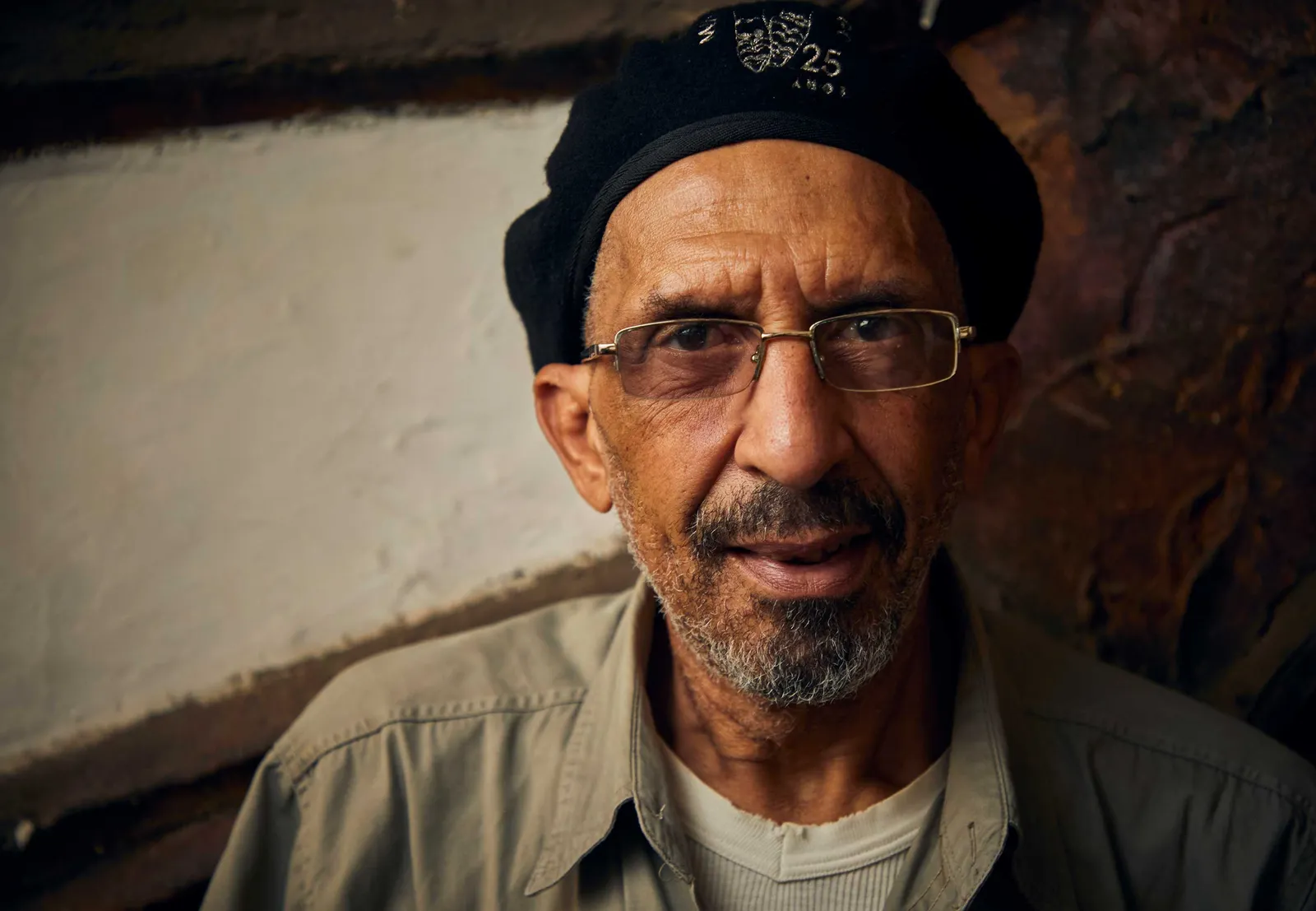
Adelino Branquinho: a man born for the stage
Written by Jaime Álvaro
Between the stage and the cinema screen, Adelino Branquinho, a 62-year-old Mozambican actor, has lived many lives over the course of his career. He has been a king and also a beggar, a feminist and a smuggler, but not once did he take a single character home with him, however much he might have wished to actually live any of the countless lives he portrayed.
He was born in Cabo Delgado, in northern Mozambique, but the theatre anchored him in the nation’s capital and took him out to see the world. The son of a Mozambican mother and a father from Trás-os-Montes, Portugal, he studied Electricity and worked as a refrigeration technician until the day he stepped onto the stage of the Mutumbela Gogo theatre company, at the Teatro Avenida in Maputo. He has never come down from it since, and three decades have passed.
I never studied theatre at an academy. My School, and today my life too, is Mutembela Gogo, which made me the man I am and the professional I have become
Branquinho lives, literally, on the stage, but for almost two years he has been away from it. The covid-19 pandemic stopped the world and he stopped living other people’s lives. He now devotes himself to being himself, without lights, without a stage, without action and without an audience. “We are living through difficult times. The pandemic has affected all of us, and us artists more particularly. I have been resting for a long time and I am eager to return to the stage and have my normal life back. Besides being good for me, it is also good for people. Theatre is very important, for people’s social as well as emotional balance.”
Among the plays he has performed in, Adelino Branquinho highlights Amor Vem, from 1992, an adaptation of a Greek comedy by Aristophanes called Lysistrata. The plot tells the story of an imaginary Athenian woman who led a sex strike. Exhausted by a civil war that dragged on in the country, the women of the cities worst hit by the conflict decided to act. Led by Adelina, the character Branquinho embodied, they resolved to put an end to hostilities using an unorthodox tactic: a sex strike to force a peace treaty. “Theatre is a quick vehicle for reaching people and breaking prejudices, and that play came to break the stereotype that was held (and still is) of women, that they are the weaker sex. Ten or twelve days after we premiered the play, the General Peace Accord was signed in Mozambique. It was a landmark moment for the country’s history and for theatre, a moment that showed the power of theatre in society,” says Branquinho. “Amor Vem categorically foresaw a heroic act aimed at saving the country from war.”
Besides Amor Vem, Branquinho took part in plays such as Governadores do Orvalho, Qual é a Coisa Qual é Ela, Nove Hora, Eu Eduardo Sonhei a Terra, As Mãos dos Pretos, Irmãos de Sangue, Hamlet, Os Meninos de Ninguém, among many others whose characters were memorable. “I like to live the character. To produce a memorable character you have to go deep, live that character in his psyche, live him in his leisure moments. You have to study the character without internalising him, to avoid psychological shocks.”
The occasion made the actor
Adelino Branquinho is a case of chance. He studied electricity and, before his life on the stage, worked as a refrigeration technician until the age of 30. His first contact with a stage, which would become his life, was pure happenstance. “In the course of my trade, I was called to fix a problem with the air conditioning at the Teatro Avenida. Halfway through the job, I received an invitation from Manuela Soeiro, director of Mutumbela Gogo, to go on stage and play the part that was being played by an absent actor. It was a magical moment that changed the course of my life for ever,” reveals the actor, who continues: “I never studied theatre at an academy. My School, and today my life too, is Mutembela Gogo, which made me the man I am and the professional I have become.”
From the cold to the warmth of the stage: such was the life transition of an actor recognised for his body of work and career in national dramaturgy, who promises new revelations in his autobiographical book. “I have played many characters over my career, but I have never had the chance to play a refrigeration technician in a scene. It would be interesting to do so.”
Indeed, there were many characters, of different social conditions, that Branquinho portrayed, but he never became any of them. “It is almost impossible to talk about me without talking about the characters, about the lives I lived on stage. But I have no difficulty defining myself, because never, in my whole career, have I taken a character home.”
Roles in cinema too
Branquinho also shines as a film actor and, as he tells it, the transition “was natural”. The first film he acted in was O Sucessor, by a Norwegian director, in which he played an investigative journalist. From journalist to exploiter of children, in the play Meninos de Ninguém adapted for cinema, he lent his talent to Hollywood with an appearance in Blood Diamond, in which he played a diamond smuggler. In that film, partly shot in Maputo, he shared scenes with the world-famous Leonardo DiCaprio. “Without a doubt it was my greatest experience in the seventh art. It was interesting to act opposite an actor like Leonardo DiCaprio. He is very professional.” More recently, Branquinho took part in “AvóDezanove e o Segredo do Soviético” (2019), by the Mozambican filmmaker João Ribeiro. Despite the cinematic adventure, it is as a stage actor that he defines himself and takes most pleasure: “I trained on the stage, and that is where I feel most at ease, because of the physical contact with the audience. I like to feel the human warmth.”
In the future, which keeps being postponed by the pandemic situation that has plagued the world for two years, Adelino Branquinho intends to focus on a Theatre Academy project, to share his experience and give young people the opportunity he did not have, offering them the tools they need to become professionals. “If a natural talent is combined with specific technical training in theatre, voice technique, diction, directing, body-expression technique to make better use of that talent, it is easier for that individual to become a good actor or good director or playwright,” concludes Branquinho, without staging.


