
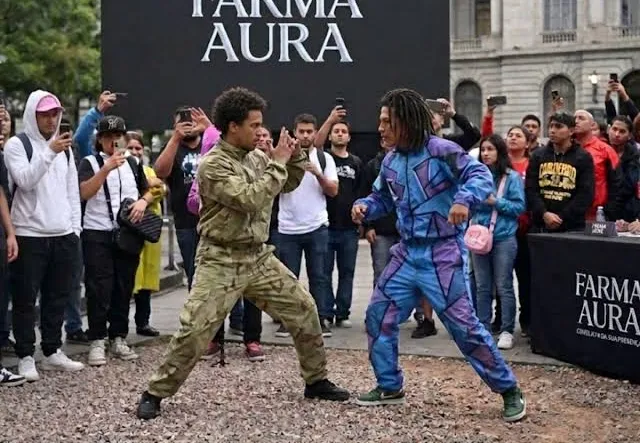
The game that turns charisma and popularity into “points” is spreading among teenagers. Experts warn of the risks of dependence on external approval, social comparison and the impact on self-esteem.
A trend that began as a joke on social media is raising concern among psychologists and experts in youth behaviour. Known as “aura farming”, the practice consists of adopting behaviours regarded as confident, charismatic or “cool” in order to symbolically earn “aura points” in front of others.
The phenomenon has grown mainly among teenagers and young people and has already moved beyond the digital sphere. In several countries so-called aura battles have emerged: face-to-face gatherings in which participants compete through poses, gestures, expressions and references popular on social media, while the audience decides who has shown the most “aura”.
In Mozambique, there is as yet no public record of organised aura battles like those that have mobilised teenagers in other countries. The expression, however, is part of a global trend spread chiefly through TikTok and Instagram, platforms on which new youth slang crosses borders very quickly.
At first glance, it is just a new youth slang. But some experts warn that the game can become problematic when the approval of others begins to influence how young people judge their own worth.
The psychologist Irene Lessman is among the voices raising this concern. According to the specialist, the risk arises when the outcome of a battle, or the perception of having more or less aura, ceases to be understood as mere fun and begins to interfere with self-esteem.
Lessman warns that excessive reliance on this kind of validation can lead young people to associate other people's reactions with their personal worth. In that scenario, winning approval may produce a momentary feeling of confidence, while a negative reaction may provoke frustration, insecurity or a sense of rejection.
The psychologist Diane Marie Rodríguez Zambrano, who analysed the phenomenon from a psychosocial perspective, also identifies risks related to social comparison, the need for recognition and dependence on external validation.
Rodríguez stresses that aura farming is not in itself a mental health problem. For many young people it is just humour, fun and a way of belonging to the group. The concern arises when the pursuit of “aura” begins to shape behaviour, mood, relationships or the way a person sees themselves.
When popularity earns points
One of the features that most attracts experts' attention is the way the trend turns social prestige into a kind of scoring system.
A confident attitude can be worth “plus a thousand aura”. An embarrassing situation can mean “minus five hundred”. An unexpected or impressive gesture can earn “infinite aura”.
The points are imaginary, but the logic behind them is not entirely harmless.
The psychologist Jenny Rojas Rusinque considers that the search for recognition has always existed, especially during adolescence. The difference is that this generation has begun to express it through codes specific to social media and video games.
The fear is that what begins as a game may reinforce a constant need for comparison.
Instead of simply thinking about whether a situation was fun or spontaneous, young people may begin to ask whether they have gained or lost status in front of others.
Pressure to always seem confident
Another point of concern is the pressure to maintain a certain image.
The idea of “having aura” is usually associated with confidence, control, naturalness and indifference to what others think.
But a contradiction can arise.
To seem spontaneous, young people may begin to think constantly about how they walk, speak, dress, react or appear in a video. The attempt to seem naturally confident thus becomes increasingly calculated behaviour.
Jenny Rojas Rusinque warns precisely of the influence that permanent exposure on social media can have on this process. A situation that would once have been seen by only a few people can now be filmed, posted and judged by thousands.
That increases the weight of outside reaction.
The fear of losing aura
Experts also identify a possible effect on how teenagers deal with mistakes and situations of vulnerability.
Stumbling, being rejected, showing nervousness, not knowing how to answer a question or doing something considered embarrassing may come to be associated with the idea of “losing aura”.
Diane Rodríguez considers that, when this logic becomes too important, it can contribute to a fear of making mistakes, difficulty coping with frustration and greater concern about how others judge every behaviour.
The problem, then, is not the expression itself.
It lies in the possibility that young people may begin to avoid natural behaviour for fear of seeming uninteresting, unconfident or “without aura”.
From digital validation to personal validation
The doctor Ramón Ceballo also draws attention to this aspect.
According to the specialist, seeking to seem interesting or admirable is not automatically a problem. The concern begins when this need for recognition becomes essential for the person to feel valued.
When that happens, the absence of the expected reaction can generate anxiety, irritability, frustration or sadness.
Ceballo sums up the risk through a simple but significant shift: no longer asking “who am I?” and instead constantly asking “how am I being perceived?”.
It is a particularly relevant concern for a generation that has grown up surrounded by popularity metrics.
Followers, likes, comments and views have already turned social approval into numbers. Aura farming adds a new layer to that logic.
Now, even traits such as confidence, charisma and presence can be symbolically counted.
A game that deserves attention
Despite the warnings, experts do not argue that aura farming should automatically be seen as something negative.
Aura battles also have positive aspects. They create moments of sociability, creativity, humour and face-to-face participation among young people.
Victor Gabriel Tourinho Camargo considers that these gatherings even help to draw teenagers away from screens and take them to public spaces where they interact with other people.
It is precisely this duality that makes the phenomenon relevant.
Aura farming may remain just a fun language among young people. But when the game begins to determine who deserves approval, who is considered interesting or how much someone thinks they are worth in the eyes of others, it ceases to be merely a meme.
It is at that point that psychologists begin to show concern.


