
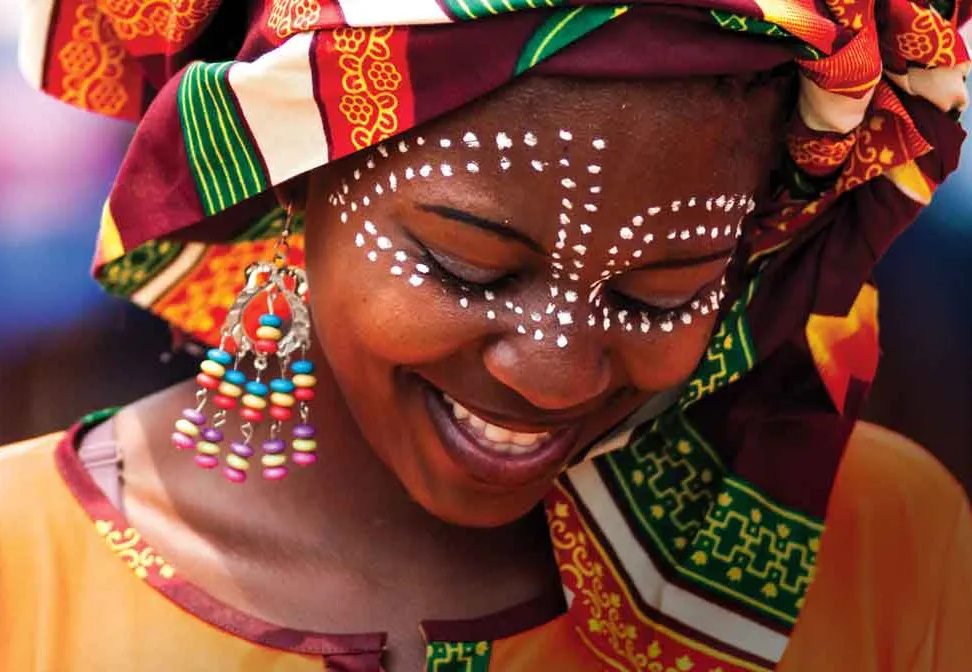
The reader probably knows little or nothing about the photo of the woman with her face painted in the Makua style, a capulana headscarf and a lovely, shy smile, which is widely used, especially on occasions celebrating women, in Mozambique and in other corners of the world. In fact, this image, which very quickly became a reference for the Mozambican woman and is known to everyone, became popular without any indication of who took it or who the woman photographed was. Today Xonguila brings you its story, revealed by the photographer himself, who for the first time is being credited for his work.
The photo is the work of Moisés Oliveira, a 37-year-old Brazilian copywriter and photographer. He was born into a humble family in the east of São Paulo, in the Jardim Sinhá favela. His childhood was, moreover, a hard one, spent on the outskirts, between the Zilah Spósito favela in Minas Gerais and the Da Baronesa favela in Belo Horizonte. He graduated in Advertising and Marketing and specialised in Creative Writing. In 2009, aged just 23, he ventured to Maputo, accompanied by a friend who encouraged him, to work as a copywriter at the agency DDB Moçambique. The contract was short, only one year, but he ended up falling in love with the country and lived here for five years. Coming to Africa meant the start of a new life and a dream professional trajectory. He is married (he met his wife in Mozambique, in fact) and has two children. He currently lives in Portugal, but dreams of getting to know Japan one day, and his favourite book is the Bible. “My experience in Maputo was fabulous. I was very young when I arrived. I was only 23. But even so, I managed to make the most of that experience and get to know a different culture, a different people, with different customs. For me, it was one of the best experiences of my life and I miss that time immensely.”
Despite the challenges he had to face, Moisés says he was made very welcome in Mozambique and that the simplicity and joy of the Mozambican people, even in the face of difficulties, made it easier for him to adapt and, because of that, he always felt at home. He acknowledges the role his friends played in his adaptation: “After Vasco Rocha, the Director of DDB, I had a colleague there, our great friend Azagaia, who sadly passed away. But he was someone who helped me enormously in that adaptation, especially with the Portuguese language in Mozambique. Because as well as being a musician, he was also a copywriter at the same company. He would look at my texts, give me tips, and helped me write in a way that came closer to Mozambican speech.”
The cherry on top of the cake
That is how Moisés describes his time at one of the largest advertising agencies in Mozambique: “In my seven years working in advertising agencies, DDB was truly the cherry on top of the cake. Because it was where I really managed to build more consistent work on a solid footing.” Moisés joined DDB Moçambique as a senior copywriter and, shortly afterwards, began acting as creative supervisor, before being promoted to Creative Director of the company, a post he held until he left the company in 2014. “It was a wonderful experience, even more so because I was extremely young, only 26, and I managed a team of almost 20 creatives. This experience added a great deal of value to my profession. We won a great many awards,” he added. Under his command, DDB was honoured at several international festivals, notably with an honourable mention at the world's biggest advertising awards, the Cannes festival.
In 2014, Moisés travelled to Portugal, where he runs his own digital communications studio. “Before beginning my entrepreneurial journey, my own business, DDB Moçambique was a great school; it had more than 60 employees. I have great affection and respect for Vasco Rocha, who gave me this great opportunity, who brought me to Mozambique and helped me in everything I needed to adapt there in that country. So DDB has a very special place in my heart. Of all the value I gained during my career in this profession as an agency advertiser, DDB was responsible for most of it, for sure,” he stressed.
It was at DDB that the copywriter developed his photography skills. From an amateur, he became a professional photographer. “Photography did not transform only my professional life, it transformed my life as a whole, because since I was a child I liked watching people who had a camera in their hands; I did not have the chance to have one so early, but I liked seeing people with that device taking photos, and I liked looking at photographs too,” explained the documentary and photojournalistic photographer. During his stay in Mozambique, Moisés travelled through several provinces in all three regions of the country, where he captured many images of everyday life. Images of events of every kind, images of artists, of politicians, images of professionals from a range of fields, street images, images of anything, of any scene and even of strangers. And, curiously, his most famous masterpiece is of an unknown woman whom he calls his muse and whom he blessed with the title “Mozambican Woman”. But where, how and when was the photograph taken?
Reconstructing the scene
Moisés is one of those photographers who never leaves home without his camera in his rucksack. And he never comes home without new images. He tries to make the most of every opportunity that arises to freeze a moment for posterity. It was with this ingrained spirit that he managed to take a photo which, after being published for the first time on a blog, went viral on the internet, becoming a symbol of 7 April, Mozambican Women's Day.
The photograph entitled “Mozambican Woman” was taken exactly 12 years ago. “On that day, 19 October 2011, they were unveiling the statue of Samora Machel in front of the Maputo Municipal Council, and figures such as Graça Machel and the then president, Armando Guebuza, would be present. I needed to go there and photograph something. I wanted to document that occasion and, who knows, get some good pictures of the President.” Moisés got much more than a good picture; Moisés managed to capture a story, a unique moment that marked his professional life for ever. “That day, I spotted a dance group of women who were there, among other groups, to adorn that special moment, dressed in orange tones, and I decided to photograph them. They saw me and became subtly shy, but smiling. I did not take more than 20 photographs of that group, but one of them marked this day for ever. Not even the photographs of Guebuza or Graça Machel, which I also managed to take, made me as happy as seeing that portrait, of that lady with the capulana on her head, the paint around her eyes and a gentle smile on her face,” he described. For Moisés, the photo “Mozambican Woman” represents an effort to draw closer to the Mozambican people, for whom he feels a special fondness. “That photograph, for me, remained marked as an image that gave me a passport, that closeness with the culture, that friendship with the Mozambican people.”
“The worst thing about this improper use for commercial and advertising purposes is not for me, it is for her, because it is her image that is being used, and she truly deserved to be paid for that use. Any gain there might have been was for her and not for me.” - Moisés Oliveira, photographer
Fame without credit
The Brazilian photographer claims authorship of the photo that spread rapidly across the internet and, mysteriously, became a reference, an image representative of the Mozambican woman. “It is a photograph that got away from me; it spread across the internet very quickly and I never again managed to have any kind of control over it. I did not try to control it either; I let the image wander off.” Moisés says he has never received credit for the photo, which today is widely used for various purposes, including advertising, without any authorisation and without any compensation, thereby deliberately infringing copyright. “I have seen a painting of a woman on a mural in Namaacha inspired by this photo. That made me even happier, more honoured and proud than the many shares on the internet; the use of the image in advertising did not make me so happy.” Moisés laments and condemns the improper use of the image, especially on commemorative dates associated with women, such as 7 April, Mozambican Women's Day, and 8 March, International Women's Day. “I never authorised the commercial use of this image, not least because I do not even have the permission of the person in the photograph herself. So I never sold this photograph, and I never received absolutely any payment for its commercial use. Everyone who has used it commercially has used it improperly.”
Moisés does not expect any compensation for the photograph. But he hopes that this article will reach the “Mozambican Woman” and serve as a tool for her to claim her rights over the use of her image for commercial and advertising purposes. “The worst thing about this improper use for commercial and advertising purposes is not for me, it is for her, because it is her image that is being used, and she truly deserved to be paid for that use. Any gain there might have been was for her and not for me.”
Even though he knows absolutely nothing about that woman, who became his muse, Moisés dreams of a possible reunion.


