
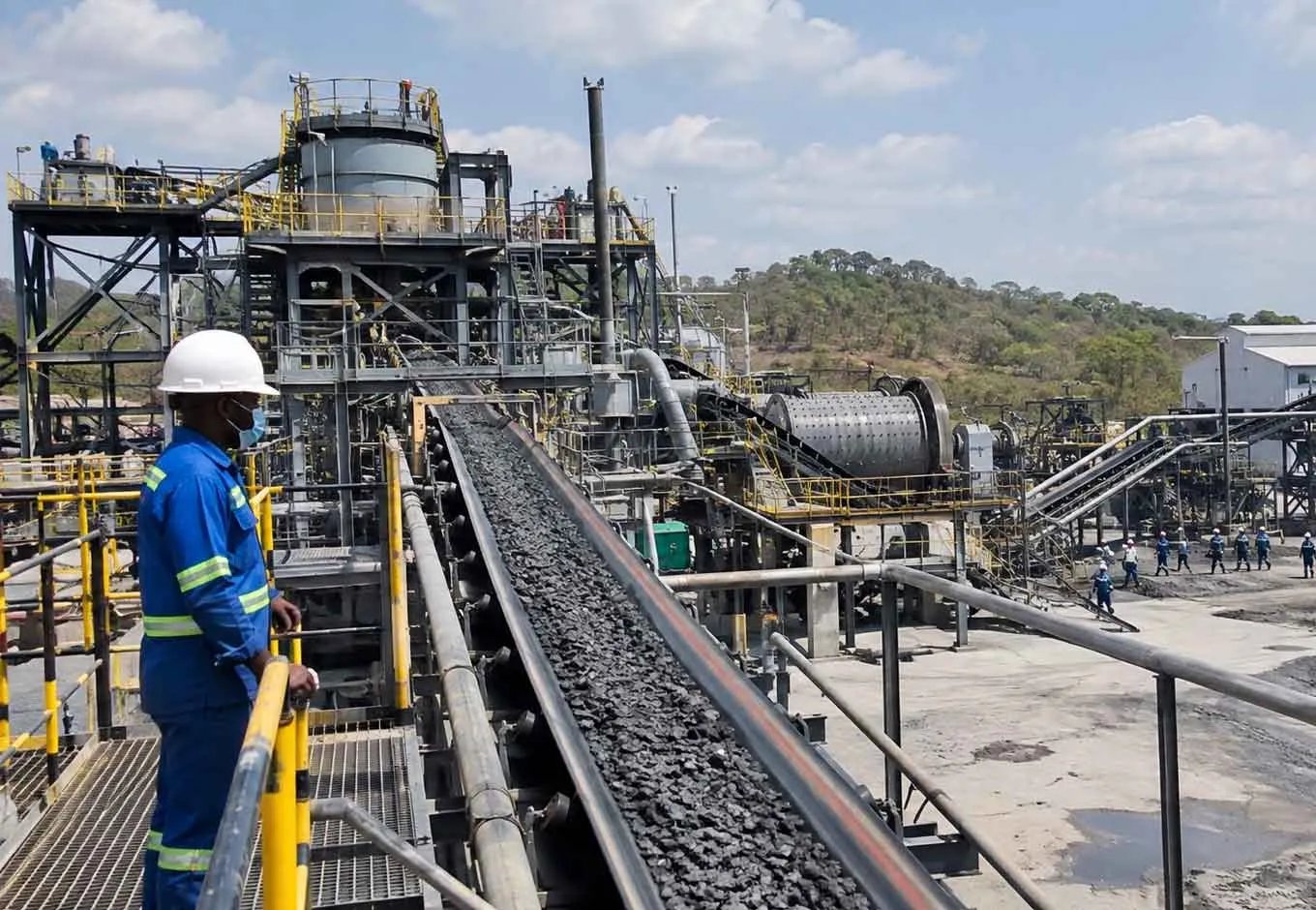
Artificial intelligence may be made of code, algorithms and computing power, but the race to dominate the new world economy is revealing a far older and deeply physical dependence: minerals.
Behind the thousands of servers installed in the big data centres lie power grids, cables, batteries, storage systems and industrial equipment that need copper, graphite, lithium, rare earths, tungsten and antimony.
It is this link between the digital and the subsoil that is turning so-called critical minerals into one of the strategic pieces of the world economy.
Goldman Sachs identifies three forces converging on these resources: electrification, growth in energy demand driven by artificial intelligence, and growing concern over the security of supply chains.
Andrew Timbers, co-head of the bank's Americas metals and mining business, sums up this convergence by saying that critical minerals now sit at the meeting point of electrification, AI-related energy demand and supply-chain security.
The change is not merely technological. It is economic and geopolitical.
Control of a deposit remains important, but it begins to be worth less when separated from the other stages needed to turn ore into a product used by industry. Processing, refining, energy, technology, logistics and manufacturing capacity are gaining a weight similar to that of extraction itself.
Artificial intelligence meets copper
One of the clearest examples is copper.
The more computing capacity the world installs, the greater the need for electricity to power the equipment. That energy has to be produced, transported and distributed, putting additional pressure on existing power grids.
According to Goldman Sachs, a single gigawatt-scale data centre can require up to 50,000 metric tonnes of copper for wiring and grid reinforcement.
The scale helps reveal what is often hidden in the narrative about artificial intelligence: growth in digital capacity also implies an enormous expansion of physical infrastructure.
The problem is that the two worlds move at different speeds.
A data centre can be developed in a relatively short time. Bringing a new copper mine into production is a far longer process. According to Goldman Sachs, 15 years or more can pass between discovery and the start of production.
Demand can thus move much faster than the capacity to create new supply.
This difference helps explain why already-developed mineral assets are becoming particularly important and why mergers and acquisitions are gaining relevance in a market where waiting for a new mine can mean waiting more than a decade.
The real power lies after extraction
Geology, however, tells only part of the story.
For a long time, the dominant model allowed a country to extract the resource and export the concentrate, leaving processing, refining and manufacturing to other economies.
The new race is challenging that model.
In rare earths, Goldman Sachs points to a logic known as “mine-to-magnet”. Instead of controlling extraction alone, the aim is to integrate separation, metal-making and the manufacture of the magnets used in vehicles, industrial equipment, advanced technologies and defence systems.
This integration makes it possible to secure supply, reduce external dependencies and capture a larger share of the economic value.
It is also here that one sees why having abundant reserves does not necessarily mean dominating a market.
A country able to process and transform minerals extracted in other territories can occupy a more powerful position in the chain than some of the producing economies themselves.
China built power where raw material gains value
China has become the leading example of this strategy.
Chinese strength does not stem only from the availability of mineral resources. Over decades, the country has developed extensive smelting, processing, refining and manufacturing capacity.
Data from the International Energy Agency (IEA) cited in the reference material show the scale of this concentration.
Excluding rare earths, the average share of the top refining country in the major mineral markets reached 72% in 2025, after standing at 70% in 2023.
In copper, the transformation has been particularly profound.
Since 2005, China has accounted for more than 90% of global growth in smelting capacity, raising its share of global capacity from approximately 15% to around 50% in 2025.
It is, therefore, in the middle of the chain that a decisive part of the power has been built.
Having several mines scattered around the world does not eliminate a vulnerability if the extracted product still depends on a few countries to reach the form that industry requires.
When a small amount of mineral conditions billions
The strategic dimension of this dependence has become more visible with export controls.
According to the IEA, the number of tariff codes for minerals covered by Chinese export controls has tripled since 2023.
In rare earths, full enforcement of the restrictions could put at risk up to US$6.5 trillion a year of downstream production outside China, involving sectors ranging from the car industry to high technology, energy and defence.
In graphite for batteries, a complete interruption of trade could affect more than US$300 billion of annual production outside the Chinese market.
It is here that the concept of a critical mineral takes on its true dimension.
The commercial value of a given quantity of mineral may be small compared with the value of the factories, equipment and economic activities that depend on that material to keep operating.
Criticality does not stem only from scarcity. It also stems from dependence.
Governments go from referees to participants
The international response is also changing the role of the State.
Governments that traditionally concentrated on licensing, regulating and taxing mining projects are beginning to use financial instruments to secure the development of resources considered strategic.
In the United States, according to Goldman Sachs, this intervention includes equity stakes, hybrid capital, low-cost credit, strategic reserves and mechanisms designed to reduce the risk associated with projects.
The reason lies in the nature of mining.
These are investments that can require enormous amounts of capital, face high risks and take years to begin generating output.
When the market considers a project too risky, but the State judges the mineral to be fundamental to economic security, public support can improve financing conditions and make it easier for banks and institutional investors to come in.
Mining thus begins to move closer to areas traditionally treated as strategic, among them energy, defence and infrastructure.
Even geography begins to define financing
The consequence is that the location of a mineral deposit comes to influence not only logistics but also the money needed to develop it.
Investors continue to look at ore grade, production costs and the outlook for international prices. But political stability, sector rules, government support, available infrastructure, offtake contracts and the country's position in international economic alliances are also gaining weight.
According to Goldman Sachs, location and geopolitical alignment have become increasingly relevant factors in capital allocation.
Thus, two deposits with similar geological characteristics can end up valued differently simply because they sit in different political, economic and logistical environments.
Africa faces the paradox of abundance
It is on this new economic map that Africa occupies a position that is at once powerful and vulnerable.
The continent has a significant presence in the world supply of several critical minerals.
According to the IEA, Africa supplies approximately 75% of the world's manganese, 70% of its cobalt and almost 20% of its copper.
Yet it accounts for less than 1% of the value produced in the manufacture of the main clean-energy technologies.
The contrast is enormous.
The continent supplies a substantial part of the materials that feed the world's technological transformation, but a much smaller share of the industrial value created after those resources leave the mines.
Refining, component manufacturing, production and technological integration remain largely outside the producing economies.
The new mineral race therefore raises a different question for Africa: not just how to increase production, but how to prevent growing world demand from reproducing the old model of exporting resources and importing higher-value products.
Processing in Africa takes more than a law
Some African countries are already seeking to change this relationship through restrictions on exports of unprocessed minerals, local beneficiation requirements and greater state participation.
The intention is to retain within national economies a larger share of the value created by the resources.
But transforming ore locally takes far more than obliging companies to do so.
It requires reliable electricity, roads, railways, ports, financing, technology, engineers, skilled technicians and buyers for the resulting products.
Without these conditions, a restriction on exporting raw material can reduce the attractiveness of a project without automatically creating a new industry.
The debate on critical minerals thus becomes a debate on industrial policy.
Graphite puts Mozambique in the contest
For Mozambique, this global transformation has a particular significance.
The country is currently the world's third-largest producer of graphite, a raw material fundamental to batteries and energy storage.
The new mining legislation promulgated in June introduced changes that point precisely to an attempt to increase national participation in the value produced by the sector.
The new framework sets a minimum state stake of 15%, free and non-dilutable, in mining projects, while also establishing local processing requirements and restricting exports of unprocessed or semi-processed products, except with specific authorisation.
The question now is how far this change can take the Mozambican economy.
Extracting graphite is one stage. Processing it adds another layer of value. Producing the specialised materials used in anodes, cells and batteries would place the country in much more advanced industrial segments.
It is precisely between these stages that it is decided how much of the mineral wealth remains within the economy.
Nipepe begins to test the new path
One of the signs of this transition appeared in Nipepe, in Niassa province.
Earlier this year, Mozambique inaugurated a Chinese graphite processing plant with an annual capacity of 200,000 tonnes.
DH Mining's investment in the mining and processing complex was estimated at US$200 million.
At the time, the operation employed 890 workers, with forecasts of reaching around 2,000 jobs in a second phase.
President Daniel Chapo presented the project as part of the ambition to move Mozambique from being a raw-material supplier to a producer and processor.
The project shows a first possibility of moving within the value chain.
But it also shows how far there is still to go.
Processing graphite is not the same as manufacturing anode materials. Manufacturing anode materials is not the same as producing cells. And producing cells is not the same as controlling a battery industry.
Each stage requires new investment, technology, skills, energy and markets.
Local content takes on another dimension
In this scenario, the very concept of local content needs to go beyond counting jobs or contracts awarded to national suppliers.
Those indicators remain important, but they do not show the full economic transformation that is possible.
The question becomes: how much value stays in the country after the mineral leaves the ground?
Training of technicians, engineering services, industrial maintenance, logistics, financing, research, energy supply, processing and manufacturing become elements of a chain that can create companies and skills well beyond the life of a mine.
That may be the difference between an economy that simply exports minerals and one that uses the resources to build an industrial base.
Mozambique's window will not be permanent
International demand currently creates an opportunity, but the picture will not necessarily stand still.
Other producers are developing new projects. Future technologies may reduce or change the need for certain materials. Recycling is also expected to supply a growing share of the minerals used by the world economy.
The IEA forecasts that the contribution of recycled minerals could almost double by 2040.
For Mozambique, this means that the current strategic value of graphite and other resources should also be analysed as a time window.
The long-term goal will not be simply to increase the tonnes extracted, but to convert the current mineral cycle into economic assets that outlast the mines themselves: energy, infrastructure, companies, skilled workers, knowledge and industrial capacity.
It is here that the artificial intelligence revolution meets a very concrete challenge for countries rich in natural resources.
While the world debates algorithms, chips and computing power, a silent part of the contest is taking place underground and in the factories that transform what is taken from it.
For Mozambique, the opportunity does not lie simply in having graphite.
It lies in deciding how far, on the long journey from mine to technology, the national economy will manage to accompany the mineral.


