
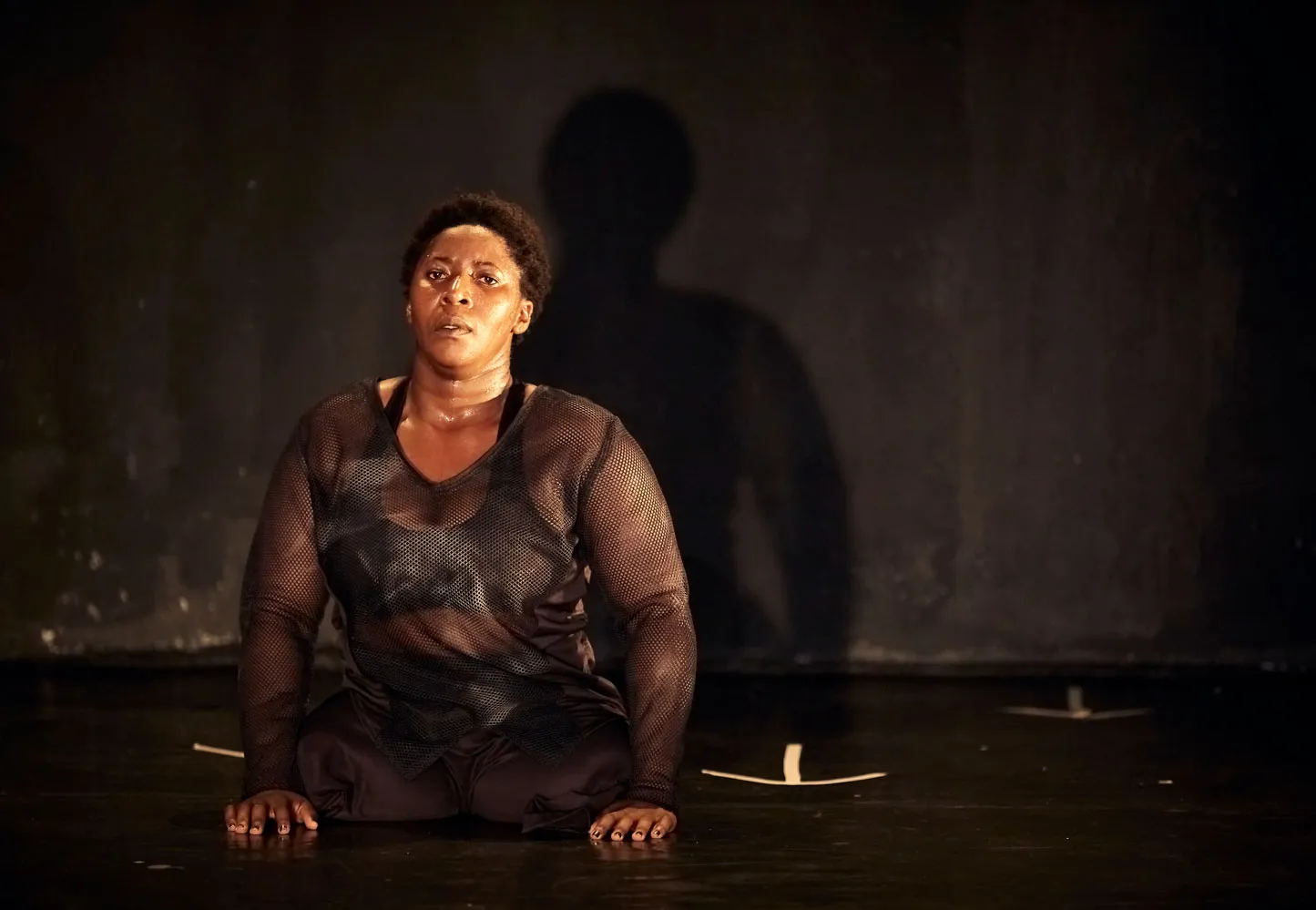
A tragic accident at the age of eight left Mariana Tembe without her lower limbs; resilient, she learnt from an early age to live with the misfortune. In 2006, she defied the usual logic by deciding to train in dance. But… how does one dance without legs? Mariana, a dancer for 16 years, explained it to Xonguila from Madeira, Portugal.
Was Mariana reborn with the accident that ended in the amputation of her legs? This was our starting point for the virtual interview with this 34-year-old artist, born and raised in Maputo. "I would not say I was reborn with the accident, but rather that I discovered myself. The Mariana of before still exists in me, but after the accident the real Mariana was revealed: strong, determined, fearless and a fighter. The accident awakened what already existed," she replied. "Life sometimes drags us down paths full of thorns just to test us and let us know how strong we are," she said.
To understand this statement, we need to go back in time. Three years ago (in 2019), Mariana received an invitation to join the Dançando com a Diferença (Dancing with Difference) Company, during a performance at a dance festival in Switzerland. "Before accepting the offer, they told me to go and see Madeira to assess accessibility. When I got there, I was shocked, because the level of accessibility is zero per cent. It is not accessible, especially for those who use a wheelchair. There are lots of ups and downs, and the slopes are truly murderous," she said.
Mariana was willing to do anything to grow professionally and did not want to waste the opportunity to see the world and learn new things, so she said yes to the invitation from the Company’s artistic director, Henrique Amoedo. "Life is made of challenges and once again I had a challenge. I looked at the bright side – professionally I was going to grow, it was going to be very good for me to leave my roots, try to break into the world and learn new things – and it was a good opportunity to leave daddy’s wing," she said, laughing. "The Company created conditions for me to have as much comfort as they could possibly offer me," she continued. Founded 22 years ago with the aim of promoting social and cultural inclusion through dance, the Dançando com a Diferença Company has around a hundred members, both young people and adults.
This is a success story that most people would wish to have lived. But there were struggles, tears and sacrifices before Mariana reached where she is today. It is a story we deliberately bring to you in this special month for women, April, to pay tribute to Mozambican women, and in particular the thousands of “Marianas”, from Zumbo to the Indian Ocean, from the north to the south of the country, who never give up on their dreams, even after being struck by life’s adverse circumstances.
The unexpected encounter with dance
Completely unlike many artists who came into contact with the art they live by at a tender age, that was not what happened with Mariana. Her first encounter with contemporary dance came when she was already older. In truth, it was not she who chose dance; it was dance that chose her.
Mariana suffered a tragic accident at the age of eight, while playing in the street outside her home with other children. She was run over by a military lorry, and her lower limbs were amputated because of the severity of her injuries. Even so, her childhood was not as difficult as one might imagine at first sight. "Even after I had the accident, my childhood was super calm and a lot of fun, alongside people who always supported me, my family. I always had love and affection from my parents and siblings." As for dance, it was pure chance, a work of destiny. “In my dreams I never wanted to become a professional contemporary dancer. I came to dance late, in 2006, at the invitation of a friend, until then a stranger, who told me about a dance inclusion project for people with disabilities,” she said, stressing that it had not been love at first sight. “I was not very interested at first. But she insisted that I should go and watch the rehearsals and, if I liked it, I could stay; if not, I should go on with my life.” After a few days mulling it over, Mariana decided to learn dance and likewise learnt to overcome her limits.
She was 18, which meant she was already responsible for her actions, including deciding whether or not to “date” what ended up redefining her life completely. “Although I was not thrilled by dance on my first real contact with it, I kept going to watch people with mobility limitations like me dancing.” And because life’s most valuable things take their time... "As I kept watching the rehearsals, I ended up falling in love and ended up enjoying it. Today I cannot breathe without dance,” she confessed. It was difficult at first, but the union was already written. Mariana would be a professional dancer without lower limbs.
The project to include people with and without disabilities in the cultural field that redefined Mariana’s life was led by Panaibra Gabriel Canda, a Mozambican choreographer and artistic director who founded the CulturArte company. “When people talk about dance, they immediately think of legs. But dance is not only legs, it is not only arms, back, head. Dance is the body, the whole body,” Mariana clarified. “I do not consider myself a miracle for dancing without legs. That is the result of a very big challenge that I faced with all my strength. There were years of training, dedication and a great deal of sacrifice to break limitations. I wanted to do it, hurting or not, I wanted to break taboos.” She says her arms have become her legs, that she no longer knows what it feels like to have legs. “I do not miss my legs because I learnt to do everything with my arms. My arms are my legs. My arms do more things than legs. When I dance, people do not even miss my legs. People see a perfect creature there, dancing just as she is,” said our dancer, who is flourishing in Portuguese lands.
The (late) stage debut
Mariana trained in contemporary dance adapted for people with disabilities between 2006 and 2008 and made her stage debut before an audience a decade and a half ago, more precisely 16 years ago. She was 18.
“After my first performance on stage, I never stopped. In fact, it was in that performance that, when we finished the show, I felt all those people applauding and was astonished, jaw dropped, and told myself that this was what I wanted to do with my life. I want to make people stand up and give me an ovation,” she revealed. “At that moment I decided, this was what I wanted to do. I did not want to do something that people would pity. I do not want people to look at me and feel sorry for me. That is what people generally do when they see a person with a disability in the street. They feel sorry or speak ill, whisper behind their backs. They speak ill because unfortunately there are many people with disabilities in the street in need, begging,” she lamented. “I have always seen begging as something terrible that can happen in a human being’s life and I promised myself that I would not let life drag me onto the street to live with an outstretched hand.”
A fight was needed to have something different, which came from the unexpected, the unpredictable, given her physical condition. She calls it the miracle of life. “When I discovered dance, I said: this is my passion, I want to do this, I want to live from this. Dance to me represents... I do not know how to explain it, I do not know what words to use, but dance is as if it were...” – this is how Mariana showed the difficulty she has in putting into words the feeling she has for dance. “When I dance, I feel free, I feel I am in a magical moment, a moment that never repeats itself, and when I am dancing on stage, I am not the Mariana everyone knows, I am simply a body sharing with the world life’s experiences, reflections, thoughts and feelings. That is a unique moment and I have no limits. It is the only moment in which I feel I am in an unusual, inaccessible place that I managed to reach, and it is an incredible feeling,” she stressed. “One of the things that motivates me to keep dancing is that, after all my performances, I see people crying with emotion. With dance I can touch people’s hearts, their souls. People look at me and believe that life did not stop there. It is this magic that motivates me and makes me get up every day.”
Mariana, who is proud to light up people’s lives, intends to dance until she can no longer, and wants to combine dance with a degree in Educational Psychology focused on people with special educational needs, she tells us, thus revealing her more sensitive and humanist side. "I was forced to interrupt the course while still in Mozambique, because of financial difficulties. In fact, that has always moved me. I want to know how to communicate with these people, how to deal with them, how to understand their concerns, their thoughts. After all, they are like us, they have feelings, they have dreams."


