
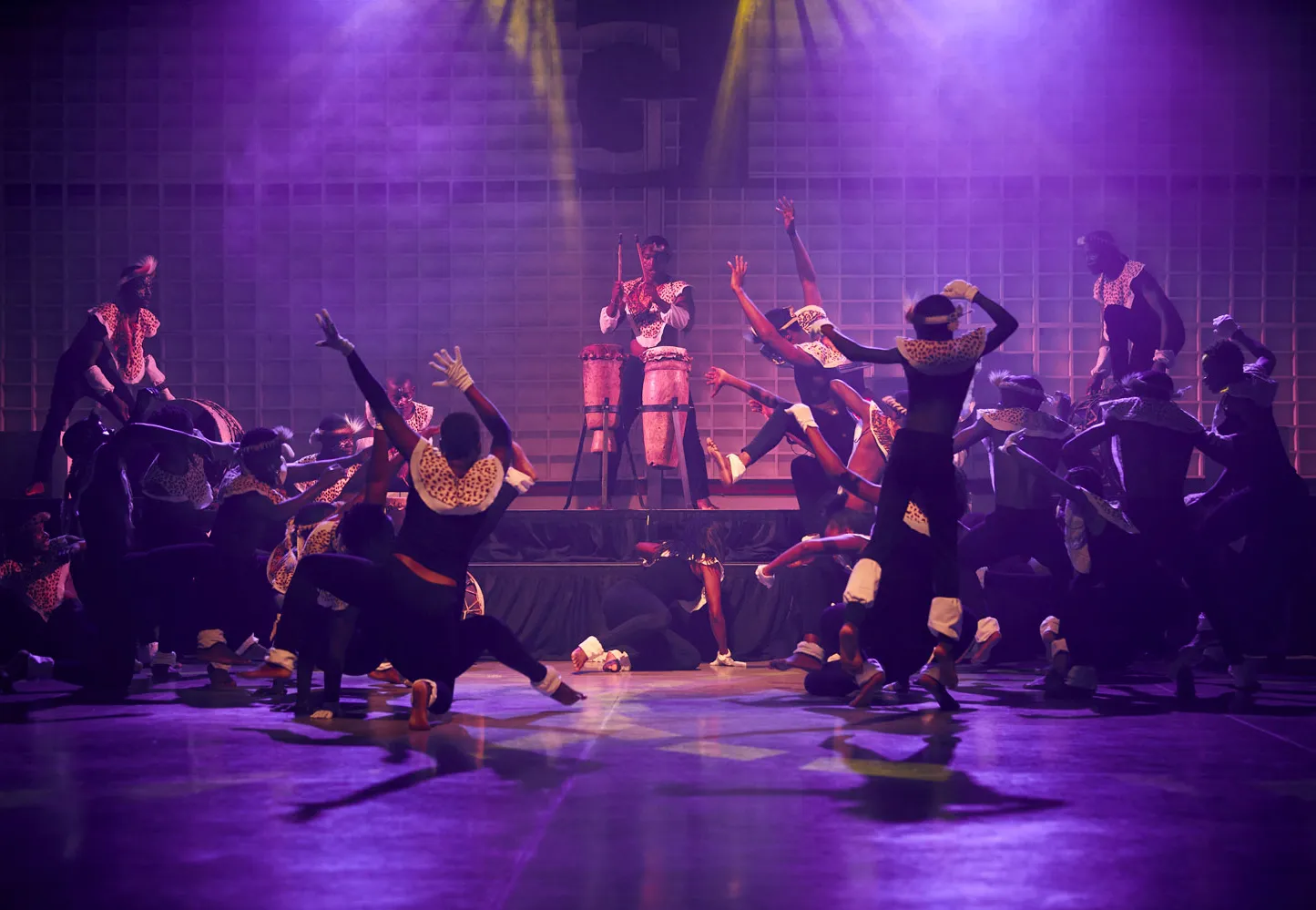
Since 1994 the rhythmic energy of dance has had greater room in the Maxaquene neighbourhood of Maputo, when a group of teachers from Maguiguana Primary School invited pupils from the school to join them in forming the Xindiro song and dance company. Today, more than two decades later, Xindiro Companhia is becoming a true lever for the spread of national song and dance, rescuing the traditional without, however, leaving the contemporary aside. “Xindiro is a song and dance company from the Maxaquene neighbourhood that currently includes children, young people, men and women, not only from this neighbourhood but also from other neighbourhoods of the city, and that seeks to share with the audience a great deal of energy, intensity, harmony and many emotions, offering spectators a unique moment that will stay with them for life,” said Arejústel Mulimela, a dancer with the company since 2005.
The company's name, Xindiro, comes from “xindire”, in the local language, “spinning top” in English, a cone-shaped toy with a metal point at the bottom, usually made of hard wood and designed to be spun vertically. “Our dance movements have a lot of energy and spins that resemble those of the xindire, that is, the spinning top,” the dancer added.
Initially focused on the variety of traditional Mozambican dances, the group soon broadened its repertoire to include other dances as well. That is how Xindiro Dance came about within Xindiro Companhia: “Xindiro Dance fuses contemporary, modern and traditional dances, with the particularity of using a chair in all of its choreographies.” It seeks to keep pace with the evolution of dance(s), without ignoring the traditional aspects that characterise the richness of this artistic form (or forms), which is very present in the everyday life of Mozambicans.
Ahoyah, a different Xigubo, yet the same
Although the company performs a variety of dances, it was thanks to xigubo that it gained greater renown. At present it has been exploring the fusion of the traditional with other elements through the show called Ahoyah, the title of the piece in which it presents a different, more modern xigubo. “It is a deconstructed xigubo. We take xigubo in its pure form and divide it into parts. There is a part in which we do the original steps and other parts in which we do more contemporary steps,” the dancer Arejústel Mulimela told us.
Designed by the choreographer and Xindiro Companhia member Alexandre Chilaúle, the name Ahoyah comes from a cry of motivation let out by the dancers to give strength and vitality in performing the dance, as Arejústel explains: “Ahoyah is a cry that the dancers make to remind the whole Mozambican people, particularly the young, that Mozambique is a very strong and motivated country. Through Ahoyah we want to become a reflection of Mozambique, a platform for collective work by artists, where each one is an essential piece, contributing their knowledge, their time and dedication for the sake of the collective. Together, we want to explore, with poetry, movement and rhythm, to deconstruct, and to question intelligently traditional dances and songs.”
The first performance of Ahoyah took place recently at the Porto de Maputo gallery. Full of energy, the dancers presented an extraordinary xigubo. Whether through the costumes or the rhythmic melody, the audience could feel a genuine revival of the dance, without losing its essence, which could be clearly seen in the power and expressiveness of the movements performed. In response, the public was lively and enthusiastic about this side of Xindiro Companhia, which motivates Xindiro to want to reach other audiences, in and outside the country. “We intend to hold a next performance here at Maguiguana Primary School, where Xindiro was born, so that the community can feel the energy of Ahoyah. Later on, we hope to take the show to other places, nationally and internationally, because we believe in the magic and strength of Ahoyah,” the dancer concluded.


