
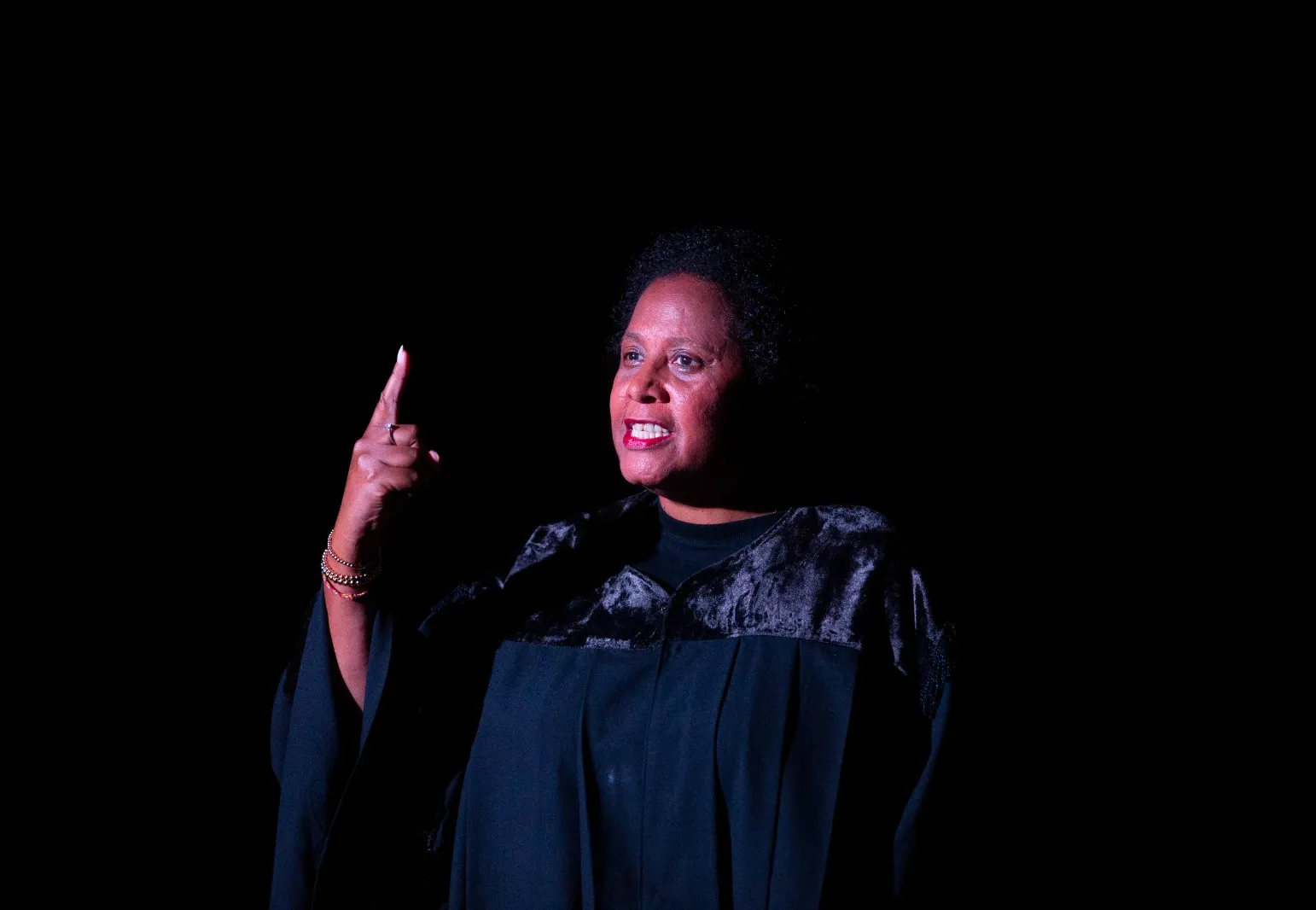
In early March the city of Maputo hosted a theatrical production that placed sensitive issues at the centre of debate, such as gender-based violence, fairness in the justice system and women's rights. The play Prima Facie, by Australian playwright Suzie Miller, directed by Expedito Araújo, returned to the Vinícius de Moraes auditorium at the Instituto Guimarães Rosa, from 5 to 8 March and again on 10 March, as part of the Women's Week activities promoted by the ÍNTEGRA programme.
The revival came after a sold-out first run in December 2025. On that occasion, the production formed part of Anti-Corruption Week and brought together magistrates, lawyers, students and civil society representatives, opening a space for public reflection on integrity, justice and gender equality.
On stage, the narrative follows Tessa, a successful lawyer accustomed to defending those accused in sexual violence cases. The apparent solidity of her career and of the legal convictions that underpin it begins, however, to crumble when she faces a personal experience that leads her to question the workings of the justice system, power relations and the female condition itself. The text directly exposes the weaknesses of a legal model that often fails to respond adequately to victims.
The staging presented in Maputo took an unprecedented approach. The central character was played by eleven actresses of four nationalities, in a succession of presences on stage that reinforced the universal dimension of the story. The cast brought together artists from Mozambique, Portugal, Italy and Spain: Ana Fernandes, Ana Mesquita, Carmen Alcobio, Catarina Caetano, Gina Montserrat, Giselda de Castro, Inês Santos, Mar Correia, Neira Gafur, Tânia Nobre and Tina Lorizzo.
Direction was in the hands of Brazilian actor, director and theatre educator Expedito Araújo, whose career has now spanned three decades. The translation of the text for this production was done by Ana Mesquita.
The work from which the production derives has been gaining prominence internationally. Written by Suzie Miller, who practised as a lawyer before turning to playwriting, Prima Facie has been translated into more than thirty languages and staged in more than forty countries. The text has also been adapted for the page in several markets. Among the best-known productions is the version starring Jodie Comer and directed by Justin Martin, which won awards including the Tony Award for Best Actress and the Olivier Awards for Best New Play and Best Actress.
In Maputo, the production's return formed part of the Women's Week campaign promoted by the ÍNTEGRA programme, an initiative funded by the European Union and co-funded by the Spanish Agency for International Development Cooperation (AECID). The project seeks to strengthen integrity in the judicial sector and encourage a more gender-sensitive approach.
The earlier experience showed the public's interest in this kind of production. In December 2025, the performances drew more than 480 spectators in just four days, demonstrating theatre's capacity to stimulate debate and social awareness.
Owing to the success of the run, the play will return to the stage in April, with new dates to be announced.
The March programme also included a significant institutional moment. On the 10th, the Guide to Good Practice for Gender-Sensitive Case Processing and Adjudication in the Mozambican Judiciary was launched, prepared by the Legal and Judicial Training Centre. The date coincided with International Day of Women Judges and underlined the role of women magistrates in promoting equality within the justice system.
The document sets out practical guidelines to support judicial decisions more sensitive to gender inequalities, proposing recommendations that seek to make proceedings fairer. Its launch reinforced the commitment of various institutional actors to a justice more aware of the asymmetries present in society.
Between theatre and public debate, Prima Facie thus returned to the Maputo stage as a space for collective reflection. The staging showed that art can go beyond the field of performance and become an instrument of questioning, calling on the audience to look critically at the workings of justice and at the challenges that persist in defending women's rights.


