
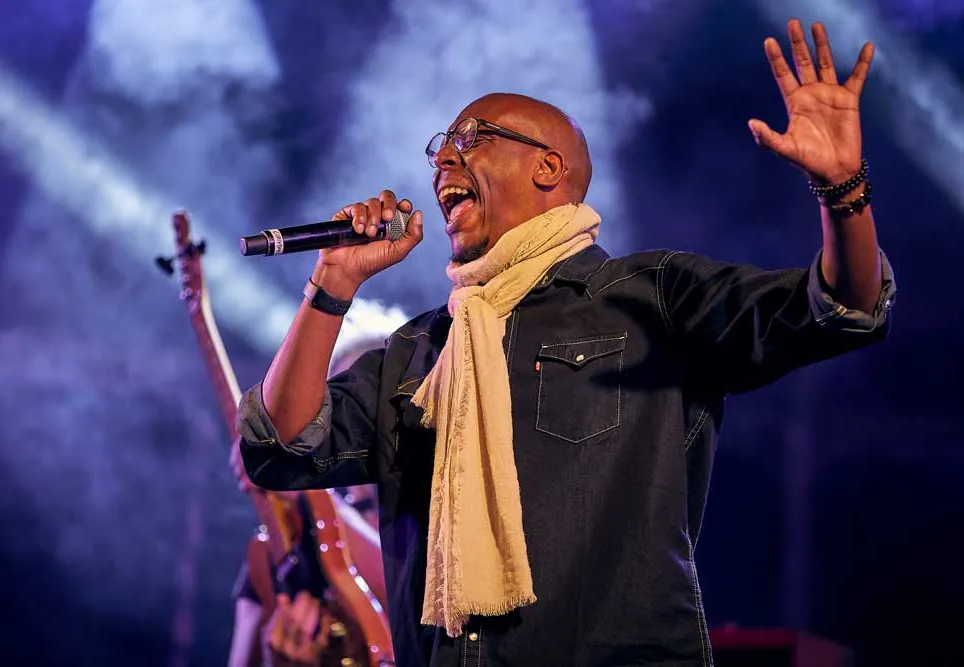
On the vibrant stage of Mozambican music, Xavier Machiana has emerged as an unmistakable voice. In this issue of Xonguila magazine, we have the privilege of talking to him about his new project, Indigo Blue, and taking a journey through the remarkable career he already has behind him.
What inspired Indigo Blue?
Indigo Blue came about almost innocently. After a long period (post-pandemic) without playing, I began to think how therapeutic it would be to set up a studio and form a band. At first, nothing serious, a sort of boys' club just to unwind at weekends and perhaps play at small events or parties. Then a short list of good friends came to mind, people I had always admired musically and with whom I had never really tried playing or recording. A few phone calls and coffees followed to find out who was available and keen to try something new, and the line-up came together organically. The funniest part was the first day of rehearsal, when most of them arrived at the studio without knowing the others and without knowing what this “experiment” would lead to. After agreeing on a few songs that the 5 of us had in common, we started to play and, 30 minutes later, we looked like teenagers in a garage band who didn't want to stop... It was interesting to start out that way.
Can you tell us in a few words what this project is about?
I would say we are a conglomerate of individuals from different cultural and musical backgrounds. There is an interesting richness that comes from our cultural and social backgrounds and, above all, from each person's musical experience. Personally, I have a specific background in national rock; Mole Mussoco (bass) comes from a traditional Mozambican music tradition; Ivan Ferreira (drums) comes from a more formal jazz school with a very rich international career; Jaime Ferreira (guitar) also comes from an international rock background, with experience alongside various musicians; and Ray Mauele (piano) comes from jazz, gospel and soul, also with many years on the road. The way we approach songs and combine our different working methods is proving to be something worth investing in. Today we no longer think of it as just a boys' club. The idea is to keep composing, recording and playing. This year we want to do a few more concerts and, who knows, some new singles. We want to bring more music into the world.
Why did you choose Indigo Blue as the name of the project? Does it have a special meaning?
It was a collective choice after considering many proposals. Indigo Blue means, among other things, serenity, integrity, reflection and respect. It has a lot in common with the way we are as individuals, as a group, and with how we would like the world to be.
What do you consider the most significant challenges in your musical journey?
The greatest of all was right at the start of my career: playing rock in a country with no rock culture and with many stereotypes surrounding the arts and, above all, the people who make this style of music. In the beginning, it was difficult to gain my family's approval and to maintain a balance between my social, academic and professional lives. There were good and bad moments along the way, but I like the way society has adjusted and become more and more receptive. Today, more than 25 years on, I think it was an interesting journey that I would make again.
How do you see the evolution of Mozambican music since you began your career?
Mozambican music has evolved a great deal, both in quality and in quantity. Today there is much greater openness, there are now higher education institutions for the arts, there is access to equipment, there are recording tools and countless platforms for promotion. In a way, some asymmetries have diminished and the range on offer in our cultural mosaic has grown. However, I believe we still have some challenges ahead in terms of quality, which I believe we have the capacity and the will to overcome.
How was the transition from being a member of a popular band to being a solo artist?
It was a very rich experience, something I had wanted to try for many years: stepping out of my comfort zone, out of the well-known band, and exploring new territory. Exploring new rhythms and ways of working, broadening horizons and working with different musicians without a predefined result or style. During that period I had the privilege of working with Joni Schwalbach, Rui Martins and Arnaldo Manhice, as well as international musicians such as Eli Menezes and John Caban. I think the beauty of being a solo artist is being able to work on independent projects. I learnt that it demands a great deal of professional maturity. I learnt to appreciate how it challenges us, ourselves, to create new conventions and dynamics.
Besides music, what passions influence your work?
I love the fine arts and I love communication. If I didn't work in communication and didn't play in a band, I would probably be painting and exhibiting.
What gives you the most pleasure: composing, recording in the studio or performing live?
I think my greatest passion is composing and recording in the studio. I love the process of building a song from a simple poem or a short sequence of chords. I love those countless hours of experimenting, of exchanging ideas, of long nights of team discussion, of record-and-repeat, and so on. I love the stage too, but perhaps, because of my (not so apparent) shyness, I express myself more quickly in the studio, with a small group.
What have been your main musical influences throughout your life?
I went through several phases: between 13 and 17, I think it was bands like Nirvana, Alice in Chains, Pearl Jam, and so on. At 18, I discovered Salif Keita, Youssou N’Dour, and so on; at 23, I began listening to Lenny Kravitz, Prince, Keziah Jones, U2, and so on. I believe that after 28 I discovered Miles Davis and Marcus Miller, among others, and entered another, more jazz-oriented dimension... In the meantime, I became more open-minded and today I listen to everything that gives me pleasure and lightness, but I confess that lately I have been fascinated by 80s pop.
And how do you balance your personal life with your artistic career?
Very spontaneously. I try to be balanced in my family, professional and artistic life. I have a lot of support from my family in that respect. I think the artistic side, in fact, makes me better in the other areas. It works as therapy and an outlet. I feel the same about my colleagues, and I believe we should all invest in parallel activities, whether artistic, sporting or otherwise. The only challenge is that, at times, the demands from the various sides increase in the same period. But whoever runs for the love of it never tires.
Plans for the future? Can you share with us what your next steps in music will be?
Clearly, to keep playing, record new music and play live. We have plans for a few singles; let's see what we manage to do in the coming months.


