
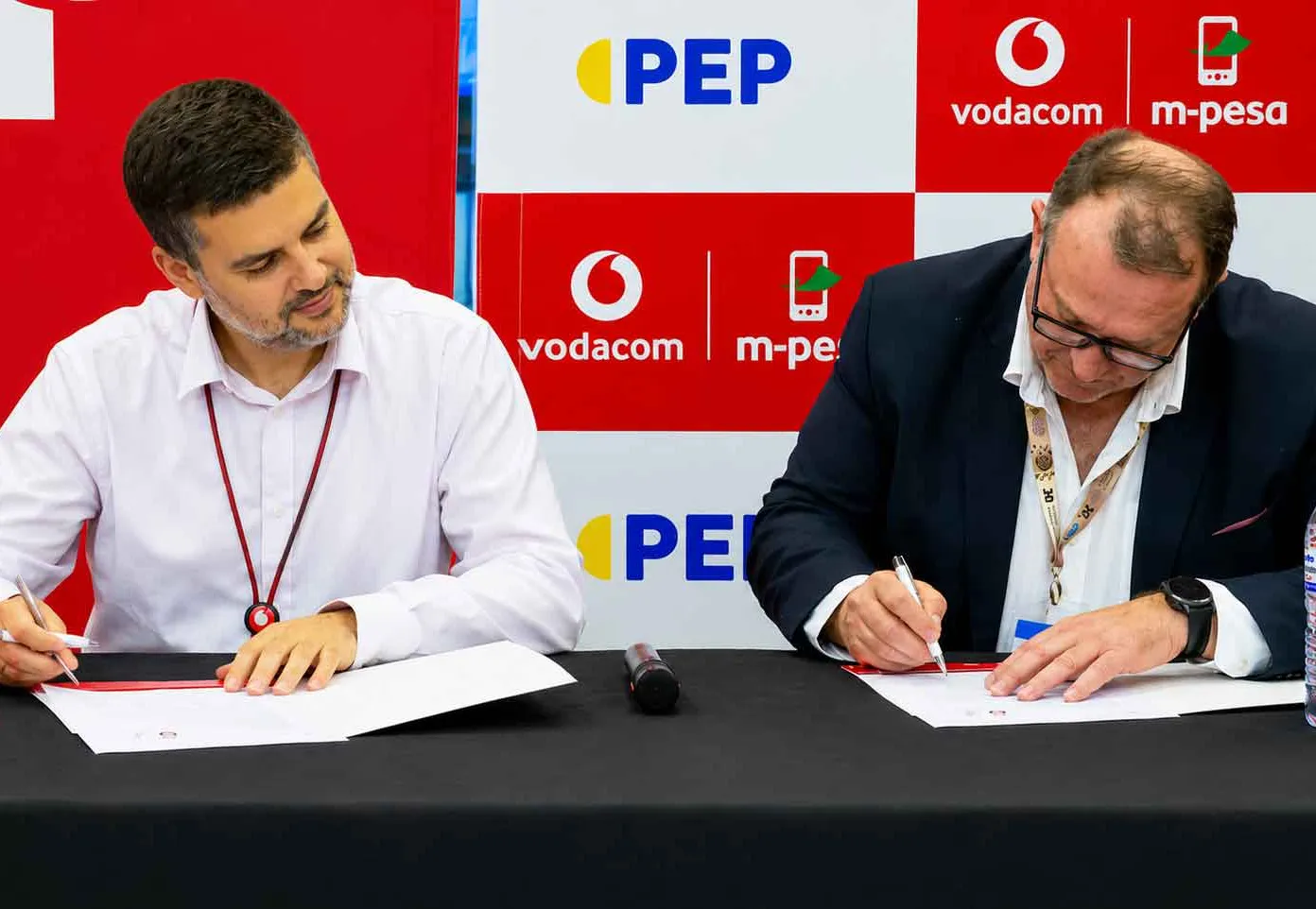
The machinery that keeps mobile money flowing in Mozambique has just received a new boost. Vodafone M-Pesa and PEP Stores have formalised a strategic partnership aimed at strengthening mobile wallet liquidity, in an initiative that seeks to reduce operational failures, increase user confidence and consolidate access to digital financial services across the country.
The agreement, signed through a memorandum of understanding, turns the PEP network into an M-Pesa super-agent, giving it responsibility for ensuring the continuous availability of cash and electronic money in its stores. The measure will allow M-Pesa agents to top up their accounts more quickly and close to hand, reducing the constraints that often affect withdrawal, deposit and transfer operations.
The signing of the memorandum brought together Vodafone M-Pesa's chief executive, Sérgio Gomes, and PEP's chief financial officer, Rodolph Prinsloo, at a ceremony that was also attended by representatives of the two organisations and various players from the digital financial sector.
In a market where trust depends on the ability to carry out transactions without interruption, liquidity has become as important as the expansion of the user network itself. Whenever an agent runs out of physical cash to make payments or lacks the electronic balance to process deposits and transfers, the impact is felt directly in the customer experience.
It is precisely this weakness that the new partnership aims to tackle. By acting as a permanent point for replenishing liquidity, the PEP network will offer M-Pesa agents a more accessible way to balance their daily operations, helping to keep services running and making the network more stable.
Sérgio Gomes stressed that the main objective is to ensure that agents have access to their money simply, quickly and reliably. According to him, M-Pesa is increasingly establishing itself not just as a payments platform, but as essential infrastructure for the circulation of money in the Mozambican economy.
The benefits could extend to thousands of small traders, informal operators, families and micro-entrepreneurs who depend daily on mobile money services to make payments, receive funds or move financial resources.
The adoption of the super-agent model also represents an evolution in liquidity management within the mobile financial ecosystem. Rather than relying exclusively on traditional channels, agents can now count on an additional commercial network to meet day-to-day operational demands, reducing journeys, costs and waiting times.
For PEP, this partnership deepens a business relationship with Vodacom that has already lasted around 18 years. Rodolph Prinsloo revealed that tests carried out before the solution was implemented recorded a 100% success rate, reinforcing the company's confidence in putting the project into operation.
With a presence in cities such as Maputo, Beira, Xai-Xai, Chimoio and Pemba, the PEP network offers coverage that could benefit agents based in the country's main economic centres, as well as in areas where the use of mobile payments has been growing rapidly.
More than facilitating transactions, the initiative is an instrument of financial inclusion. In many Mozambican communities, mobile money agents are the main link between the population and formal financial services. Ensuring these service points keep working means ensuring that millions of citizens can move money safely, quickly and predictably.
Vodafone M-Pesa believes the partnership will have a direct impact on customers' daily lives, will strengthen small businesses and will help accelerate financial and economic inclusion. The aim is not just to increase the physical presence of the services, but to ensure they remain available whenever they are needed.
Part of a broader strategy to expand digital financial infrastructure in Mozambique, the memorandum reflects the growing importance of mobile payments in national economic activity. The combination of M-Pesa's extensive agent network and PEP's commercial presence could boost the circulation of electronic money and cash, bringing financial services closer to communities and lowering barriers to access.
The real test will begin now, with the practical implementation of the model. Its effectiveness will be judged by its ability to reduce service disruptions, increase user confidence and support the growth of the small businesses that increasingly depend on the digital economy.


