
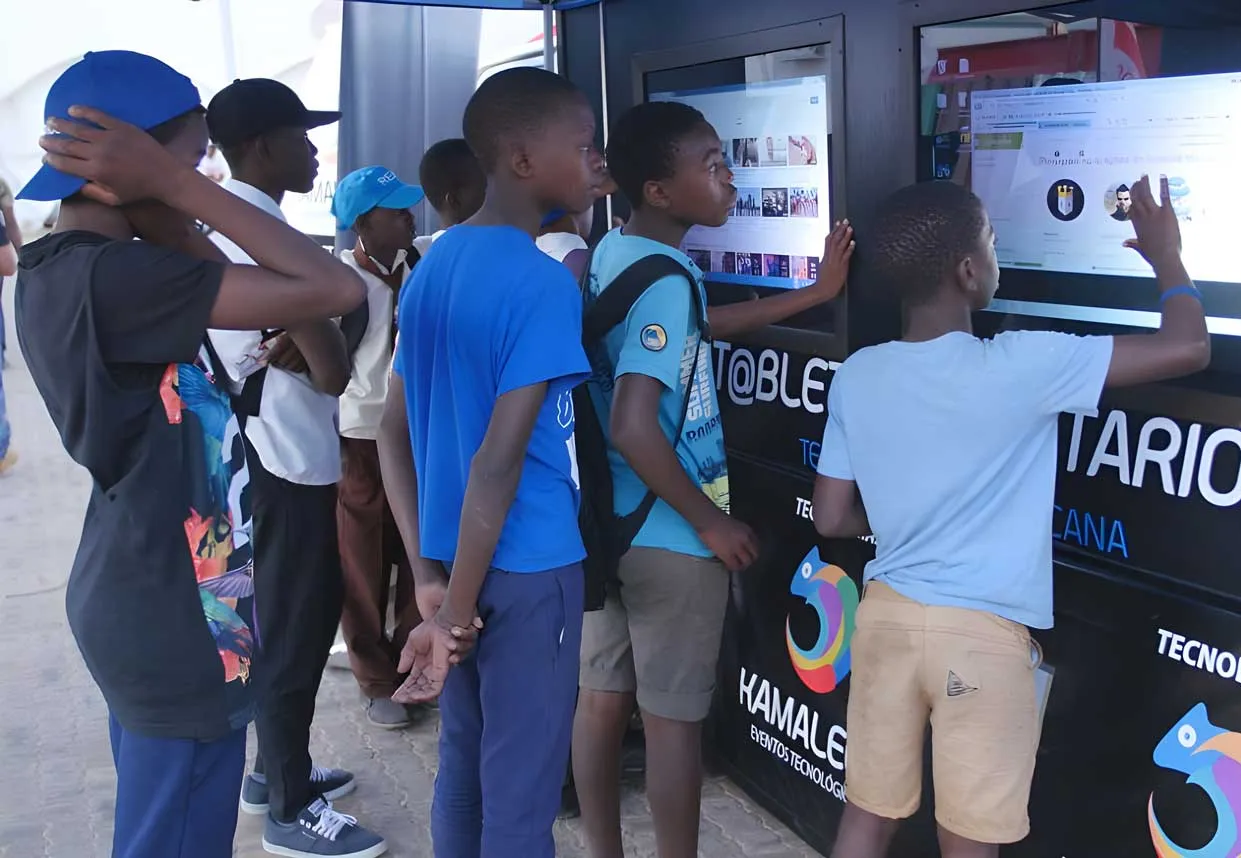
In Mozambique, a technological innovation is transforming the way communication and education reach the most remote communities. The Community Tablet (Tablet Comunitário), a pioneering project developed with Mozambican technology and people, is the first of the ten projects selected for the CFAO Entrepreneurship Challenge, run in partnership with Xonguila magazine. The challenge highlights initiatives focused on mobility and road safety, and the Community Tablet shines as an example of how technology can be applied successfully in these fields. As already announced, all the selected projects will be put to a vote in December, and the winner will earn not only the opportunity to pitch the project to the CFAO Group's “Mobility 54” programme, but also a prize of 60,000 meticais.
The mission of the Community Tablet is clear: to provide public services on a platform with integrated services and to ensure inclusion in a realistic and sustainable way. Operational for five years, the project has already reached more than 2 million people since 2015, setting up 11 units across the country. Its multifunctional "all-in-one" approach and the adaptability of its design allow a wide range of uses, from road safety education and psychotechnical tests on simulators to facilitating basic government services, especially in areas with poor access to mobile phone and data networks.
The infrastructure behind the Community Tablet is equipped with an expandable screen of at least 100 inches, with touch-screen function, and plug-and-play technology for various accessories, such as webcams and speakers, among other useful items. Data communication is via GSM with a switch to satellite, for areas where necessary, benefiting not only those who use the infrastructure but also anyone nearby with a mobile device able to access WiFi, provided they are within a 5 km radius. The use of clean energy is favoured throughout, with the infrastructure fitted with photovoltaic (solar power) solutions. Versatility is further increased by features such as individual booths with adjustable height – to allow access for wheelchair users –, sign language and speech-to-text recognition and vice versa, which makes this technology accessible to people with disabilities and special needs.
When it comes to road safety, this innovative infrastructure is used to educate the population considered to have little access to information, or to be outside the digital era, about how to behave on the roads, how to recognise and respect traffic signs, and the importance of not driving under the influence of alcohol or other substances that alter normal behaviour and affect reflexes. The infrastructure makes it possible to carry out psychotechnical tests, aimed at retraining both drivers and pedestrians, in programmes linked to the vehicle licensing service. Its cross-cutting scope has as its main objective to bring public services in digital and interactive format to disadvantaged communities; its mobility makes it possible to reach many communities without leaving anyone behind, ensuring inclusion.
This project not only brings government closer to the citizen, increasing the territorial coverage of government services, but also proves essential in emergency response, such as natural disasters, by providing itinerant service-desk and mobile contact-centre services. The Community Tablet is designed to deliver essential public services, including data registration for identity documents and driving licences, proof of life, remote medical assistance (including tracking the patient's clinical condition in real time, provided the relevant devices are connected), education, training, and other services that require communication and interaction, contributing significantly to e-governance in Mozambique.
Synergies were created with the University of Évora, in Portugal, for a proof of concept that is intended to be standardised on a global scale. They hold registered patents in the United Kingdom, the United States, the European Community and China, and their technical report has also been approved in plenary and published by the ITU – International Telecommunication Union, the United Nations agency for communications.
The Community Tablet is a brilliant example of how technology can be used to overcome significant challenges in remote communities, promoting inclusion, education and safety. The Community Tablet is a bridge to a more connected and informed future, in which every citizen has access to essential information and services, regardless of their geographical location. It is only the beginning of a series of exciting discoveries that we promise to present throughout the year, where innovation and entrepreneurship meet to make a difference in Mozambique. We would already like to draw your attention to more inspiring revelations to come.


