
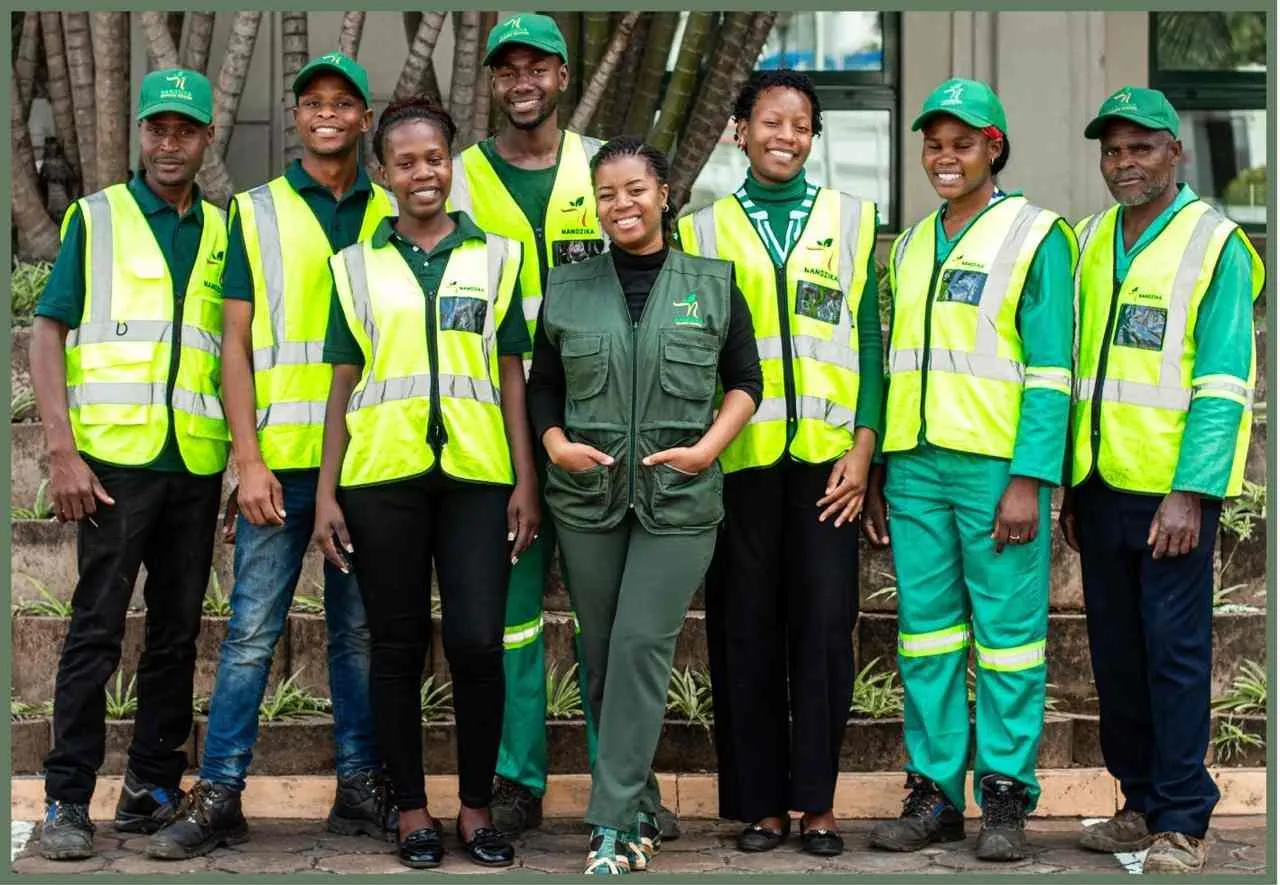
Some businesses are born from a plan and others begin simply because someone noticed what was missing. Nandzika belongs to the second group. What began with plants introduced into homes in Matola has become a brand that seeks to bring people closer to nature, create spaces where people want to stay and make sustainability a practice. Behind this vision is Jusaina Violanda, founder and CEO, an entrepreneur who wants to take Nandzika far beyond a simple plant shop.
It all began when Jusaina worked for an investment and construction company responsible for luxury homes in gated communities in Matola. It was her job to look after the finishing and the final design. The more she worked on the spaces, the more she felt that something was missing. The answer lay in plants.
She began introducing them into the homes and noticed the difference. "People felt more comfortable in the homes. They said they felt truly at home."
Finding good suppliers, however, proved difficult. There were problems with availability, quality and consistency, as well as little information about the species and the care they required. It was to meet this need that Jusaina began building her own greenhouses.
Nandzika Lifestyle with Plants did not yet exist. Jusaina was simply solving a concrete problem. Over time, she realised she could take plants to another level, combining quality, refinement and information.
The passion for nature went back further. Years earlier, while researching natural body products in Mozambique, she came across a book by Anita Roddick, founder of The Body Shop, and identified with her vision of building a business around what one truly believes in.
"When I created NANDZIKA, I had the vision that I would be the Green Queen of Mozambique, an entrepreneur passionate about nature."
Her ambition goes further: "I want to become an international reference as a woman who had an impact on sustainability", she says.
A name for a feeling
In Changana, Nandzika refers to something pleasant, whether to feel, to have nearby or even to taste. The name conveys what Jusaina intends to create. "I want to create environments that are pleasant to be in and to feel, through plants."
More than selling plants and pots, Nandzika seeks to create spaces where people feel good and recover a connection that Jusaina considers essential. "We do not just sell plants or pots. We create spaces where people feel good and we try to reconnect them with their essence: nature."
This is also why biophilic design has gained importance in the brand's proposition. The idea is not simply to place plants in a space, but to combine greenery, natural light, ventilation, materials, textures and other elements capable of bringing people closer to nature.
"We do not simply want to put a pretty plant in a pot. We want each element to contribute to the experience and to the feeling that the space is meant to convey."
Learning from nature
Nandzika itself had to learn from the plants. In the early days, it worked with around a thousand species, including more exotic varieties from local suppliers and nurseries in South Africa. Experience showed that many did not adapt well to the Mozambican climate and were more vulnerable to pests and diseases.
Today, the company has several nurseries, produces most of its own plants and favours species suited to local conditions. It also produces its own organic compost, using waste from the condominiums, manure from local chicken farmers and charcoal dust, without using chemicals or inorganic fertilisers.
At the same time, Jusaina notes a transformation among consumers. "Today we see an increasingly sophisticated Mozambican customer. The internet has brought more information, references and expectations."
Customers increasingly look for quality, presentation and concept, but they also show greater interest in sustainability and in the presence of nature in homes, offices, conferences and events.
Growing an idea
Turning a passion into a business also brought difficulties. Jusaina sums up the main challenges in three areas: people, funding and technical know-how.
Experience has led her to favour young people who are keen to learn and to invest in training within the company itself. Access to funding, for its part, continues to be an obstacle for a small company that needs to invest in order to grow.
There is also a lesson she considers fundamental: information and experience are not the same thing. The internet and new technologies have made knowledge much more accessible, but knowing how to find a solution does not necessarily mean knowing how to carry it out.
"Finding the technical solutions is the easy part. Implementing them and putting them into practice is the real challenge. And there is no substitute for experience."
From the shop to new spaces
One of the projects that most marked the company's journey was the Nandzika Garden Centre, designed and built at Novare Mall in Matola. Jusaina believes the space reached international standards and helped make the brand quickly known.
But being just a plant shop is no longer the focus. Nandzika is designing Green Spaces with different gardens, including areas dedicated to orchids, anthuriums and philodendrons.
The idea is to create places where people can walk, cycle, read or simply spend some time in contact with nature.
"We want to create something so spectacular that people look and think: I want this in my home. I want a garden like this."
Sustainability beyond plants
Jusaina also sees sustainability as an important part of the company's future. "For me, sustainability is not simply planting trees or carrying out a single community activity. It goes much deeper."
The ambition is for Nandzika to work increasingly with businesses, not only in creating and maintaining their green spaces, but also in implementing sustainable practices, monitoring results and, in future, supporting the preparation of sustainability reports.
Jusaina believes there is room for specialist knowledge in this area, in the same way that organisations turn to specialists in technology, security or accounting.
"For me, that is the true meaning of sustainability: not a one-off action, but the creation of a change that becomes part of how the company operates."
An idea that keeps growing
The initial idea was to sell plants. Today, the vision is to create spaces where people can stroll, learn, read and enjoy a different experience in contact with nature.
Jusaina also wants to deepen the work on sustainability and show that Mozambique can take responsibility and leadership in this area.
"I want to create a brand that represents a different way of living, of thinking about spaces and of relating to nature."
It is an ambition that brings the story back to where it all began. First, Jusaina realised that a house was lacking plants. Then she realised that what they brought was not merely decoration. It was the feeling of being truly at home.


