
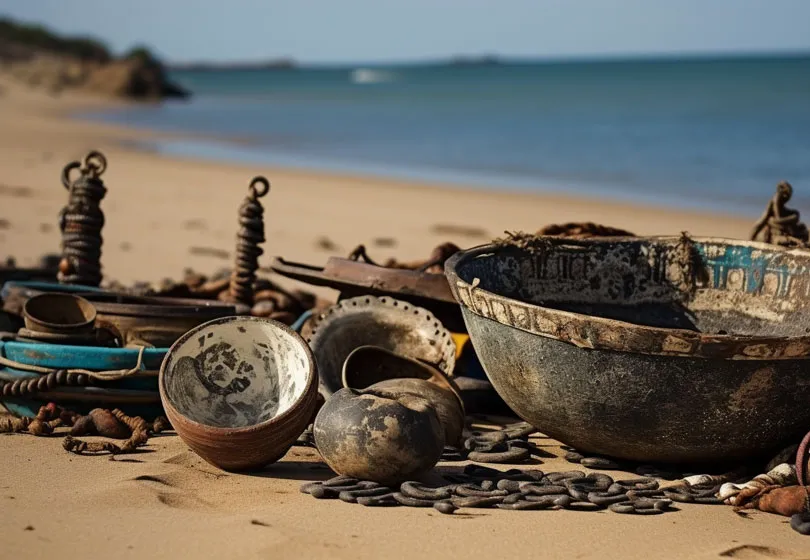
Mozambique Island, situated on the country's northern coast, is a place full of history and charm. Since the fifteenth century, when the Portuguese arrived there, this small piece of land has been the stage for countless cultural and commercial exchanges. One of the interesting and curious manifestations of this historical heritage is the presence of old beads and crockery which, to this day, wash up on the beaches of that city.
Beads, small coloured glass pearls, have a long history in Mozambique. They were used as adornments and status symbols, but also as a medium of exchange on the trade routes between Africa, Europe and Asia. On Mozambique Island, the presence of these beads bears witness to the fundamental role the place played in commercial and cultural exchanges over the centuries. As for crockery, it is mostly fragments of porcelain and ceramics dating back to the Portuguese colonial era. Such fragments, many of them with vibrant patterns and colours, are vestiges of trade between Europe and the East. Porcelain, originating in China, was a valuable and sought-after commodity, frequently carried by the Portuguese ships that called at that island location.
Sea currents and the storms that hit the Mozambican coast contribute to the scattering of these historic treasures across the Island's beaches. With every tide, new fragments of beads and crockery are deposited on the sand, providing a unique opportunity for visitors and local residents to discover pieces of a distant past.
Besides their historical value, these relics have cultural and artistic value. Many residents of Mozambique Island and artists make use of those fragments to create costume jewellery, decorative objects and works of art that, keeping alive the memory of a past rich in cultural and commercial exchange, perpetuate the traditions and history of the Island.


