
Pulango
Wood recycling
From waste come new products and new brands
Reuse and recycling stopped being a fashion long ago and became a sustainable trend, and examples abound. In this country and around the world, there are more and more social projects based on preserving natural resources, with a view to mitigating the negative effects of climate change.
Pulango (a word that, translated literally from Changana into English, means wood) turns what for most of us has a name, rubbish, into wooden chopping boards for various purposes, making it a source of income. They are offcuts and scraps of wood that would usually go straight to landfill, or be burned and turned into charcoal, but which here become new products bearing the Pulango mark.
Created in 2020, Pulango is a brand born of a friendship linking two peoples and two sister countries, united by history, culture and language. Pedro Schünemann Christófaro Silva is a carioca who is also a mineiro: he was born in Rio de Janeiro but raised in Minas Gerais, in Brazil, where he studied Economics. Fernando Mahade, who lives in Matola, is Mozambican, a native of Zandamela, in southern Mozambique, precisely in the “Land of Good People”, Inhambane province. He is a carpenter and has been doing the same work for more than three decades. He is a true master of the art of carving wood to produce an endless range of furniture, such as household furnishings, among other things.
Fernando and Pedro have known each other for at least five years, but it was only last year that they decided to form a business partnership to create the wooden chopping boards that bear the name Pulango. Pedro combined design and creativity to develop Pulango, which makes it possible to reuse wood waste to produce household utensils.
“The craft manufacture of furniture generates a large quantity of very small wood offcuts and, traditionally, these pieces are burned and turned into charcoal. This activity, however, brings little return for the carpenter, in addition to possible health and fire risks.” And there is a great deal of waste.
With the technical knowledge available, the necessary manual skill and the raw material (wood) accumulated as offcuts from making pieces such as furniture, the idea took shape and became reality.
“Producing kitchen boards with a distinctive design and excellent finish was technically simple for experienced carpenters to adapt to,” explained the economist, who has an interest in income-generating projects involving wood and design.
“Fernando Mahade, the patriarch of the family, was the one who taught me to work with wood, to bring this precious material to life in the form of furniture with a story to tell. Since 2016 the family has been making beautiful furniture for me and for friends. So it was an organic transition from our client-and-friend relationship to being partners in Pulango.” That is how we learned how the partnership came about.
The meticulous production process
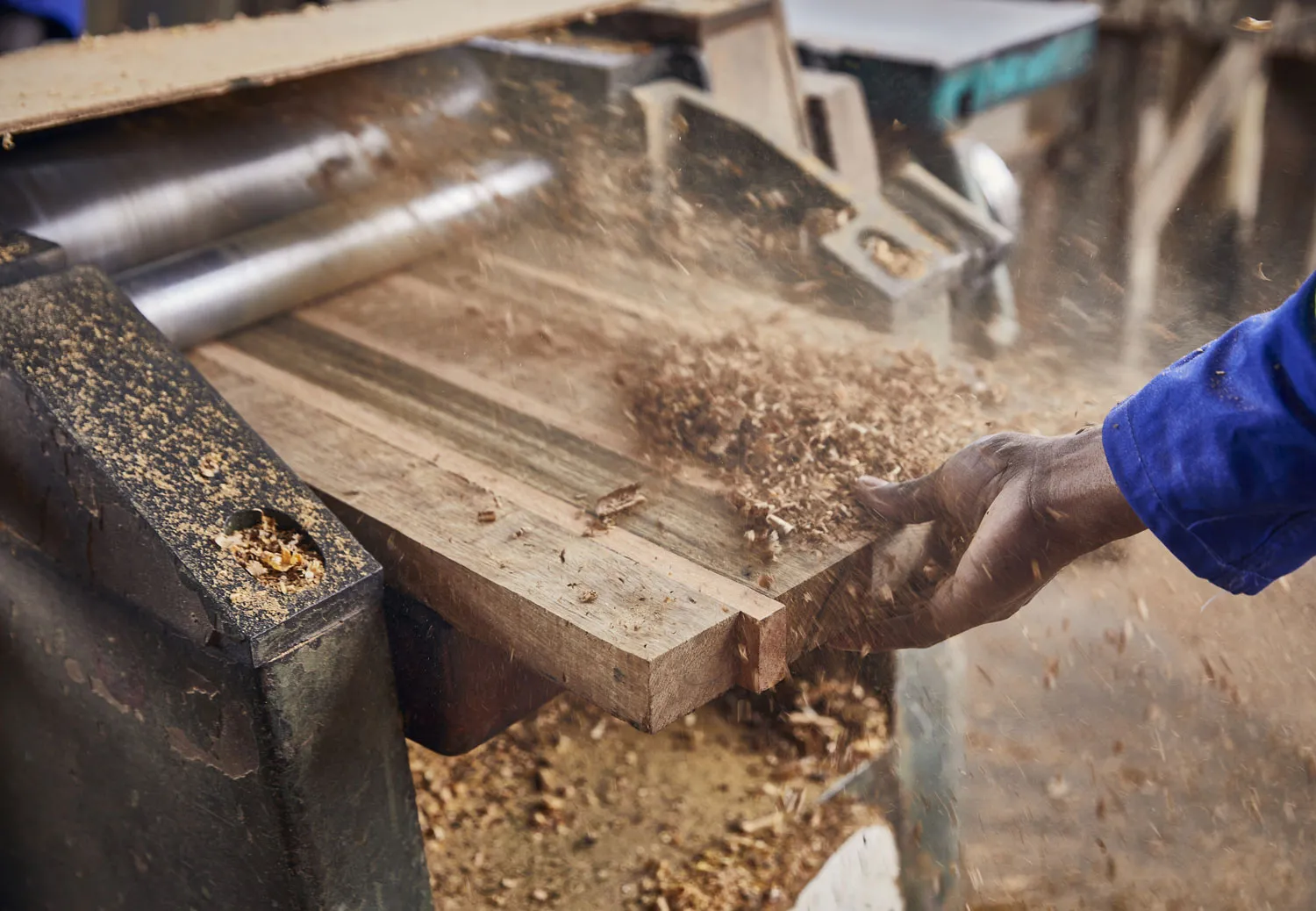
The production process for “Pulango” wooden chopping boards takes place in four stages, starting with the selection of the wood. Then the wood is cut and prepared for assembly. The second stage is gluing, with waterproof glue, and the boards dry in 24 hours. In the third stage, the boards are planed again and the edges trimmed, to ensure consistency and uniformity. In the fourth and final stage, the planed boards are sanded, marked and finished with a special oil for chopping boards.
Pulango mainly produces wooden chopping boards for various purposes. The traditional Pulango boards are large and heavy, measuring 60x30x4 cm and weighing 4-5 kg. The plain boards are commonly used for cutting dry foods and serving at the table; the boards with a groove, in turn, are more for those who enjoy a good barbecue, as they are ideal for catching the juices that run from the meat as it is carved. “Recent additions to the collection are the Pulanguinho, at 30x20x4 cm, perfect for serving sushi, and the cheese boards, at 45x15x2 cm, thinner and lighter, good for serving cheeses and cured meats. The mix of woods is used in all products as a matter of brand identity and to reuse as much waste as possible,” they tell us.
All the boards are made from solid Mozambican woods, such as Umbila, Chanfuta and Jambirre. The technique allows the carpenters to make the most of the wood and supplement their families' income.
“Pulango emerged as an option to increase the Mahade family's income without major investments, which are impossible in the current situation. The brand was created to solve a social problem, but we also wanted it to be an environmentally friendly project”
A family-based “green” project
Illegal logging and improper disposal of wood have negative impacts on the environment. To avoid deforestation and minimise the damage done to nature, recycling wood is one of the best solutions.
Pulango was born from thinking about sustainable environmental solutions, but wood waste was not the only problem Pedro wanted to solve. There was another, more pressing purpose for him. “The Pulango idea emerged as an option to increase the Mahade family's income without major investments, which are impossible in the current situation. The brand was created to solve a social problem, but we also wanted it to be an environmentally friendly project. Producing high-quality chopping boards appears as a solution to both problems, creating a sustainable source of extra income with low risk for the family.”
“Pedro is a fantastic man in his ideals and excellent at marketing. He is responsible for promoting Pulango, but he does not limit himself to that role. He also helps promote the sale of the various pieces of furniture I make with the help of my sons and other young apprentices,” the carpenter said, highlighting the importance of his friend and business partner. “Pulango is a project that has greatly improved the family income. Pedro transformed the wood we considered rubbish into a new, value-added product. I am very happy with this partnership. I hope the orders never stop coming.”
According to Pedro, the market response was far above expectations. “We launched Pulango at the right moment and took advantage of the festive season to sell much more than we had forecast. Even now, in the new year, demand and interest remain high. Besides direct sales through online channels, we have also formed partnerships with 3 shops in Maputo, in which we have great faith, and Pulango can be admired and bought at Café 3D, Bairro Bistrô and Mobi.” Social media, mainly Instagram and Facebook, are the main vehicles for promoting Pulango's products, which can also be found on the website www.pulango.co.mz.
In the medium term, Pulango intends to expand through a range of furniture products and to broaden partnerships with local shops and in other countries, as a way of achieving internationalisation while seeking to consolidate itself at home.
Text by Jaime Álvaro


