
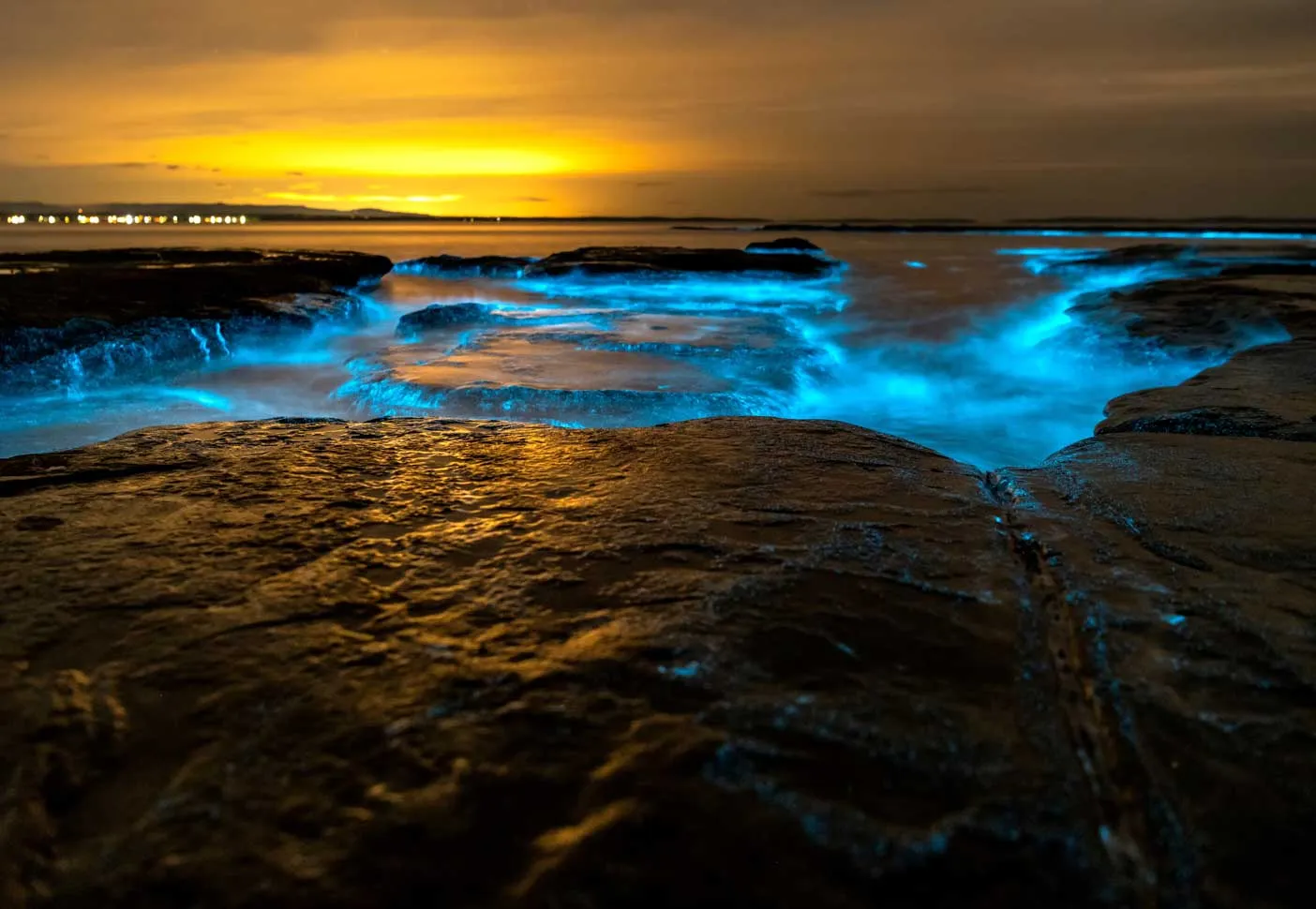
There are nights, on certain beaches in our country, when the sea seems to hold fragments of the firmament. With the touch of each wave, tiny blue sparks appear, as if thousands of stars had swapped the sky for the waters. This spectacle is called bioluminescence and is caused by minuscule marine organisms – often phytoplankton – which, when disturbed, release their own light through chemical reactions in their bodies.
The phenomenon, the result of the interaction between an enzyme called luciferase and a molecule called luciferin, is more than a whim of nature. For some marine creatures, bioluminescence serves to attract prey, confuse predators or communicate with others of the same species. For us humans, it is pure visual magic, a rare moment that seems to suspend time.
Although it is observed in various parts of the globe, in Mozambique this spectacle finds a privileged stage. Places such as Ponta do Ouro, Inhaca Island, Maputo Bay, Tofo Beach, the Bazaruto archipelago, Mozambique Island and even some lesser-known beaches on the coast of Nampula and Cabo Delgado have already been the setting for this dance of light. Fishermen and coastal communities know the phenomenon well, and in some oral histories it is described as “the sea talking to the stars”.
Seeing bioluminescence is almost like entering a dream. Each step taken on the wet sand leaves a luminous trail, and a simple swim becomes a ballet of light around the body. But this wonder is delicate and fleeting. To witness it, you need a dark night and calm waters. It tends to appear most intensely in summer and in periods of greater biological activity in the ocean, when phytoplankton blooms.
So, the next time you find yourself on the Mozambican coast after sunset, stop and look. Perhaps the sea is about to reveal an ancient secret to you, written not in words but in light – a silent dialogue between the night and the waves.


