
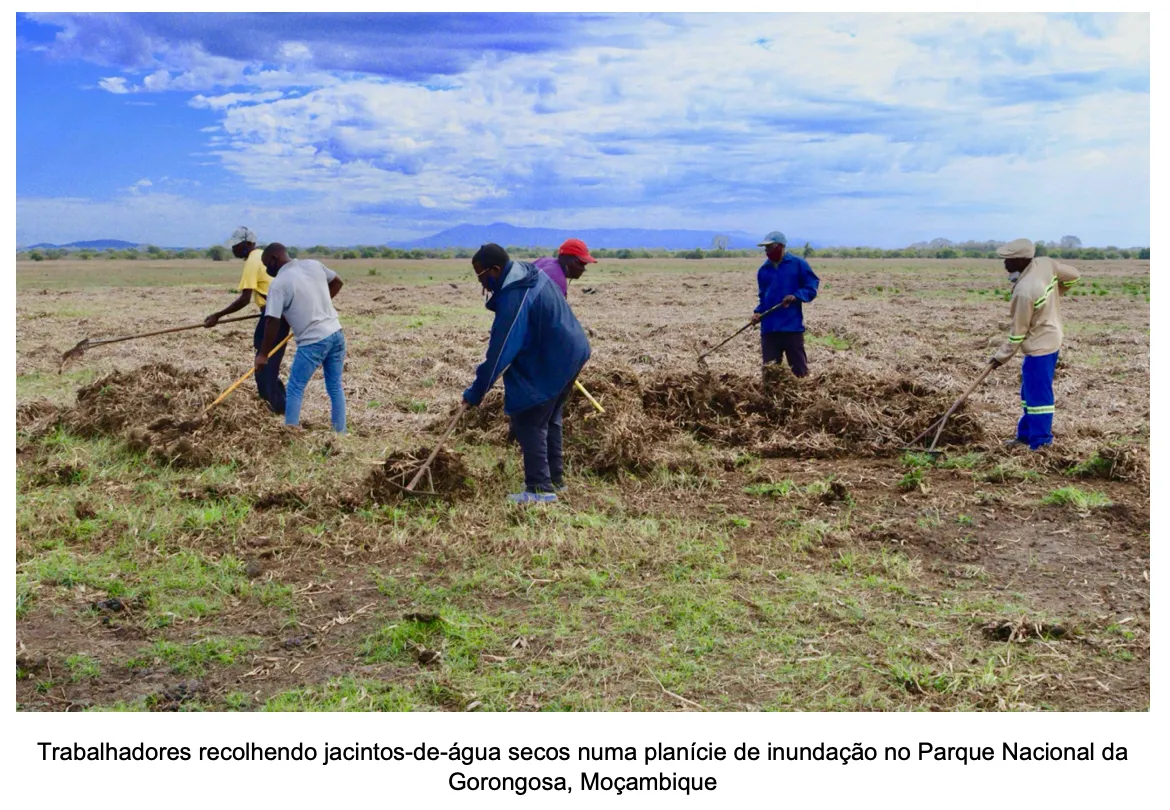
Gorongosa National Park creates organic fertiliser
Water hyacinths are free-floating perennial aquatic plants. The leaves can rise above the water surface to a height of 1 metre. They are attractive when in bloom. That is the good news.
The not-so-good news is that they are not native to Gorongosa National Park, yet they are found here. They are native to South America. Non-native plants in an ecosystem are known as invasive species.
Back to the good news: water hyacinth is an excellent organic fertiliser. Soils enriched with water hyacinth become more fertile and better suited to farming. In fact, compost made from water hyacinth appears to perform better than factory-made chemical fertilisers.
Water hyacinth absorbs nutrients and, as it decomposes, those nutrients are returned to the soil (including the essential elements nitrogen, phosphorus and potassium sought in soil additives). Water hyacinth also improves soil texture thanks to its fibrous qualities.
As the floodwaters recede after the rainy season in Gorongosa Park, it is easy for workers to collect the dried water hyacinths left behind. In the next stage, our agricultural team will turn the water hyacinths into compost that we will give free of charge to local farmers. The staff pictured here include former combatants. This is part of our Peace Clubs initiative, where we create opportunities for these individuals and their families - as a component of our overall human development activities for the approximately 200,000 people who live near Gorongosa National Park.
To sum up the benefits:
- We remove the invasive water hyacinth from Gorongosa National Park.
- We create natural organic fertilisers (chemical fertilisers can harm the environment in the long term, for example by polluting groundwater).
- We provide free compost to local farmers, increasing their incomes.
- We create jobs for local communities, some of whom are former combatants.


