
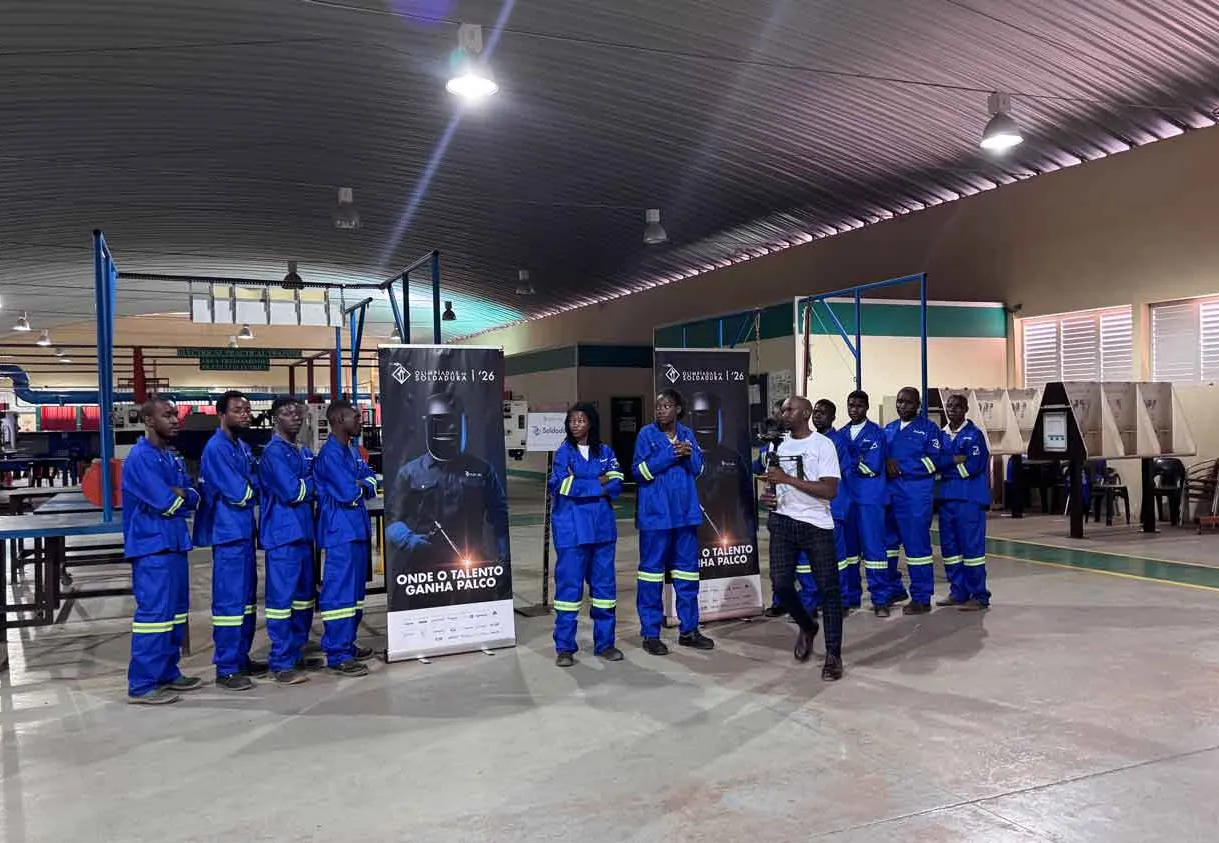
The sparks from welding machines have reached Pemba on an unprecedented scale. The Welding Olympics 2026 (OS26) kicked off at the Ascending/IFPELAC Training Centre in Cabo Delgado, opening a second edition which, for the first time, extends the competition to different regions of Mozambique.
The opening ceremony of the Northern regional competition marked the start of this new stage of the initiative, which this year is no longer concentrated in a single place in the country. The contests take place in the North and South regions, with competitions in Pemba and Matola, in an expansion intended to turn the Olympics into a truly national platform for valuing technical skills.
Over two days, students and trainers from the main technical and vocational education institutions in Cabo Delgado put their welding skills to the test. The competitors' performance was assessed by internationally certified juries, in an exercise that seeks to bring vocational training closer to the standards required by industry.
The opening was attended by the Governor of Cabo Delgado Province, Valige Tauabo, the Chairman of the Pemba Municipal Council and ExxonMobil Mozambique's Director of Public and Government Affairs, Matthew Scharf. The oil company is the initiative's main sponsor.
For Valige Tauabo, the importance of the Olympics goes beyond the competitive element and lies above all in the possibility of preparing young people for the labour market.
“More than a competition, the Welding Olympics represent an opportunity to strengthen the technical skills of young people who have embraced welding as a profession. This initiative promotes local talent, strengthens community resilience and is duly aligned with public policies on economic development, vocational training and employment,” said the Governor of Cabo Delgado.
The competition's arrival in Cabo Delgado comes at a particularly relevant time for the province. With the region's growing importance in the development of the oil and gas industry in Mozambique, the need also grows to train a national workforce able to meet the technical demands of the large industrial projects.
It is in this context that the qualification of young technicians takes on a strategic dimension. Investment in specialised skills could widen the participation of Mozambican professionals in the projects, strengthen local content and open up new employment and business opportunities for communities.
Matthew Scharf believes that technical training will be decisive in enabling Mozambicans to benefit from the opportunities associated with the development of the energy sector.
“Developing technical skills such as welding is fundamental to ensuring that Mozambicans are prepared to seize the job opportunities that the oil and gas sector will create. We are committed to ensuring that the communities of Cabo Delgado benefit through training, employment and business opportunities — and the Welding Olympics are a concrete expression of that commitment,” declared ExxonMobil Mozambique's Director of Public and Government Affairs.
The initiative, however, does not end at the welding benches. The Olympics combine technical competition, a Talent Fair, networking and a documentary mini-series, seeking to create a bridge between training institutions and companies.
Through this model, the aim is not only to identify the best competitors, but also to provide young Mozambicans with concrete opportunities for internships, certification and employability, while reinforcing the importance of technical and vocational education for the country's economic development.
The 2026 edition introduces another change: for the first time, the best welders from the North and South regions will be recognised. After the Pemba stage, the competition moves on to Matola, where the Southern regional stage takes place on 9 and 10 September. Subsequently, the top finishers from the two competitions will be brought together at the National Awards Ceremony.
For Mateus Costa Santos, Coordinator of the Welding Olympics, the expansion represents progress in consolidating the project.
“This edition represents an important step in consolidating the Welding Olympics as a national benchmark. The expansion to Cabo Delgado broadens the initiative's representativeness, involves a greater number of technical and vocational education institutions and makes the assessment process more comprehensive and consistent. Our aim is for this platform to continue bringing technical education closer to industry and creating real opportunities for young Mozambicans,” he explained.
The Welding Olympics 2026 are being developed through a partnership that brings together public- and private-sector bodies as well as international cooperation organisations. The partners include ExxonMobil, German Cooperation (GIZ), the European Union, Ascending, ABSA, Tri-M, AIMO, IICM and IFPELAC.
The participation of these institutions seeks to strengthen the link between technical and vocational education, industry and economic development, at a time when Mozambique needs specialised personnel able to keep pace with the growth and increasing complexity of its industrial projects.
With the expansion to two regions, the Olympics thus seek to stop being merely a competition and to establish themselves as a national platform for identifying and valuing skills. The ambition is to prepare a new generation of Mozambican professionals and, at the same time, respond to the needs of a growing industry.
An expanding initiative
The project began in 2025, when the first edition of the Welding Olympics was held in Matola. The competition brought together 153 participants and involved more than 15 institutions and companies.
The inaugural edition was covered by national and international media and culminated in the signing of a Memorandum of Understanding between Talento, IICM, ABSA, AIMO and ACLM.
The agreement consolidated the commitment of the entities involved to promoting technical training and youth employability in Mozambique. A year later, the Olympics' arrival in Cabo Delgado widens that commitment: from the first contests in Matola to a competition split between North and South, with technical training gaining ground in an industry that increasingly seeks qualified professionals.


