
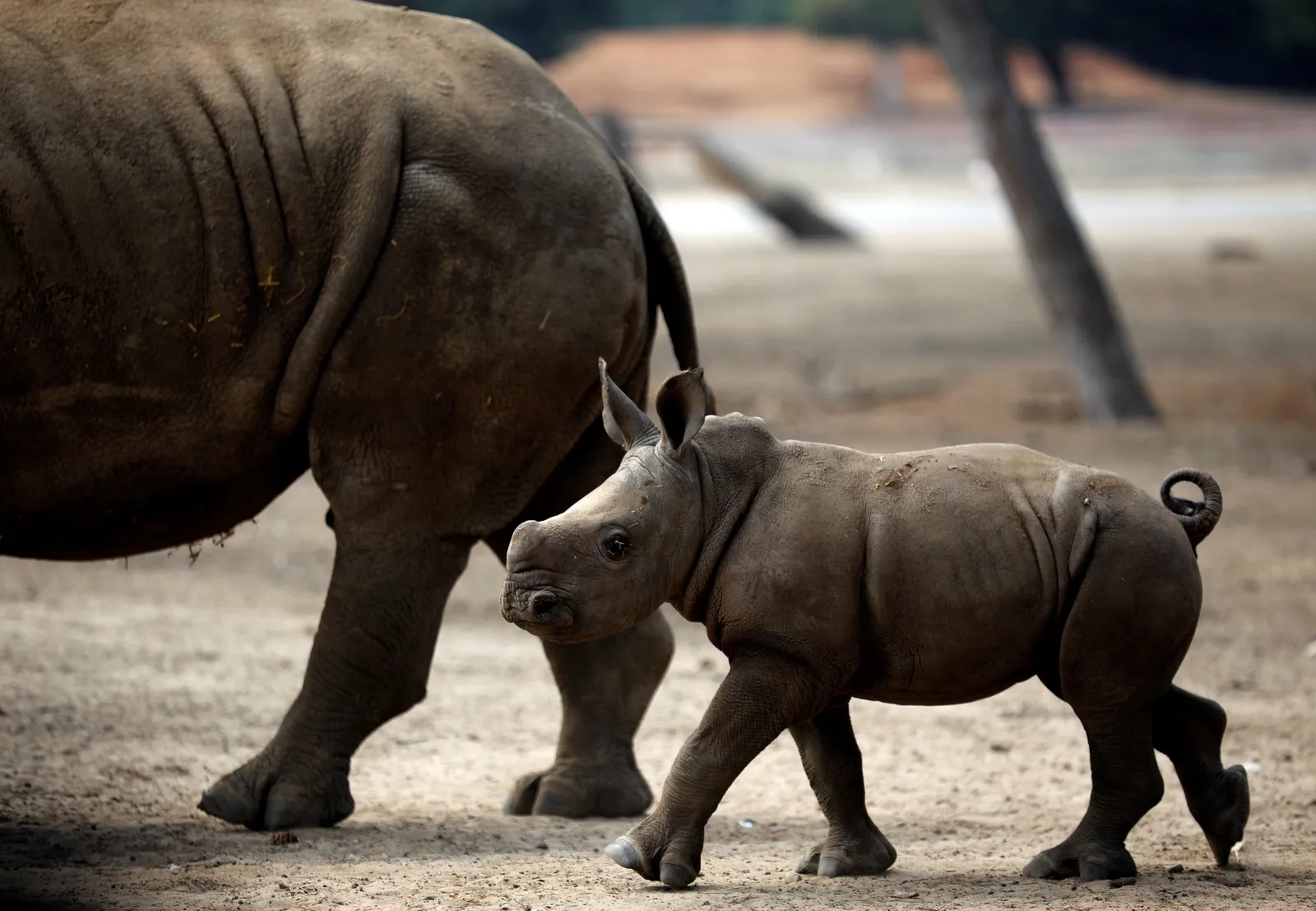
For decades, silence has hung over the savannas where rhinos once roamed. The absence of one of Africa's most emblematic species became a symbol of the fragility of conservation, of human pressure on ecosystems and of the slow erosion of Mozambique's natural heritage. Today, however, that silence is beginning to be broken.
The arrival of nine new female white rhinos at Zinave National Park, in Inhambane province, represents much more than a successful conservation operation. It is the visible sign of a deeper transformation: the affirmation of biodiversity as a strategic asset capable of boosting tourism, attracting investment and generating sustainable development.
The operation, considered one of the most complex ever carried out in the country in the field of wildlife protection, significantly strengthened the species' presence in Mozambican territory. Zinave is now home to 39 white rhinos and 22 black rhinos, consolidating the recovery of animals that, for decades, disappeared from several Mozambican protected areas.
But the significance of this achievement goes beyond the numbers.
With the rhino's presence reinforced, Zinave consolidates a rare distinction: it is the only Mozambican national park where it is possible to see the so-called "Big Five" — lion, elephant, buffalo, leopard and rhino. In a highly competitive tourism market, this represents a strategic advantage that is hard to ignore.
The economic value of a rhino
Often analysed only from an environmental perspective, the rhino is also a high-value economic asset.
Safari tourism generates billions of dollars every year in Africa and continues to grow, fuelled by international demand for authentic experiences of contact with nature. For many international tour operators, being able to guarantee visitors an encounter with the "Big Five" is one of the main selling points of African destinations.
In practice, the presence of the rhino translates into a greater ability to attract tourists with high spending power. Visitors tend to stay longer, raise occupancy levels in accommodation and stimulate consumption across a broad chain of associated services, from transport to catering, as well as recreational and cultural activities.
By bringing together all five of the great symbols of African wildlife, Zinave is approaching the standards of excellence seen in some of the most renowned safari destinations in Southern Africa, strengthening Mozambique's position on the regional tourism map.
Biodiversity as natural capital
However, the rhino's value is not exhausted by its ability to attract visitors.
As a keystone species of savanna ecosystems, it performs essential functions in maintaining natural habitats and ecological balance. Its presence contributes to preserving biodiversity, maintaining ecological corridors and the stability of the natural systems that sustain countless species of fauna and flora.
It is precisely this view that has been gaining strength in major international debates on sustainable development. Governments, investors and multilateral organisations increasingly recognise that well-managed natural resources are a form of wealth capable of generating lasting economic benefits.
In this context, the recovery of the white rhino should be understood not only as a conservation victory, but as a strategic investment in enhancing Mozambique's natural capital.
Zinave establishes itself as a benchmark
The results now visible are the fruit of patient, long-term work.
Since 2015, the Peace Parks Foundation and its partners have invested around 34 million dollars in the recovery of Zinave National Park. The effort included the reintroduction of more than two thousand animals, the rebuilding of infrastructure and the strengthening of enforcement and monitoring systems.
That investment is finally beginning to be reflected in a more robust, differentiated and competitive tourism offer.
On a continent where some destinations face the challenges of mass tourism, Zinave presents itself as an alternative capable of providing exclusive safari experiences in settings that remain relatively unexplored.
In a sector where differentiation often determines success, the presence of the rhino is a strategic advantage of enormous value.
Communities at the heart of the benefits
International experience shows that the dividends of conservation are not confined within the boundaries of protected areas.
Increased tourist flows tend to create multiplier effects in local economies, through job creation, the emergence of small businesses, the expansion of the services sector and the enhancement of complementary activities such as crafts, subsistence farming and community tourism.
As Zinave strengthens its position as a leading tourist destination, the potential for surrounding communities to share in the economic benefits generated by tourism also grows.
In a country where development challenges remain significant, this link between conservation, social inclusion and income generation is becoming increasingly important.
Conservation as a development strategy
Zinave's journey reflects a profound shift in how Africa views its protected areas.
For many years, conservation was seen mainly as an unavoidable cost associated with protecting fauna and flora. Today, a new approach is gaining ground: the idea that biodiversity can be a powerful instrument for creating wealth, attracting investment and promoting sustainable development.
The recovery of the white rhino symbolises that transformation.
More than celebrating the return of an emblematic species, Mozambique is strengthening a strategic asset capable of producing environmental, social and economic benefits for decades.
At a time when the country is seeking to diversify its economic base and make the most of its endogenous resources, the success of Zinave National Park shows that natural heritage can be at once an object of conservation, a source of national pride and an engine of sustainable growth.
The return of the white rhino is not just an environmental victory.
It is also proof that, when protected, valued and managed with strategic vision, nature can become one of the most solid promises for Mozambique's future.


