
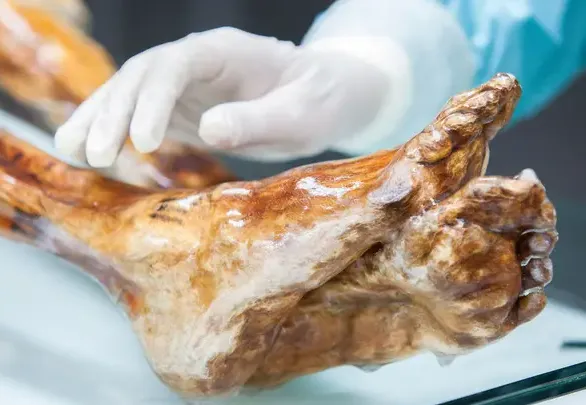
At minus six degrees, wrapped in carefully controlled humidity, Ötzi continues to challenge the idea that death freezes time. The famous mummy found in the Italian Alps is not only an extraordinary testament to human life more than five millennia ago. It is, in fact, a living world on a microscopic scale.
A new study published in the journal Microbiome, from the Nature group, has concluded that the so-called "Iceman" harbours a unique biological ecosystem, in which ancient microorganisms coexist with species introduced in recent times, after the body was discovered in 1991.
Ötzi, who lived around 5,300 years ago, has already revealed a great deal about the past. Since he was found by German tourists in the Alps, he has been the subject of countless scientific investigations, allowing aspects of his physical appearance, eating habits, state of health and even the events leading up to his violent death to be reconstructed.
This time, the researchers turned their attention to an invisible universe: the mummy's microbiome. From gut bacteria to yeasts adapted to extreme cold, the aim was to understand which organisms accompanied Ötzi over the millennia and which appeared more recently.
To do so, the team analysed bacteria and fungi present in skin samples, tissue fragments and water collected during the controlled thawing of the mummified remains. These results were compared with soil and ice samples preserved since 1991, collected at the site where the body was found.
The analyses identified genetic material belonging to Ötzi's original gut microbiota in the mummy's internal tissues. According to the scientists, several of these bacteria are now rare among populations living in industrialised societies, making the Iceman an exceptional source for understanding the evolution of the relationship between human beings and the microorganisms that inhabit their bodies.
Eurac described this discovery as "an exceptional glimpse into humanity's microbial past".
The study also revealed the presence of several species of cold-adapted yeasts, most likely originating from the glacial environment where the mummy remained for thousands of years. The researchers detected highly degraded ancient DNA and well-preserved recent DNA, suggesting that some of these organisms remain active under current preservation conditions, although possibly in a dormant state.
"The Iceman is not a static relic, but a dynamic biological interface," the study's authors wrote, stressing that the coexistence of ancient gut microbes and modern colonisers demonstrates the extraordinary complexity of this microscopic ecosystem.
The results also point to an unexpected consequence of the preservation methods used over recent decades. Three of the four yeast species identified have the genetic capacity to break down phenol, a compound applied after the mummy's discovery to prevent fungal growth on its surface.
According to the researchers, these yeasts may have turned the preservative itself into a food source.
"A mummy's microbiome is unique because it combines microorganisms more than 5,000 years old with species introduced since the body was discovered," explained Mohamed Sarhan, the study's lead author.
The findings suggest that, although the current preservation system manages to curb the development of most microorganisms, it may at the same time favour the survival of species particularly adapted to the cold.
Elisabeth Vallazza, director of the South Tyrol Museum of Archaeology, which is responsible for conserving Ötzi, assured that current preservation conditions are "very stable". Even so, she issued a warning: "more research and a comprehensive conservation effort are needed to preserve him for many generations".
More than three decades after emerging from the Alpine ice, Ötzi continues to tell stories. But some of the most surprising do not belong to the man he was. They belong to the millions of invisible beings that still inhabit his silence today.


