
For almost half a century, it was a technology that was ignored. Now the world's largest liquid air energy storage facility is preparing to enter operation in 2026 and aims to compete for space with grid-scale lithium batteries and with hydroelectric power, storing clean electricity and reducing the need to rely on fossil fuels.
As global consumption of renewable electricity soars and overtakes coal for the first time, there is also growing urgency to find ways of keeping that energy for when the sun disappears and the wind drops. Some are betting on large lithium batteries, others on pumped hydro. But a small industry, increasingly confident, believes there is a better alternative: batteries made of air.
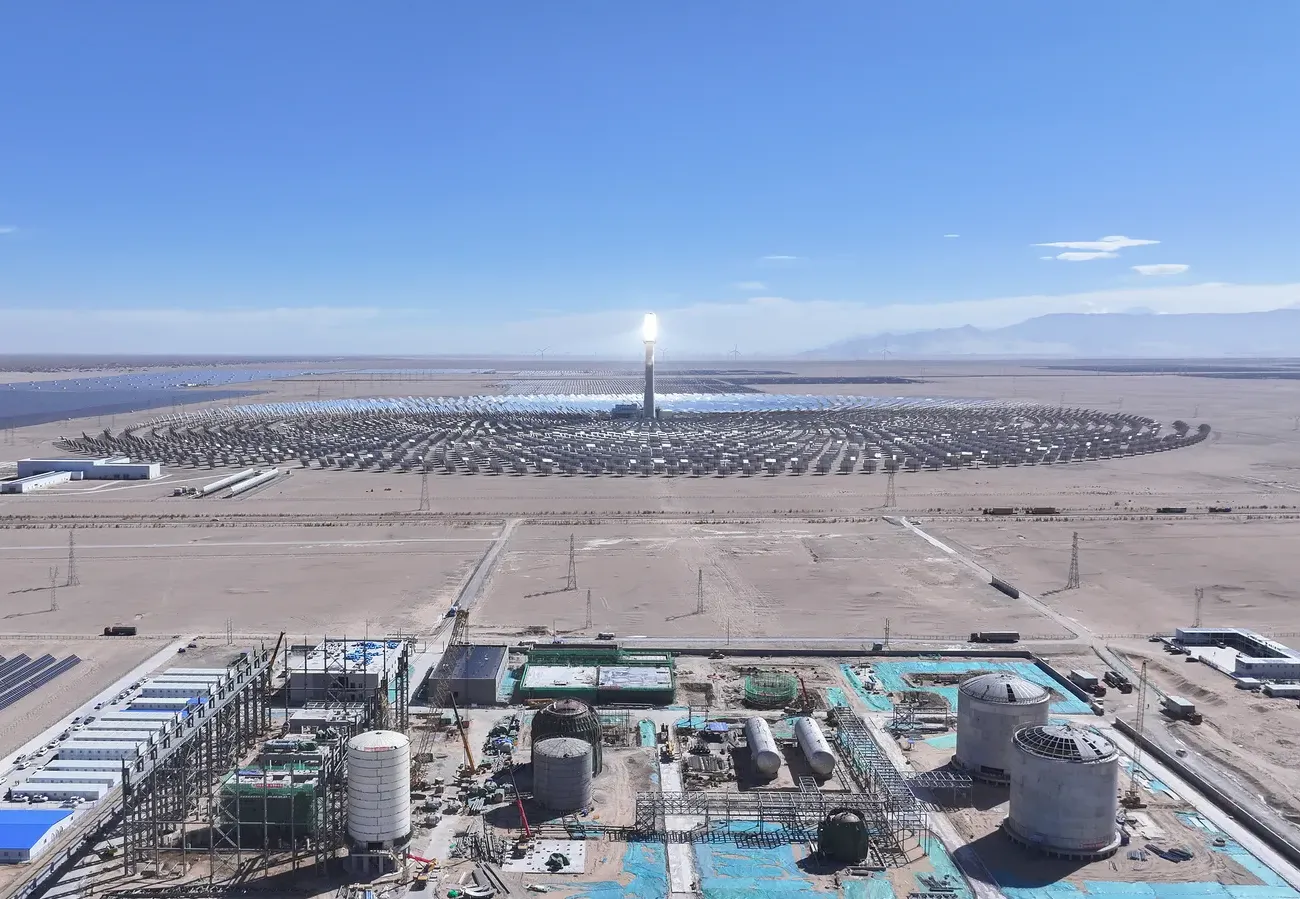
Near the village of Carrington, in north-west England, the foundations are beginning to rise for what is set to be the world's largest commercial liquid air energy storage plant, and one of the first of its kind. The site will house an array of industrial machinery and several large tanks, filled with air that has been compressed and cooled until it becomes liquid, using surplus renewable energy relative to demand. That stored energy can then be released when demand exceeds supply.
If the project works, others will follow. Highview Power, the company responsible for the development, believes liquid air storage could make it easier to replace fossil fuels with clean renewable sources — although, for now, the technology remains expensive. Even so, with demand for clean storage solutions accelerating sharply, the bet is clear: the balance will eventually tip in favour of liquid air.
The problem of intermittency
The transition to renewable energy is decisive for reducing greenhouse gas emissions and avoiding the worst impacts of the climate crisis. But this path brings serious challenges for electricity grids.
Coal- or gas-fired power stations can be switched on and off as needed, ensuring a predictable supply, matched to demand. Renewables, on the other hand, are intermittent. There are times when they do not produce enough electricity, increasing the risk of supply failures, and others — such as on very windy days — when they produce too much, which can destabilise the grid.
An essential part of the answer lies in storing the surplus so that it can be released when needed. This helps ensure a reliable supply and reduces the risk of damage to the grid. As the share of renewables rises, it has become increasingly important to strengthen grid-scale storage capacity, explains Shaylin Cetegen, a chemical engineer at the Massachusetts Institute of Technology (MIT), who studies energy storage systems.
For decades, the main form of storage was pumped hydro. Surplus electricity is used to pump water to higher ground, where it is held behind a dam. When the energy is needed, the water is released, passes through turbines and generates electricity. In 2021, the world had 160 gigawatts of installed pumped hydro capacity.
More recently, as demand for storage has increased, large-scale battery systems have begun to emerge. Growth has been rapid and increasingly fast. According to the International Energy Agency, grid-scale battery storage rose from 1GW in 2013 to more than 85GW in 2023, with more than 40GW added in that year alone.
The liquid air solution
Liquid air energy storage is, by comparison, a relatively recent technology. The basic idea has existed since 1977, but only in this century has it begun to receive real attention.
The process takes place in three stages. First, air is collected from the environment and purified. Then, it is compressed successively until it reaches a very high pressure. Finally, it is cooled until it turns into liquid, through a multi-stream heat exchanger — a device with several channels and tubes through which substances at different temperatures flow, allowing controlled heat transfer.
“The energy we take from the grid powers this charging process,” explains Cetegen.
When the grid needs additional energy, the liquid air comes into play. It is drawn from the tanks, evaporated and returns to a gaseous state. It then drives turbines that produce electricity for the grid. In the end, the air is released back into the atmosphere.
Throughout the process, there are some ingenious mechanisms for saving energy. One arises from the fact that gases heat up under high pressure: compressing air generates heat. That heat can then be reused to help restore the liquid air in the second half of the cycle. “Without these heat recovery cycles, the efficiency of the process is around 50%, but when we apply them we can exceed 60%, approaching 70%,” says Cetegen.
The real challenge lies in expanding liquid air storage to a scale large enough to significantly accelerate the energy transition.
A cushion for the grid
The new Manchester plant is seen as one of the first commercial projects of its kind in the world. It is being built by Highview Power, a company that has been working on this technology for 20 years. It follows a demonstration plant at Pilsbury, nearby. The Carrington facility will have the capacity to store 300 megawatt-hours of electricity, enough to cover a short shortfall in supply to up to 480,000 homes.
According to chief executive Richard Butland, it will come into operation in two phases.
In August 2026, the turbine is due to begin operating. At this stage, it will not yet produce electricity, but will help stabilise the grid. Today, says Butland, operators sometimes turn to gas-fired power stations for this purpose. “It is an enormous cost to the system,” he says. By offering an alternative for this stabilisation, “we can stop them having to do it”.
In 2027, the liquid air storage system is due to begin full operation. Highview's plan is simple: to sell electricity to the grid at the times when it is most needed.
The economic question
Although energy storage is an indispensable technology, the economic reality remains difficult, stresses Cetegen. In a study published in March, she and her colleagues assessed the viability of liquid air storage in 18 regions of the United States. They compared eight decarbonisation scenarios, with different levels of renewable energy penetration. In each of them, they estimated how much money a project could generate by buying and selling electricity over 40 years.
In the most aggressive decarbonisation scenario, liquid air storage proved viable in Florida and Texas, but nowhere else. “We did not observe economically viable systems in the other decarbonisation scenarios,” says Cetegen.
Even so, the researcher rejects a simplistic reading of these results as “negative”. Firstly, the methods used were deliberately conservative, and the study concluded that other forms of storage, such as pumped hydro and batteries, were even less viable economically. More importantly: the main obstacle was that storage infrastructure could not generate much income in the early years, because there were not yet enough renewables on the US grid to cause much price volatility. “The system was not being used much in the early years [of the model],” she explains.
Liquid air storage operators could simply wait a few years, until the growth in renewables made prices more volatile and, therefore, the business more profitable. But that would delay the energy transition itself, argues Cetegen.
For that reason, she argues, governments can play a decisive role in supporting the technology. In the study, subsidising upfront capital costs proved to be “a viable approach to achieving economic viability in the short term”.
Furthermore, faster adoption of renewable energy would increase energy price volatility, making storage more competitive and profitable.
The global expansion plan
At Highview Power there are no signs of concern. “Manchester is going to give very good returns,” Butland assures us.
Two other projects planned by the company — in Hunterston, Scotland, and Killingholme, Lincolnshire — have benefited from a British Government policy known as “cap and floor”, which guarantees the company a minimum return on the capital invested. According to Butland, this mechanism was fundamental in giving investors confidence. Even so, he maintains that it should not represent any cost to the State. “They are expecting every project to do better than the minimum return,” he says, “so the Government does not expect to have to pay”.
The company is also preparing two more plants in the United Kingdom, as well as projects in Japan and Australia. And they will be much bigger. While the Carrington plant will have a capacity of 300MWh, the Scottish facility is expected to be almost ten times larger, reaching 2.5GWh. As the compressors and refrigeration equipment are expensive, but the storage tanks are relatively cheap, the technology is easy to scale up.
Cetegen adds one last argument in favour of liquid air: cost. Storage technologies are often assessed using the so-called “levelised cost of storage”, a metric that estimates how much each unit of stored energy costs over the lifetime of the project. In the case of liquid air, this figure can fall as low as 45 dollars — around 34 pounds — per megawatt-hour, compared with 120 dollars — 89 pounds — for pumped hydro and 175 dollars — 130 pounds — for lithium-ion batteries.
“Although none of these forms of storage is likely to be economically viable at the moment without political support, liquid air storage stands out as a particularly cost-efficient option for large-scale storage,” says Cetegen.
In the end, Butland believes the electricity grids of the future will rest on a combination of several technologies. Pumped hydro is extremely effective and can operate for decades, but it depends on location, because it requires the availability of water. Batteries, for their part, are very efficient and can be installed virtually anywhere, although they need to be replaced after around 10 years. Liquid air offers another advantage: it can store energy for longer than batteries, with minimal losses.
As countries enter the green transition, their electricity grids will have to be redesigned. “We are rebuilding every electricity grid in the world around a new form of generation,” says Butland. And that could mean, in many cases, a central role for liquid air energy storage.


