
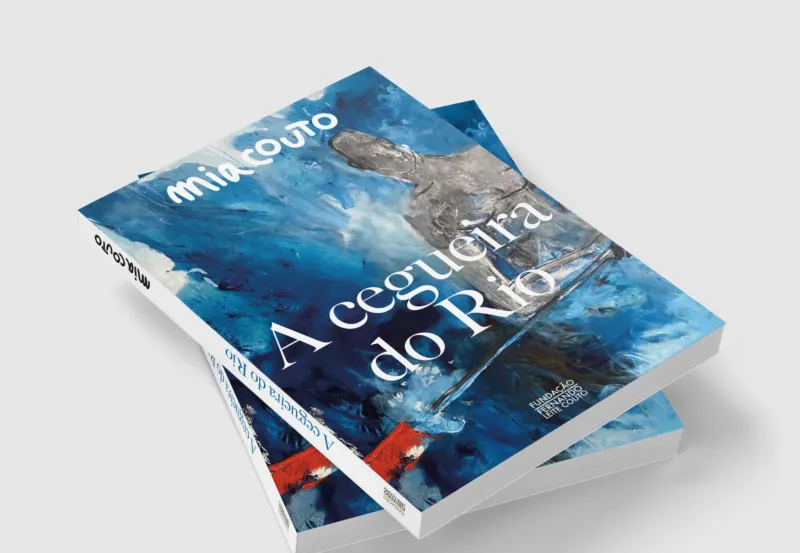
The renowned Mozambican writer Mia Couto launches this Wednesday, at 6 pm, at the Mozambique-China Cultural Centre in Maputo, his most recent novel, A cegueira do rio. The work, which promises to transport readers into a narrative where the real and the fantastic intertwine, is set in a village in northern Mozambique, in the context of the outbreak of the First World War on the African continent.
The plot begins with an unexpected military episode that sets off a series of mysterious events. Among them, the most disturbing: the disappearance of writing all over the world. Books, reports and even maps begin to appear faded, and the ability to master the art of writing seems to die out completely. In this unusual setting, the small village becomes the epicentre of the solution, with its inhabitants called on to teach Europeans how to write again and to recover the arts of navigation.
According to the Fernando Leite Couto Foundation, which publishes the book, A cegueira do rio will be presented by the writer Daniel da Costa. The event will also feature readings and artistic performances by Negro, Rita Couto and Letícia Deozina.
The novel’s synopsis reveals that, although rooted in Mia Couto’s characteristic imaginary, the book was inspired by two true historical events that took place on the banks of the Rovuma River, which separates Mozambique from Tanzania. The first is the Maji-Maji Rebellion (1905-1907), a violent protest against German colonial exploitation, which culminated in one of the greatest massacres in African history, with an estimated toll of between 200,000 and 300,000 dead. The second refers to the German attack on the Portuguese military post of Madziwa, in August 1914, during which a Portuguese sergeant and 11 African sepoys lost their lives.
In the author’s own words, “everything reported in this book became true from the moment it was written”. Another chapter in the distinguished career of Mia Couto, who, through his deeply poetic writing, continues to unravel the mysteries of history and the human condition.


