
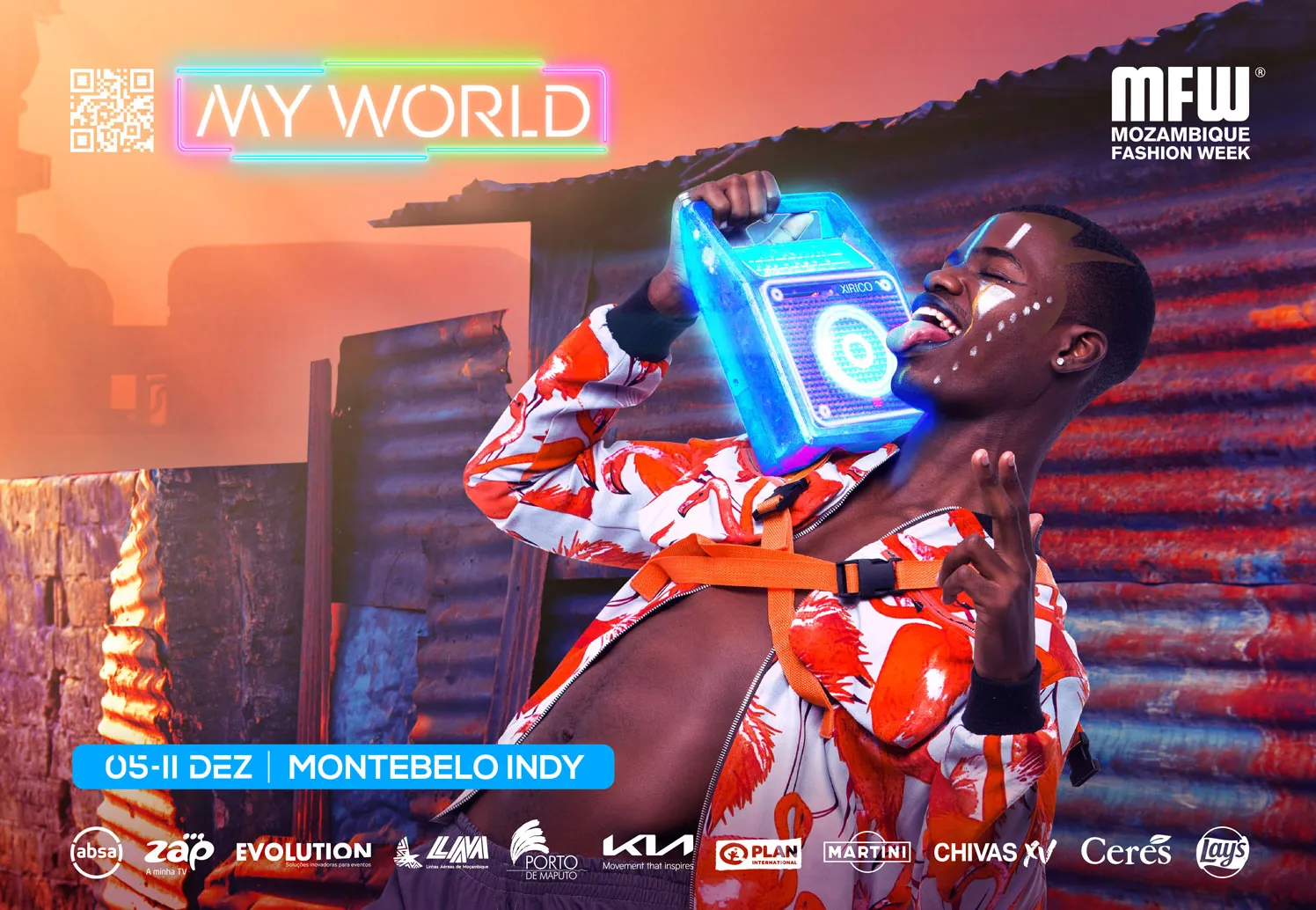
The curtain has fallen on the 18th edition of Mozambique Fashion Week (MFW). Over seven days, the event, organised by the agency DDB since 2005, brought together some 150 designers, both national and foreign, from young designers to the most renowned, who showed Mozambique and the world their talent and the beauty of fashion, at what is regarded as the largest national fashion platform.
The city of Maputo once again became the Mozambican capital of fashion with the staging of this edition of Mozambique Fashion Week (MFW), which this year, under the theme My World, explored the metaverse (a virtual reality environment) and the possibilities that technological advances can bring to the world of fashion. The event took place from 5 to 11 December, at different venues across the city of Maputo, and brought together various players from the industry. Once again, MFW reinforced its commitment to the discovery, encouragement, training and promotion of Mozambican fashion. The now traditional workshops and MFW Talks (discussion forums), on topics relevant to the growth of the Mozambican fashion industry, marked the Week, whose guiding thread was technology and sustainability.
Around a hundred and fifty designers presented their new collections to the vast audience, who turned out in large numbers for all the sessions of this first event of the post-pandemic period. Indeed, the very staging of MFW in person and without restrictions is a sign of a return to normality, although normality is a noun that definitely does not do justice to all those who showed their worth and why MFW is considered one of the biggest fashion events on the African continent.
With no disrespect to the many shows that took place in the first days of the event, we would like to single out the designer Doutor dos Tecidos, who showed off his class on the third day, presenting a set of pro-environmental pieces. These were formal and casual clothes for men and women, made from rags and other disposable materials, such as plastic and coconut waste, leading the audience to reflect seriously on reuse, preservation and environmental sustainability. Doutor dos Tecidos shone, as did those who came before and after him sharing the catwalk, which was also used for human and social causes.
Out of fashion!
Social ills can also be fought with fashion. This is the message that the MFW organisers wanted to convey (and succeeded in conveying) to Mozambican society. There are ills that must go out of fashion for good, such as prejudice, early marriages and the resulting early pregnancy. One of the biggest attractions at the 18th edition of MFW was the show Os Invisíveis (The Invisible Ones), an initiative of the Maputo Port Development Company (MPDC) and the Makobo Platform, which took place on the fifth day. The pieces were produced by a professional seamstress, supported by the talented hands of a waste picker from the Hulene rubbish dump in Maputo, whose dream is also to become a seamstress one day. The models were all young people living in situations of social exclusion. The aim of the show was, on the one hand, to draw attention to people in situations of social exclusion (the “invisible ones” of society) and, on the other, to raise support for the Kaya Platform, a social project that aims to reintegrate this group into the labour market. On the same day the audience applauded, among others, the well-known brands Nivaldo Thierry and Nuno Jota Jota, and the night closed in great style with musical performances by Kamané, Jay Arghh and Stefânia Leonel.
On the penultimate day of Fashion Week, Plan Moçambique, an organisation that promotes children’s rights and equality, brought the audience a performance show involving girls aged between 10 and 16. In it, children were seen in various situations (married and mothers at an early age) that run contrary to their dreams of qualifying and having a prosperous professional career. According to DDB, the aim of the initiative was, through fashion, to make society aware of the need to combat early marriages and early pregnancy, which crush the dreams of many girls. More than 20 designers brought colour and sparkle to the sixth day of the celebration of Mozambican fashion, whose audience included several distinguished guests, notably Gianni Bardini, Ambassador of Italy to Mozambique, Paolo Gozzoli, Director of the ICE Agency in Maputo, Vasco Rocha, Managing Director of DDB, António Franceschini, national head of CNA Federmoda, and Roberto Corbelli, researcher and trends specialist.
Fashion and plenty of conversation too
Quite rightly, the shows, the designers and, naturally, the models captured everyone’s attention at the country’s biggest fashion event. The Week was also interspersed with debates, called MFW Talks, whose aim was to stimulate the development of Mozambican fashion. Recurring topics included financial education, leadership and women’s entrepreneurship. Alongside the shows and debates, a fair linking art with fashion also took place over the seven days, with more than 20 stallholders.
The week ended on a Sunday, with more shows and more emotion. The organisers were delighted with the result achieved at this edition of MFW, which is expected to become ever more surprising, and bigger than it already is. The Managing Director of DDB, Vasco Rocha, thanked everyone who made the event possible, from the production team, the designers, partners and sponsors, to the audience, who followed the shows from the first day until the curtain fell, always with emotion, energy and enthusiasm. Vasco Rocha said that MFW is an initiative that celebrates the national arts, promoting creativity and cultural exchange through meetings between the main players in the fashion industry. “This edition of MFW, the 18th, is another step in a journey that began 18 years ago, when nobody expected it to go so far,” he said, stressing that “the great aim of Fashion Week is to make fashion a true industry at national level”. MFW 2022 brought together some 150 national designers and designers from South Africa, Angola, Italy and Japan.


