
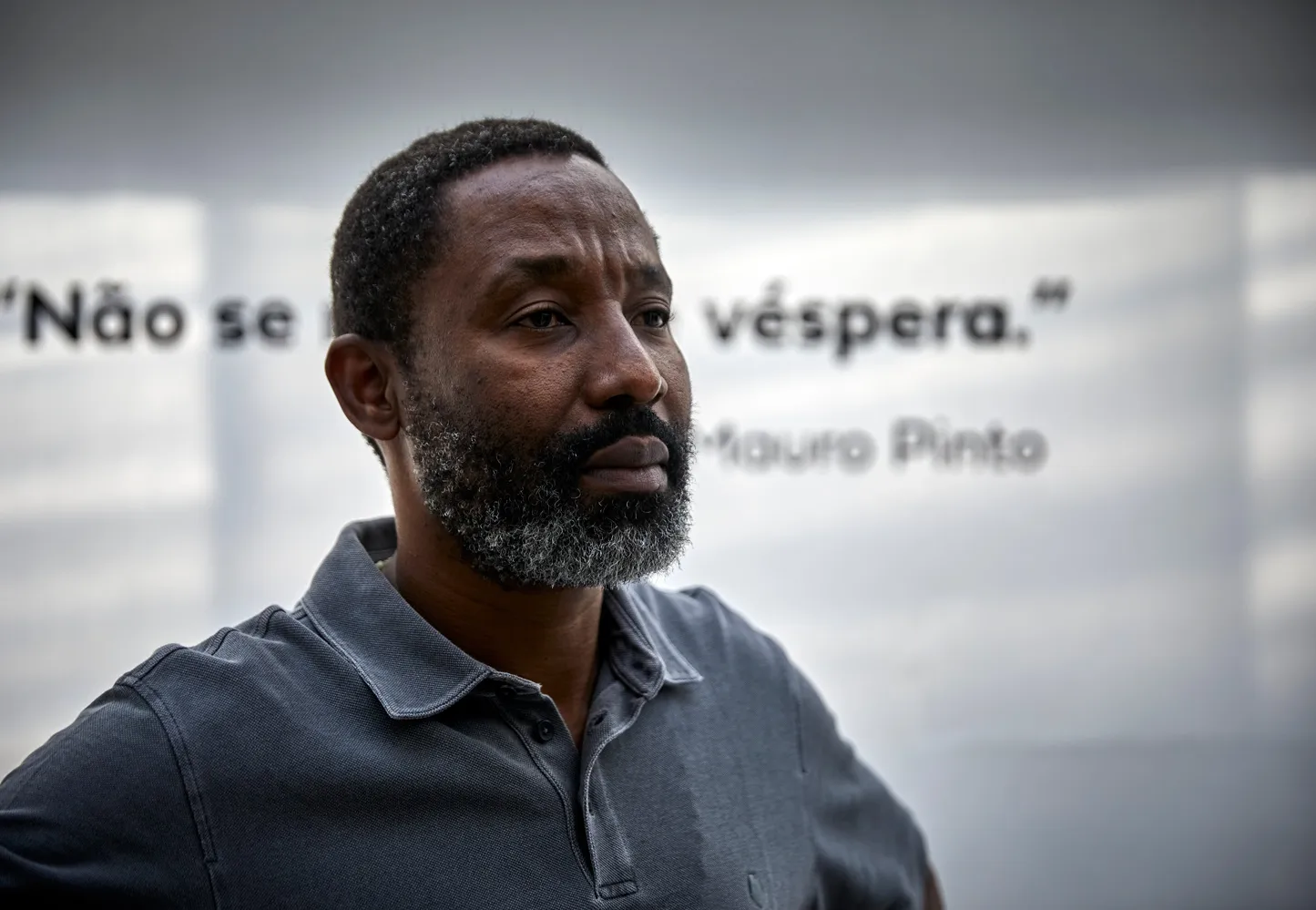
While still in his mother's womb, he already felt art dominating his existence. Everyday life, marked by the presence of relatives and people close to him who made art their way of life, conveyed to the new being that his life would only make sense after contact with the mysterious universe of the arts. Mauro Pinto never doubted that art had chosen him so as to communicate better with the world: “I can say that it all began inside my mother's belly. She had a cousin who was married to an artist. In addition, I had an uncle you may have heard of, Jaimito Machatine, who was one of the first guitarists in Mozambique. I began to have that contact with art inside my mother's belly, and it stayed in my subconscious.”
“I am a bit introverted and so I prefer to let things speak for me.”
Already in primary school, Mauro came into contact with the photographer Alexandre Júnior, the father of one of his schoolmates and his neighbour, an event that awakened the “bug” he already carried inside him. With time, the calling grew stronger. Seeking shelter in painting, he soon realised that it was in photography that he found the fullest expression of his existence. “I used painting as a way to express myself. I am a bit introverted and so I prefer to let things speak for me. However, I felt that painting could not convey what I wanted, and in the end I found in photography everything I was looking for to reach out to the world. So, at the end of the 1990s, he took a photography course at the Monitor International School and, at the same time, an internship with the photographer José Machado. In 2002 he began to approach photography professionally.
“You don't die the day before”
In developing his work, Mauro Pinto always seeks to prompt reflection on social life. His photographs are full of expressiveness and invite the mind to step out of itself and enter another, towards an ever more empathetic state of existence. “I start from the principle that all of us have a duty of citizenship and professional ethics. I always look at the most disadvantaged people and I think we should look more at others in order to improve social and public health. It is important to have discussion so that we can improve our well-being as individuals. We are only passing through this world and we cannot be afraid to speak. I am an “artivist”, which is why I often say this phrase of my own, “You don't die the day before”.
The photographer and “artivist” (artist and activist) has brought together work over his career that invites social analysis and reflection. Such is the case of the project “Disintegrated Vision”, in which Mauro photographed mentally ill people on the streets and in psychiatric hospitals, or even the project “Simply a Child”, which involved a series of photographs of street children. Mauro Pinto has never stopped campaigning since his first solo exhibition in 2002. More than 50 appearances in group exhibitions followed, notably Photography by Ricardo Rangel and Mauro Pinto, Mgnin-A Gallery (2011), and The Past, The Present and the Between, at the Venice Biennale in Italy (2019).
Mauro Pinto's voice echoes across much of the world through his photographs. His work is represented in several national and international collections, such as the Musée du Quai Branly, Paris; the Jean Pigozzi Contemporary African Art Collection, Geneva; the Manuel de Brito Collection, Lisbon; and the College of Arts and Sciences, University of North Carolina. The Mozambican photographer has collected national and international prizes won in recognition of his excellent work. These prizes include the Ricardo Rangel prize (2005), won in Mozambique, and, in 2012, the BES Photo prize (Portugal), with the photographic project “Dá licença” (“Excuse Me”), in which, through 12 photographs taken in Mafalala, he portrayed the interiors of homes, landscapes, people and streets of that historic neighbourhood.
Blackmoney, the old and ever-new exhibition
The public recently got to know Blackmoney, Mauro Pinto's most recent photographic exhibition. On show at the Franco-Mozambican Cultural Centre in the city of Maputo, the exhibition aims to prompt reflection on Man and the Earth. In Blackmoney, Mauro Pinto offers a delicate view of miners in their daily working routines, conveying through images the drama faced in the mines and by the miners as they seek conditions for their survival. “I like to photograph things that I think are a bit out of the ordinary, people who work in difficult situations. That is what I wanted to bring, to prompt collective reflection and, collectively too, to be able to resolve it.”
The experience of the exhibition goes far beyond the visual; it is an exhibition that can be heard and felt with the heart. In it, visitors have the chance to have a visual and sound experience, because the arrangement of the photographs in the space imitates a real coal mine. The audio, which also imitates the sound of the mines, helps visitors get closer to the reality portrayed by the photographs. In ten photographs, Mauro Pinto speaks of culture, society and the economy without saying a single word. In Maputo the show opens two years after it was exhibited in Portugal and will be on until 15 October.
Like any artist, Mauro Pinto has professional dreams that feed his hopes for the future, and he looks with joy at what the present has already allowed him to achieve. “An artist's greatest dream is to have what I am having with this exhibition: to be surprised by people's reaction every day. People who have never set foot in a gallery, a museum or a cultural centre come to visit the exhibition. For me, this is my greatest gain, being able to have these new people see art,” the artist concluded


