
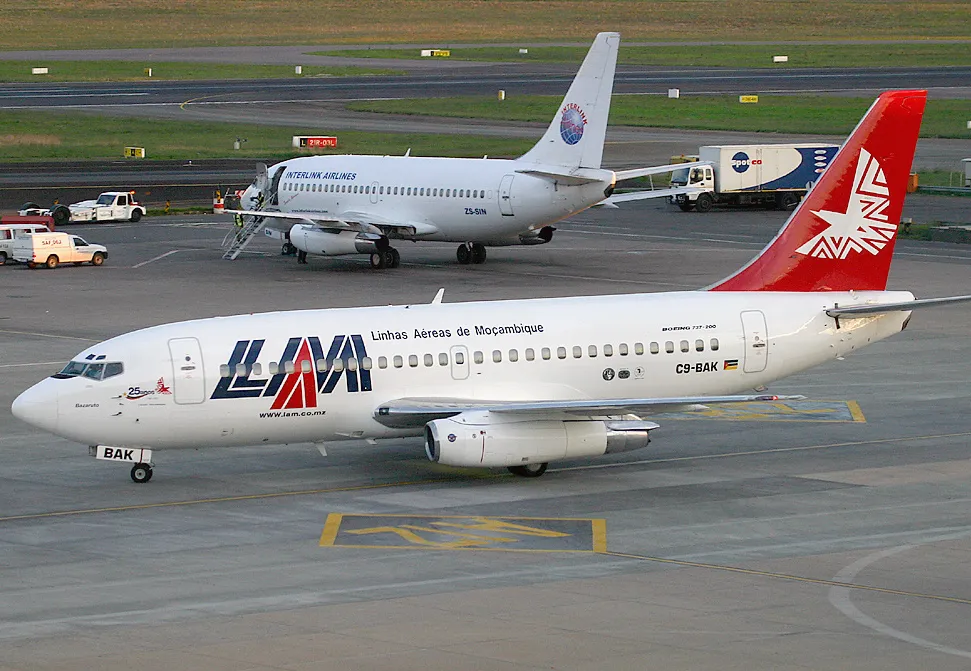
Mozambique Airlines (LAM), a state-owned company in the midst of restructuring, has launched a public tender for the short-term lease of five aircraft. The measure forms part of the carrier’s strategic modernisation plan and aims to fill operational gaps that for years have compromised the reliability of the company’s services.
According to the official statement, the temporary lease aims not only to secure immediate operational improvements, but also to respond to growing demand for aviation services in the country and the region, driven by the energy and tourism sectors and by major development projects. The tender will remain open until 22 August, allowing the participation of national and international companies interested in supplying aircraft under a ‘wet lease’ arrangement, which implies a complete package: aircraft, crew, maintenance and insurance.
Chronic deficit and incidents
The initiative comes in a context marked by serious operational problems at LAM, fuelled by a small fleet and scant investment over the years. Experts have attributed a number of non-fatal incidents to maintenance failures and ageing aircraft.
The company’s financial situation has deteriorated significantly in recent years. In 2021, losses exceeded 1.4 billion meticais (about 21.7 million dollars); in 2022, they were 448.6 million meticais (approximately 6.9 million dollars); in 2023, losses of 3.9 billion meticais (60.5 million dollars) were recorded and, in 2024, losses already amount to 2.2 billion meticais (34.1 million dollars).
Privatisation and new administration
In February, the Mozambican Government announced the sale of 91% of LAM’s shares, in a private negotiation. The disposal is estimated to generate 130 million dollars (equivalent to 8.3 billion meticais), an amount that will be invested in the purchase of eight new aircraft and in restructuring the carrier.
The decision follows statements by the President of the Republic, who denounced the presence of "foxes and corrupt individuals" within LAM, preventing structural reforms from moving forward. Shortly afterwards, the State Holdings Management Institute (IGEPE) dismissed, with immediate effect, the then chairman of the Board of Directors, Marcelino Gildo Alberto, and two other directors: Altino Xavier Mavile, responsible for finance and corporate affairs, and Bruno Miranda, technical and operations.
Strengthened oversight and international consultancy
In parallel, a new non-executive board of directors was appointed, made up of representatives of the public companies that have become LAM shareholders, namely Mozambique Ports and Railways (CFM), Cahora Bassa Hydroelectric (HCB) and Emose (Mozambican Insurance Company).
A “management committee” was also created, with executive functions subordinate to the non-executive board, tasked with ensuring the continuity of operations and the implementation of reforms.
To coordinate the new phase of financial and operational restructuring, the Government hired, in May, the consultancy Knighthood Global, led by James Hogan, former chief executive of Etihad Airways. The firm has three months to stabilise and reposition LAM. “The focus in the first three months will be to stabilise and reposition LAM”, the consultancy’s statement reads, assuring coordinated action with the new shareholders and authorisation to renew the fleet.


