
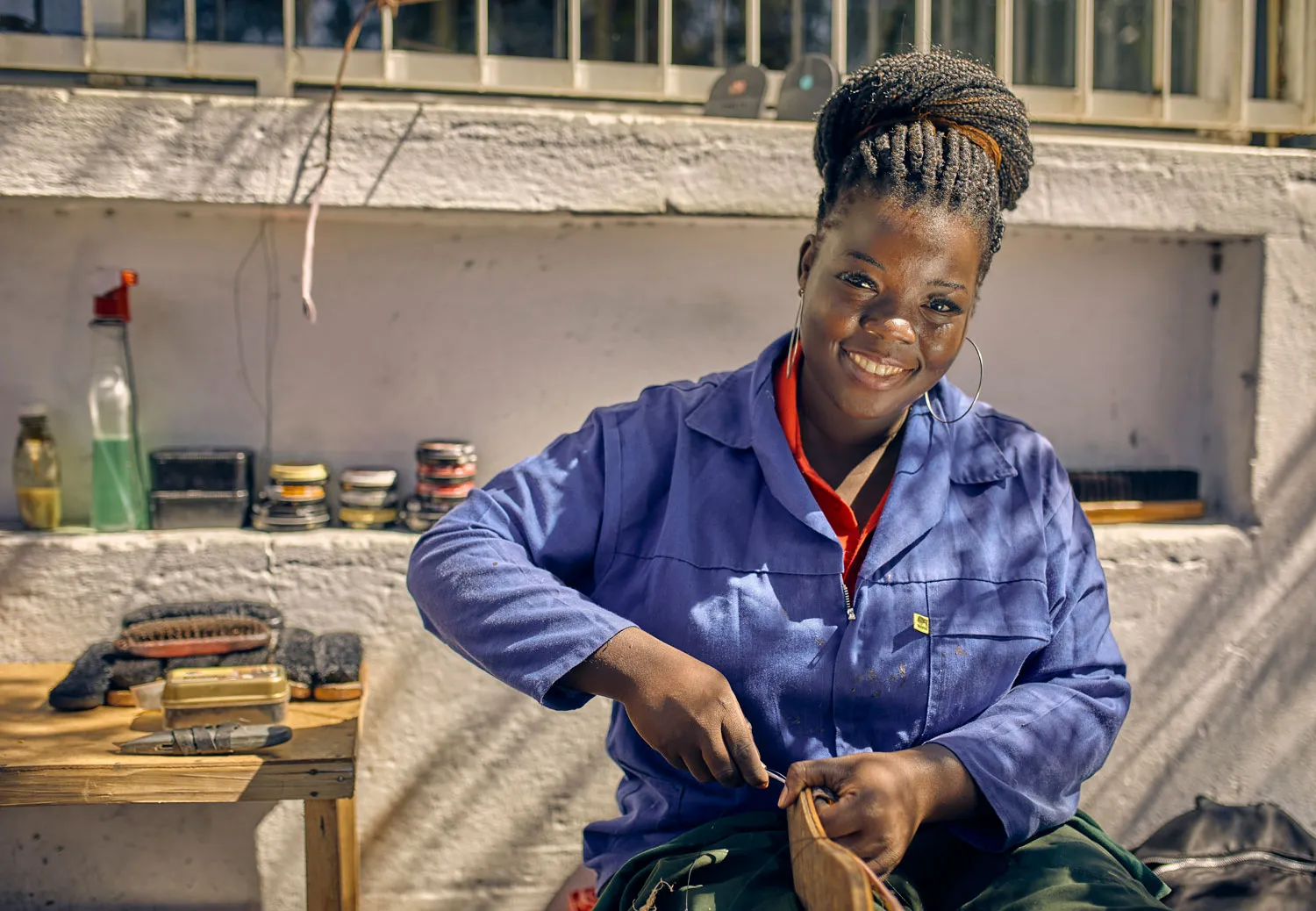
Irene Boane, more than a cobbler
Written by: Jaime Álvaro
Irene Boane learned the art of mending shoes from her father when she came of age (18). She is very probably the only woman, at least in the city of Maputo, working in this trade, which is dominated by men, and that makes her special. More than a cobbler, Irene is a symbol of the fight for gender equality and unequivocal proof that many stereotyped professions can also be described in the feminine.
The 23-year-old is a university student in the second year of an Agricultural Sciences degree at the Universidade Pedagógica de Maputo (UP). She invests almost all the money she earns on the street, mending and polishing shoes, in her studies. Her monthly income varies between two and three thousand meticais.
“I do this work as a way of supporting myself to finish my studies. I feel very honoured to be doing it, very special, and alongside my father too. He was the one who taught me the trade of which I am proud today, after I finished secondary school. I could not have expected more from him. He taught me a skill for life. It is the best lesson a child can receive from a father,” explained the young cobbler, who draws strength from it to keep going with her work, even in the sun, the rain and in the face of prejudice.
Irene has been working as a cobbler for five years. She says she has had difficult days and, in truth, still does. And time and again she has thought of giving up and finding another occupation. But her mentor, her father, has always supported her in doing what, for many, is still a job exclusively for men.
Irene is a symbol of the fight for gender equality and unequivocal proof that many stereotyped professions can also be described in the feminine
“It is not easy, and it never was. There is a lot of prejudice around shoe repair. But I have managed to overcome it thanks to the support that some customers give me. I have been snubbed many times by the very same customers who support me today. It took away my morale to come to work, but my father always said to me: ‘Daughter, focus. You are not there for the people, you are there for yourself.’ So that is what strengthened me to be here to this day.” That is how Irene recalled her father's words of encouragement in moments of indecision.
“Many customers have come looking for a cobbler, and when I introduced myself as the cobbler, they were astonished. Some were surprised and others were not. So I always make those who do not like it understand that they should move along,” Irene said regretfully, before continuing. “It is wrong to measure people's ability by their gender. I would like to encourage all women who are doing nothing at the moment to do any honest work to generate some income. There is no profession for men or for women. One must not be ashamed of honest work, because it dignifies us. What one should be ashamed of is stealing or prostituting oneself.”
Even though she likes being out on the street, which allows her closer, more human contact with customers, the future agronomist does not want to stay there much longer. “For now, my focus is to finish my studies. After I graduate, I want to develop my footwear factory project, with my brand ‘IS’ (Irene Shoes) stamped on every item. I want to put shoes on Mozambique,” said the young woman, picturing a bright future for herself, and then revealing the passion she feels for the work she does, which, she says, is more than mending shoes.
“When my father invited me to do this work, I was very shocked, because I had never seen a woman in this field. It was not easy to accept. But after some time I got used to the idea, and today I love what I do. I am a ‘shoe doctor’ who, as well as restoring customers' shoes, helps them restore their self-esteem, because nobody, really, likes walking around in a shoe with a coming-off sole. It is not at all comfortable,” she emphasised.
We never know when we are going to need the services of a cobbler. So knowing where to find a shoe repairer is useful information. So make a note of the address of Irene, the shoe doctor: “Anyone who wants my services should come here to the Alto-Maé neighbourhood, on Avenida da Zâmbia, at the corner with Avenida 24 de Julho, at Pastelaria Versalhes. Come, because it is quality work and, mind you, done by a woman,” she concluded.


