
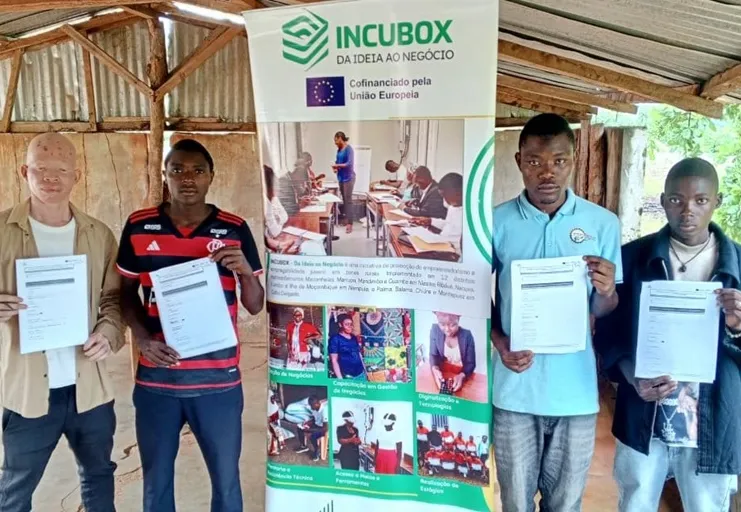
Throughout January, the INCUBOX Project carried out a wide range of pre-incubation, incubation, monitoring and community mobilisation activities, consolidating its commitment to promoting youth entrepreneurship and strengthening micro, small and medium-sized enterprises (MSMEs) in Northern Mozambique.
Implemented by Gapi and the Aga Khan Foundation, with co-funding from the European Union, the INCUBOX – From Idea to Business initiative aims to boost youth entrepreneurship and employability in rural areas, through access to business training, mentoring, technical assistance and financial resources. The project has been supporting the creation and development of startups in various economic sectors with growth potential, as well as generating opportunities for internships, self-employment and job creation for other young people.
At this stage, the 12 sustainable modular incubators — prefabricated, environmentally friendly structures equipped with solar power, Wi-Fi, sanitary facilities and storage space — began pre-incubation activities. These included radio debates and other mobilisation activities, with the aim of publicising applications for the third incubation cycle.
INCUBOX is currently training 1,080 young entrepreneurs through structured mentoring processes, with the clear target that 40% of the startups be led by women. The businesses created will benefit from access to funding, technical assistance and formalisation processes, and it is estimated that the project could generate between 3,000 and 3,250 direct jobs, contributing significantly to strengthening the local economy and the rural productive fabric.
Strategically located in the districts of Mandimba, Cuamba, Mecanhelas and Marrupa, in Niassa province; Ilha de Moçambique, Lumbo, Mossuril and Ribáuè, in Nampula; and Balama, Montepuez, Chiúre and Palma, in Cabo Delgado, the incubators marked the close of the second incubation cycle with events that brought together representatives of local governments, youth associations, strategic partners and community members. The sessions included business meetings and debates on the challenges and opportunities of entrepreneurship in the respective districts.
Across the board, pre-incubation activities were also carried out focusing on community mobilisation, dissemination of information about applications, talks, awareness-raising sessions and the use of community radio, with a view to reaching a larger number of potential beneficiaries.
In parallel, INCUBOX technicians made monitoring visits to second-cycle beneficiaries, after the allocation of start-up funds, making it possible to follow the implementation of the projects, identify progress and strengthen the sustainability of ongoing businesses.
The programme also included thematic training activities, namely radio debates on basic nutrition and food security, aimed at MSMEs, promoting good practices in food hygiene, handling and preservation, as well as the valuing of local products.
In the area of institutional coordination, meetings were held with local administrative authorities, community leaders, youth associations and strategic partners, strengthening cooperation and the alignment of activities with local development priorities.
With this set of initiatives, INCUBOX establishes itself as a relevant instrument in promoting youth entrepreneurship, economic inclusion and sustainable local development in Northern Mozambique.


