
The technological engine that has helped sustain the global economy could become one of its greatest sources of instability. The International Monetary Fund (IMF) has warned that a sharp slowdown in artificial intelligence (AI) investment, accompanied by financial market turmoil, could leave global gross domestic product (GDP) 1.1% below its projected level by 2028. In the United States, the impact could reach 1.8%, confronting central banks with a particularly complex dilemma: tackling inflation without exacerbating the economic slowdown.
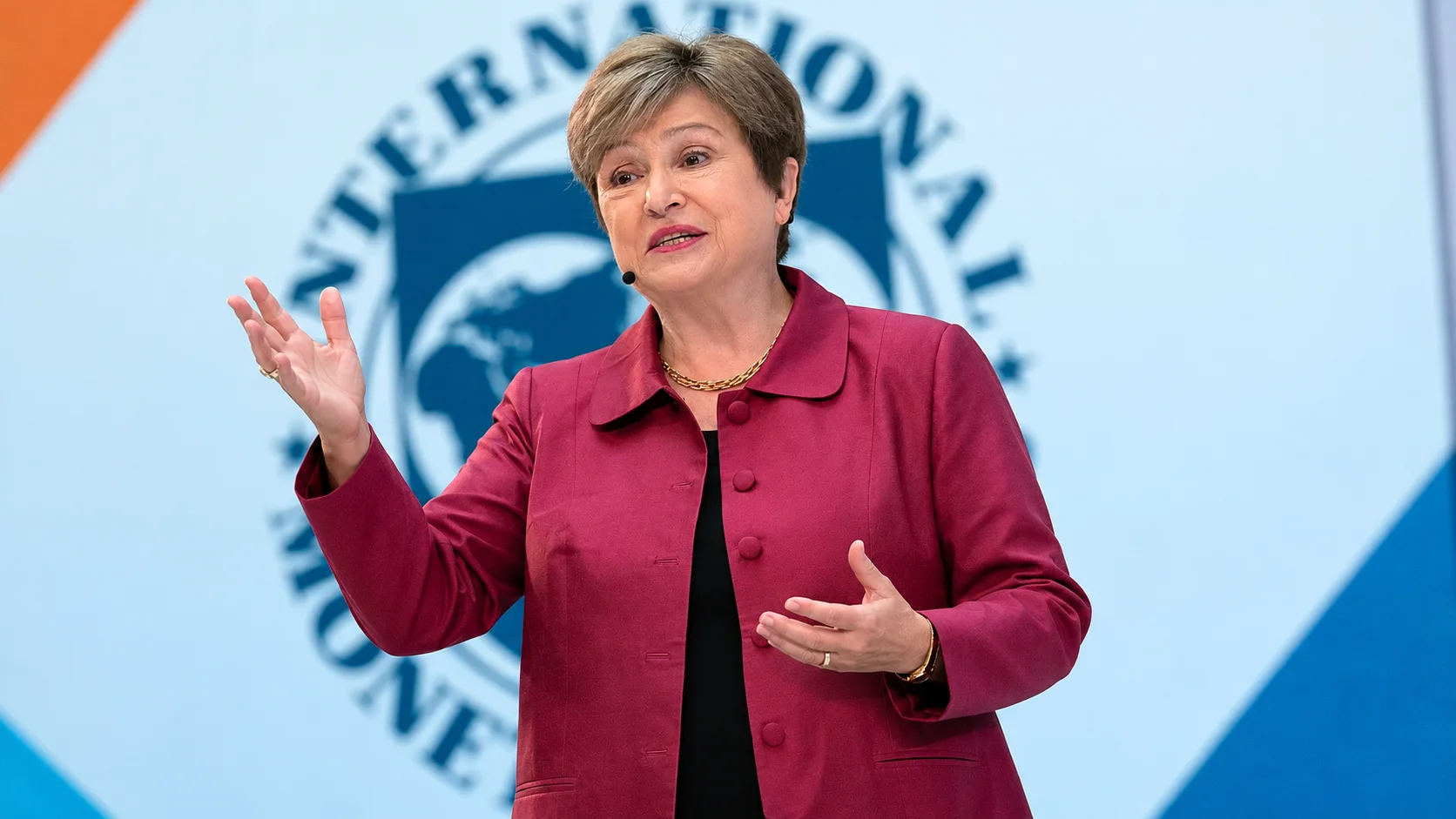
The warning was issued by IMF Managing Director Kristalina Georgieva on Friday, 6 November, during an address at the institution’s headquarters in Washington, as technology shares experienced sharp fluctuations and investors began questioning the financial sustainability of the race to develop artificial intelligence.
At the heart of these concerns lies an increasingly apparent contradiction. Technology investment is stimulating economic growth and partially offsetting the negative effects of the oil shock associated with the war in the Middle East. However, its scale, concentration and dependence on high expectations of profitability could amplify any potential market correction.
Kristalina Georgieva warned that central banks would need to consider the possibility of a slowdown in this technological momentum when setting monetary policy, particularly against a backdrop of persistent inflationary pressures and risks to financial stability.
The IMF chief anticipated continued market volatility, acknowledging that the combination of economic uncertainty, abrupt financial market movements and elevated inflation could make it more difficult for monetary authorities to act.
Global economic output could fall 1.1% below projections by 2028
The concerns expressed by the IMF Managing Director are supported by economic analyses published by the institution in October 2026.
Under one of the adverse scenarios examined, a significant reduction in artificial intelligence investment, combined with falling financial asset valuations and tighter financing conditions, could leave global output 1.1% below the baseline scenario by 2028.
The US economy is particularly exposed. In the United States, which accounts for a substantial share of global artificial intelligence investment, the negative deviation in economic output could reach 1.8%.
Potential impact on GDP by 2028
IMF adverse scenario — deviation from the baseline
Global economy | United States |
|---|---|
−1.1% | −1.8% |
Source: IMF, World Economic Outlook, October 2026, as cited by Reuters. The figures represent potential deviations from the baseline scenario, not annual growth rates.
These estimates do not represent baseline forecasts of a recession. They are conditional simulations designed to assess the economic consequences of a possible abrupt reversal in the technology investment cycle.
The impact could, however, extend far beyond companies directly involved in the development of artificial intelligence.
A substantial decline in technology share prices would reduce investors’ financial wealth, make it more difficult for companies to raise capital and could lead to the postponement or cancellation of new projects.
The effects would spread to sectors such as construction, semiconductors, electronic equipment, energy and specialised services, which are currently benefiting from the expansion of digital infrastructure.
The IMF’s principal concern lies precisely in this potential for contagion. A correction initially concentrated in technology markets could develop into a broader shock affecting investment, consumption and international economic growth.
Central banks face a dilemma between inflation and growth
A potential weakening of artificial intelligence investment comes at a time when central banks are facing simultaneous and, in some cases, conflicting challenges.
Technological expansion is currently producing two distinct effects on the economy.
On the one hand, investment in data centre construction, semiconductor purchases, software development and digital infrastructure installation is stimulating demand for goods and services, generating economic activity and contributing to output growth.
On the other, the scale of these projects is increasing demand for electricity, specialised equipment and financing, potentially intensifying pressure on certain prices and production costs.
According to Kristalina Georgieva, the momentum associated with artificial intelligence has helped partially offset the negative economic consequences of the oil supply shock caused by the war in the Middle East.
An interruption to this momentum would place monetary authorities in a more difficult position.
If technology investment slows while energy prices remain elevated, central banks could simultaneously face weaker economic activity and persistent inflation.
Under such circumstances, maintaining high interest rates would allow them to continue combating inflation but could deepen the economic slowdown.
Conversely, cutting interest rates to support growth could make it more difficult to stabilise prices.
Georgieva therefore considers it essential for monetary authorities to incorporate developments in technology investment into their economic and financial assessments.
The nature of the problem will also differ between countries. Economies that have benefited most directly from the expansion of artificial intelligence could experience a more pronounced slowdown in activity, while others would be exposed primarily to the indirect effects of financial volatility and changes in international prices.
Technology company valuations raise questions about sustainability
The rapid expansion of artificial intelligence has fundamentally transformed investors’ expectations about the future of technology companies.
Prospects of substantial productivity improvements, revenue growth and changes to business models have driven up the valuations of companies specialising in semiconductors, digital infrastructure and artificial intelligence systems.
However, the volume of resources required to sustain this expansion has begun to raise questions about companies’ ability to recover the capital invested.
Building data centres requires substantial expenditure on computing equipment, cooling systems, electricity supplies, transmission networks and computing capacity.
To justify these investments, companies will need to demonstrate that the use of the technology can generate sufficiently high revenues, efficiency improvements and productivity gains.
The IMF identifies this potential imbalance between investment and financial returns as one of the main vulnerabilities of the current technology cycle.
The Global Financial Stability Report, published in October, also highlighted rising debt levels, investment concentration and the complexity of financial relationships between companies involved in artificial intelligence.
One particularly sensitive issue concerns arrangements in which different industry participants invest in one another, finance projects and enter into commitments to purchase future services.
These structures can help accelerate technological development, but they also increase financial interdependence between companies.
According to the IMF, an analysis of 14 transactions completed since 2023 identified particularly substantial amounts:
Financial interconnections in the artificial intelligence sector
Equity | Debt | Future revenue |
|---|---|---|
US$300bn | US$650bn | US$1.4tn |
Source: IMF, Global Financial Stability Report, October 2026. Analysis of 14 transactions carried out since 2023.
The scale of these commitments demonstrates the intensity of the financial relationships established within the sector.
It also reveals an additional risk: difficulties at a company of major importance to the technology ecosystem could affect other participants, jeopardising investments, contracts and revenue expectations.
A financial correction could therefore spread across multiple companies and institutions, even when the initial problems are concentrated among a relatively small number of participants.
Technology share sell-off heightens fears of a correction
The IMF’s warnings gained particular significance following the sharp decline in shares of artificial intelligence-related companies on Thursday, 5 November.
The correction triggered adjustments across financial markets, prompting investors to reduce positions in assets considered riskier and increase their exposure to bonds.
The instability reflected not only concerns about the future profitability of technology investments but also uncertainty surrounding the regulatory framework for artificial intelligence in the United States.
Following the Democratic Party’s victory in the US midterm elections, expectations of legislative changes that could affect the sector increased.
According to Reuters, Democratic Party leaders are preparing initiatives to strengthen oversight of artificial intelligence systems and data centre development when they take control of Congress in January 2027.
The prospect of additional regulatory requirements introduced another source of uncertainty into a market already under pressure from concerns about the high costs of investment.
Financial market fluctuations also triggered margin calls and position adjustments by institutional and retail investors.
These movements highlighted how quickly a shift in expectations can set off successive reactions across financial markets.
For investors, the central question has become whether the revenues and productivity gains associated with artificial intelligence will be able to keep pace with the growth in corporate expenditure.
The episode also demonstrated the vulnerability of financial valuations sustained by exceptionally high expectations of future growth.
Artificial intelligence supports growth but increases concentration of risks
Despite its concerns about financial stability, the IMF acknowledges that artificial intelligence has become an important factor in the recent performance of the global economy.
Investment in technological infrastructure has helped sustain economic activity during a period marked by geopolitical tensions, trade uncertainty and increasing pressure on energy costs.
In its October World Economic Outlook, the institution projected global growth of 3.1% in 2026 and 3.4% in 2027.
The IMF acknowledged the positive contribution of artificial intelligence-related investment in partially offsetting the negative economic effects of the war in the Middle East.
However, it warned that the outlook remains subject to significant risks, including a prolonged conflict and a potential correction in the technology investment cycle.
The concentration of investment among a relatively small group of companies and sectors represents an additional concern.
The more economic growth depends on major technology projects, the greater its potential vulnerability to unexpected changes in those companies’ investment decisions.
The institution also considers it necessary to distinguish between the immediate economic effects of infrastructure expansion and the structural benefits that artificial intelligence could deliver over the coming years.
Data centre construction and equipment purchases generate demand for goods, services and financial resources in the present.
Sustained productivity gains, by contrast, will depend on the effective adoption of the technology by companies, institutions and workers, as well as their ability to transform production processes.
In an article published in October, Kristalina Georgieva acknowledged that artificial intelligence could add approximately half a percentage point to annual global economic growth over the next decade.
That benefit, however, depends on the realisation and widespread diffusion of the productivity gains associated with the technology.
Achieving this will require complementary investment in professional skills, business adaptation, infrastructure and institutional conditions that support technological adoption.
The economic potential of artificial intelligence therefore remains significant, but realising it is neither automatic nor sufficient to eliminate the financial risks associated with the current pace of investment.
War in the Middle East exacerbates vulnerabilities in the global economy
The geopolitical environment adds to the complexity of the risks identified by the IMF.
The war in the Middle East has disrupted energy supplies, driven up transport costs and contributed to mounting inflationary pressures.
At the same time, artificial intelligence investment has helped certain economies maintain higher levels of activity, partially offsetting the negative effects of the oil shock.
A technology slowdown coinciding with persistent difficulties in energy supplies could create particularly adverse conditions for economic recovery.
Weaker investment would reduce productive activity and aggregate demand, while persistently high energy costs would continue to complicate efforts to bring inflation under control.
In this scenario, central banks would have less room to support growth without compromising their price stability objectives.
The IMF also identifies vulnerabilities associated with high levels of public debt, the risk of further increases in sovereign bond yields and the financial system’s growing exposure to cyber threats.
The combination of these factors could amplify the effects of a potential technology market correction.
A sharp decline in financial asset valuations, accompanied by reduced liquidity and greater risk aversion, could worsen financing conditions for companies and governments.
The transmission of shocks could become particularly severe if investors sought to rapidly reduce their exposure to assets considered vulnerable.
A slowdown initially associated with artificial intelligence investment could therefore interact with existing weaknesses in the global economy, magnifying its effects on financial stability.
Sustainability of investment will determine the next economic challenges
Kristalina Georgieva’s warning marks an important shift in the assessment of risks associated with artificial intelligence.
For much of the recent expansion, economic debate focused primarily on the opportunities for growth, productivity gains and business transformation offered by the technology.
The IMF is now also drawing attention to the scale of investment, financing mechanisms and the possibility that profitability expectations may not materialise as quickly as markets anticipate.
The sustainability of this cycle will depend largely on companies’ ability to convert invested resources into actual revenues, efficiency improvements and lasting productivity gains.
For central banks, it will be essential to monitor these developments without underestimating inflationary risks or vulnerabilities within the financial system.
A gradual and orderly slowdown in investment could represent a normal adjustment in expectations, allowing resources to be reallocated without significantly compromising economic stability.
An abrupt correction, accompanied by substantial financial losses, financing difficulties and a contraction in credit, could have considerably more serious consequences.
The IMF’s estimates show that the risks extend beyond technology companies and could affect investment, consumption, financial markets and global economic growth.
Artificial intelligence has become one of the forces sustaining the current expansion of the global economy. The challenge now facing monetary authorities and investors is to determine the extent to which that expansion rests on sustainable economic gains.
It is precisely this uncertainty that lies at the heart of the IMF’s warning: the technology that is currently helping to protect global growth could, in the event of an abrupt reversal in investment, become a mechanism for transmitting economic and financial instability at a time when inflation and geopolitical tensions continue to constrain central banks’ ability to respond.


