
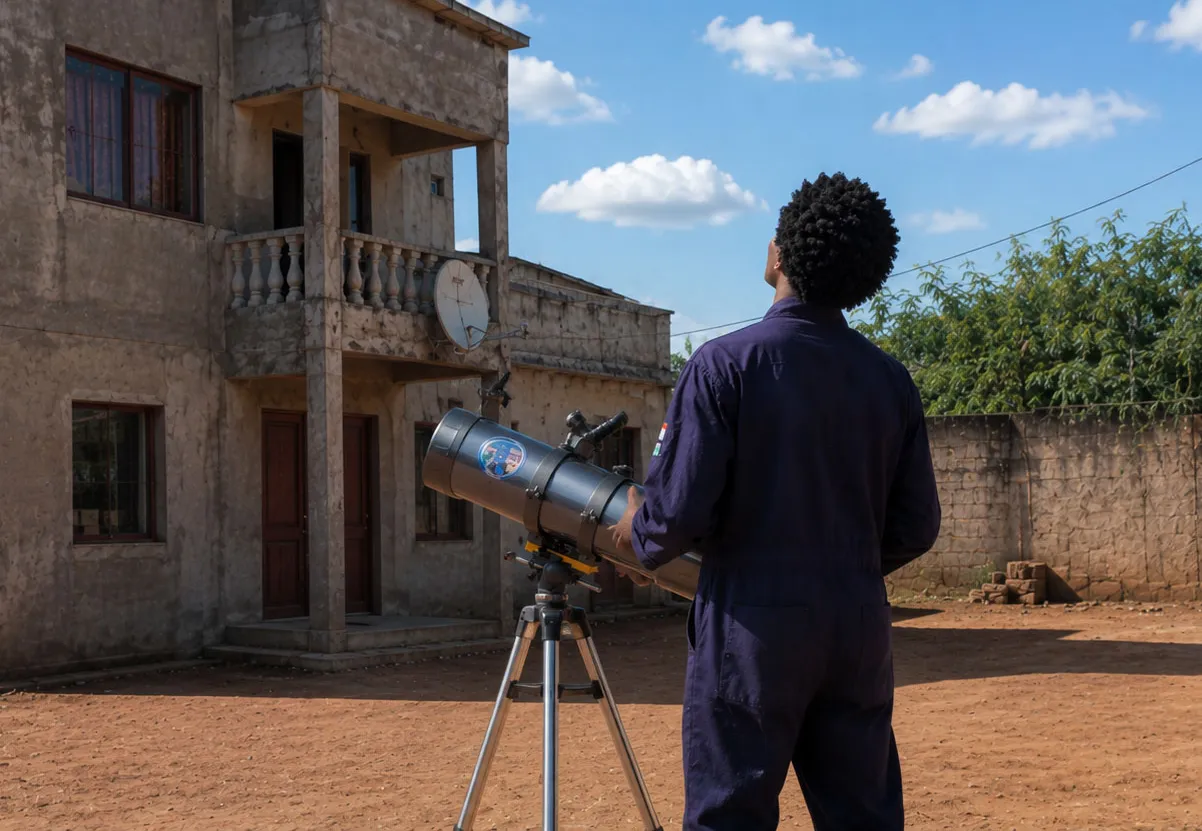
In a bedroom turned into a laboratory of ideas, where architectural drawings share space with musical scores and sketches of futuristic projects, a dream was born that seems improbable to many, but is absolutely real to Fernando Cavele. At 25, the young Mozambican architect became the country's first “analogue astronaut”, after taking part in an international mission that simulated, on the ground, the extreme conditions of a space expedition.
In an interview with Lusa, Fernando said that the achievement is only the beginning of a much longer journey. The ultimate goal remains clearly defined: to work at NASA as a space architect and take the name of Mozambique to the heart of the exploration of the universe.
It all began in 2019. That was when the young man began to delve into the study of astronomy, driven by a curiosity that quickly went beyond the limits of the classroom. A physics teacher would go on to play a decisive role by drawing, during a lesson, an unexpected link between astronomy and architecture.
“That was when I began to realise that I could combine knowledge of space with architecture, which was exactly the course I was starting,” explains Fernando, at his home in Maputo, a space that serves at once as home, creative workshop and centre of intellectual experimentation.
From that moment on, the sky ceased to be merely something to contemplate. It became a field of study.
Fernando then plunged into an intense search for knowledge, exploring ways of integrating architecture into space exploration scenarios, above all in the design of habitable environments for future missions to planets such as Mars or to the Moon.
Among his international references is Elon Musk and the trajectory of SpaceX, a company he finds inspiring for its boldness and its ability to turn seemingly impossible ideas into reality. But the young Mozambican also highlights national figures who encouraged him in his first steps, such as Edson Jackson, founder of Mozambique's first astronomy club.
“NASA also inspires me. It is an agency where I dream of getting one day, as a technician and space architect,” he says.
A path marked by obstacles
The road to recognition was far from simple.
Fernando recalls years marked by financial difficulties, institutional barriers and countless rejections. Even so, he persisted.
“I went through a lot of turbulence and institutional rejections along the way,” he admits.
The first major international validation would come only in 2025. The young man decided to submit research in the field of materials science to a scientific conference in India. Among many international candidates, his work was selected.
More than that: the organisers fully funded his participation.
“They believed in me. I was one of the youngest in that room,” he recalls proudly.
What does an analogue astronaut do?
Unlike traditional astronauts, an analogue astronaut takes part in missions carried out on Earth that simulate extreme space conditions. These programmes recreate environments similar to those found on Mars or the Moon, making it possible to test technologies, scientific procedures and human behaviour in situations of isolation.
This was exactly the challenge Fernando faced earlier this year, during an analogue mission carried out in India.
For seven days, he lived in a strictly controlled environment, subject to isolation, limited resource management and routines designed to reproduce future space missions.
“It was a little bit difficult,” he confesses.
Among the difficulties, he highlights the language barrier, the different schedules and the constant need to manage resources in a balanced way. Even so, he says the support of the international team was essential in getting through the most demanding moments.
“The people who were with me did a lot to make me feel almost at home.”
It was after returning from the mission that Fernando realised the historic scale of the feat. Driven by curiosity, he began researching to confirm whether any other Mozambican had already achieved the same recognition.
The conclusion was clear.
“I had to do a lot of research and I found that I was the first.”
The next step: taking Mozambique to NASA
Despite this unprecedented achievement, Fernando believes the real challenge begins now.
Aware of the limitations in the country for fields linked to space exploration, the young architect is currently working on several fronts to bring Mozambique closer to that technological and scientific universe.
One of them is fundraising to secure a place on a master's in Advanced Architecture at the Institute for Advanced Architecture of Catalonia, in Spain.
At the same time, he has launched a start-up dedicated to developing technologies linked to space exploration, seeking to place Mozambique in a global industry dominated by major scientific powers.
“We are developing technologies capable of meeting the demands of space exploration and of integrating Mozambique into that global ecosystem,” he explains.
In a country where opportunities in this sector are still scarce, Fernando insists on a message addressed to Mozambican youth: where you come from should not define the limits of your future.
He argues that it is necessary to “look beyond the difficulties” and keep believing that, with vision, effort and persistence, dreams can take on a universal dimension.
And while many look at the sky merely as a horizon, Fernando Cavele continues to see it as a destination.


