
In the bustling heart of Xipamanine market in Maputo, an alternative economy has risen that clothes more than bodies — it clothes dreams and sustains families. The sale of secondhand clothing, driven by small traders and boosted by the NGO ADPP, not only keeps the Mozambican capital's largest informal marketplace moving, but generates income for more than 200,000 people, while also feeding social and educational projects across the country.
Olinda Matule, 59, is one of the living voices of this reality. She has sold secondhand clothes for more than three decades, with a fixed stall in Xipamanine market, where she says she has found dignity and independence.
“With the sale of clothes I managed to build my house and bring up my children, because I am a separated mother and a widow at the same time. I managed to do a lot,” she tells the Lusa news agency, as she visits, once again, the ADPP warehouses, where for the past three years she has bought bales of clothes at affordable prices.
Proud of her work, Olinda stresses that she has never been the target of prejudice: “I always had clean, nice clothes. That makes a difference.” Swimsuits and Indian clothes are among the most sought-after items, but, she says, it is common to find pieces from international brands among the lots.
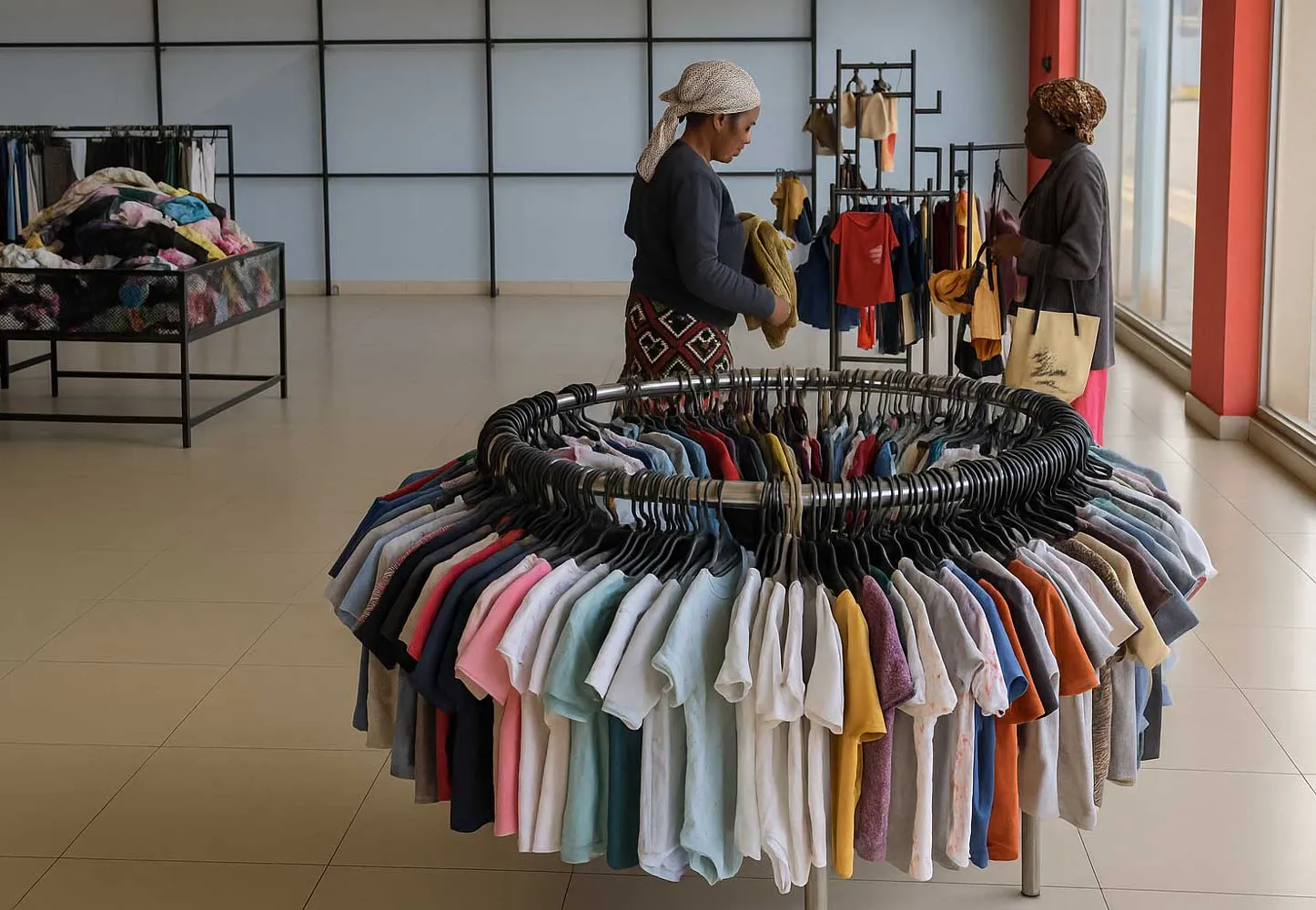
In Machava, on the outskirts of Maputo, one of the ADPP shops serves as a restocking point for new traders, such as Saquina Davide, 27, who recently joined the business.
“I started this very year. Today, for example, the clothes are 25 meticais [0.3 euros]. I buy twenty pieces and resell them at 100 meticais [1.3 euros] each,” explains Saquina, as she examines hangers loaded with colourful fabrics in search of the most original pieces.
Vasco Muchamo, 36, is also a regular customer. With a trained eye, he looks mainly for men's T-shirts and children's items. He no longer remembers when he started in the business — “it's been a very long time” — but assures us that, to succeed, “you have to have patience. It's not easy to choose”.
For Vasco, shops like the ADPP's offer dignity to those who cannot pay shopping-centre prices. “There are people who can't afford to go into the shops and buy at a high price,” he stresses.
According to Damião Mabote, Programmes Officer at ADPP Mozambique, the secondhand clothing project has been in existence for three decades and represents a crucial cog in the functioning of various educational and social initiatives in the country.
“With this income, they educate their children. We have success stories of even young graduates on the back of selling secondhand clothes,” he says.
The project funds, among other things, 11 teacher-training schools and other educational activities, all dependent on the revenue from the sale of secondhand clothes.
Mabote also highlights the practice's positive environmental impact: “We know that producing new clothes consumes many resources, mainly water. By reusing clothes, we avoid unnecessary production and protect the environment.”
In the crowded alleys of Xipamanine, among colourful garments and stacked bales, another kind of fabric is born — the social one — where solidarity, resilience and entrepreneurship are interwoven, stitching together new opportunities in a country that recycles more than clothes: it recycles destinies.


