
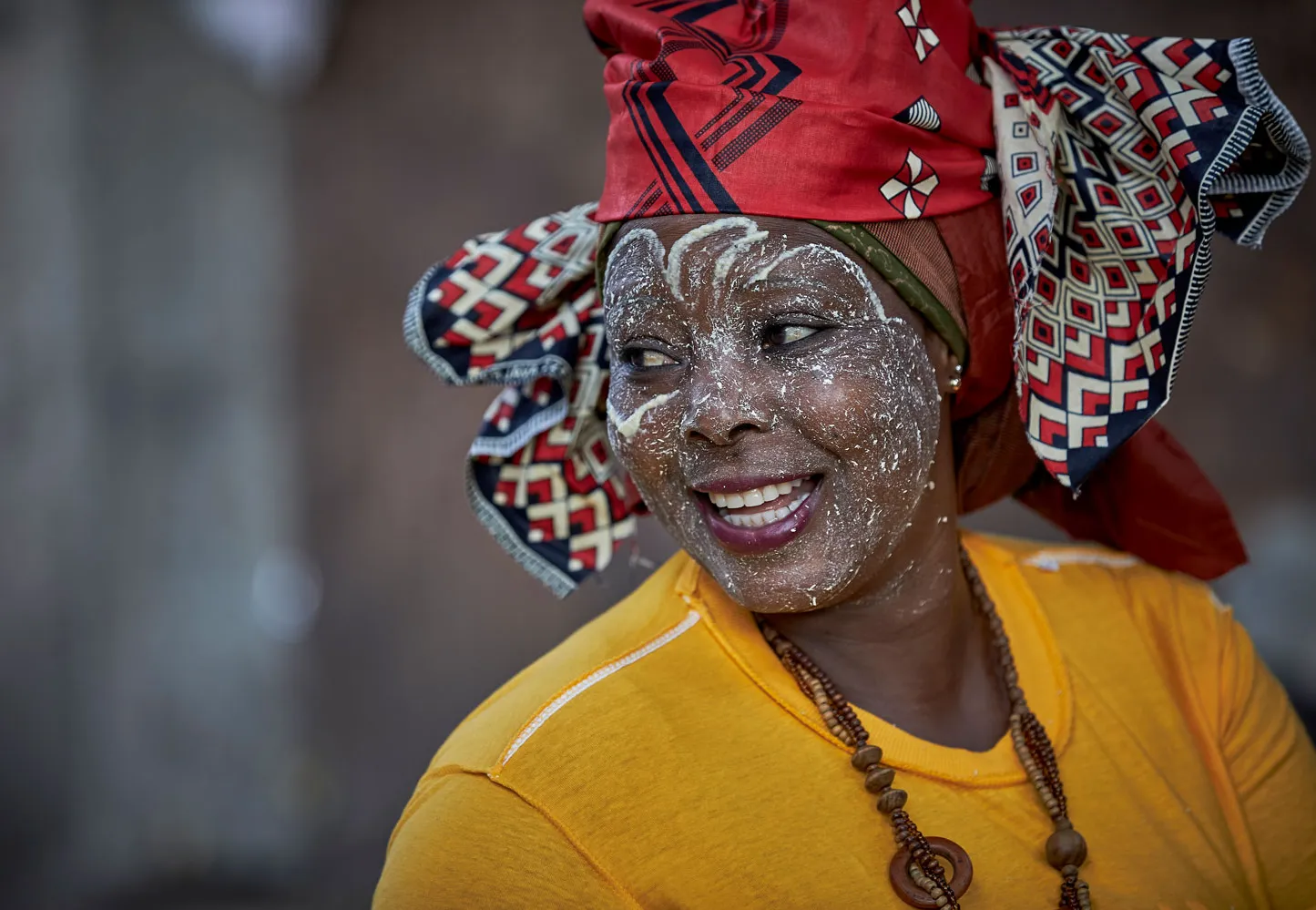
A dance of Arab origin, the tufo came into Mozambique and spread through the north of the country, especially in the provinces of Nampula and Cabo Delgado, or so the story goes. Its name probably derives from the name of the musical instruments the Arabs used, “ad-duff”. In Portuguese, this word became “adufe” or “adufo”, and then “tufo”.
If it was once a typical dance for the Arabs’ amusement, today there is a Mozambican group in our capital that champions this cultural expression as an educational ritual and as a way of announcing celebrations. Founded more than 50 years ago by Mr Matano Abdala, the Tufo da Mafalala, made up mostly of women, has for years served as a school for the new generations. Indeed, through song and dance, the group seeks to educate women and young people to adopt a more responsible attitude in their daily lives.
The cultural group Tufo da Mafalala is the keeper of an extensive cultural and artistic mosaic, with a history of cultural crossings in the Indian Ocean. Its vast repertoire of traditional Nampula dances includes the tufo, the ndzope and the matsepwa, rhythms marked by Afro-Arab influence. In typical brightly coloured costumes, the “muthianas horeras” (beautiful women) cover their faces with mussiro – a kind of facial cream or lotion used mostly by Macua women –, and wear blouses and capulanas in vivid colours and a headscarf. They make light movements with their arms, legs and waists and, in melodious voices, sing and dance. The group has fifteen members, of whom ten are women, two are girls, two are instrumentalists and one is the president of the group. They come from Nampula province, with the exception of the two girls, who are from Maputo. Saquia Rachid, aged 49, a mother of two boys (aged 27 and 30) and a native of the capital of the North, is the queen of the Tufo da Mafalala, of which she has been a member for around 35 years. After the death of her father-in-law, the group’s founder, she took over the leadership, where she remains to this day.
For this issue marking Mozambican Women’s Day, 7 April, Xonguila magazine spoke with Saquia Rachid, who gave her version of the history of the dance she practises. She told us that the Arabs who took the tufo to Mozambique Island were in the habit, in the break from the working day, of playing pots and dancing. “Our grandparents found it strange, but at the same time funny,” said Saquia. Nowadays, the tufo dance is seen as a cultural inheritance, and while in the past, in our interviewee’s opinion, it was a dance practised exclusively by men, over the years women reinvented it and became the main dancers.
According to Saquia, the tufo is a dance that was created especially for swaying, and when men swayed, the women would comment: “Look, that man swaying doesn’t even look like a man.” Hence the men thought it best to leave the dance to the women, to avoid connotations and labels, explained the queen of the Tufo da Mafalala, adding that the men now only sing and play the instruments.
Every week the women gather in one of the suburban neighbourhoods of the city of Maputo, the Mafalala neighbourhood, to dance the tufo. According to the group’s queen, this dance is considered a therapeutic dance. “Young people and women join us to forget their everyday problems in a relaxed way and venture into dance. It is an excellent form of spiritual purification,” she maintained. With the tufo dance, the women seek to convey joy. As a result, they only dance on special occasions, such as birthdays, lobolo, weddings and other celebratory events.
The Tufo da Mafalala frequently travels within and outside the country to present some numbers from its work. By way of example, they have been to neighbouring South Africa three times, to Algeria, to Brazil, specifically Rio de Janeiro and São Paulo, and Italy was also one of the destinations on their itinerary, our source stressed, visibly moved, adding on the same occasion that it is generally the organisers who decide how many people should travel. “For a good dance, we need at least eight people. Although the movements are light, they are tiring, so the members of the group have to be swapped during the dance,” said Saquia Rachid.
“The money from our performances is shared among the group to ensure that each of us can buy the necessary costumes and the corresponding jewellery. Lately, because of the situation the country and the world are going through, it is normal for us to have only one show a month, contrary to what used to happen in other times,” said the group’s representative, pointing to one of the main challenges that could ruin the group’s continuity. According to her, new blood needs to be brought in, although this is a very difficult task, since young women in the South do not show much interest in this type of culture, whereas in Nampula children grow up already dancing the tufo.
The group dreams of learning other skills besides singing and dancing, since most of its members have little schooling and, with the cost of living rising, need other sources of income.
The Mafalala neighbourhood is located in the city of Maputo, in the KaMaxaquene Municipal District. Because of its history and cultural symbolism, it is one of the best-known neighbourhoods in the country, associated with the emergence of Mozambican identity. Great names in the country’s literature, music, sport and political life came from it. Mafalala is home to people from the most diverse parts of the country, with their varied religious and cultural expressions, and the presence of people of the Macua ethnic group, who most practise the tufo dance, is significant.


