
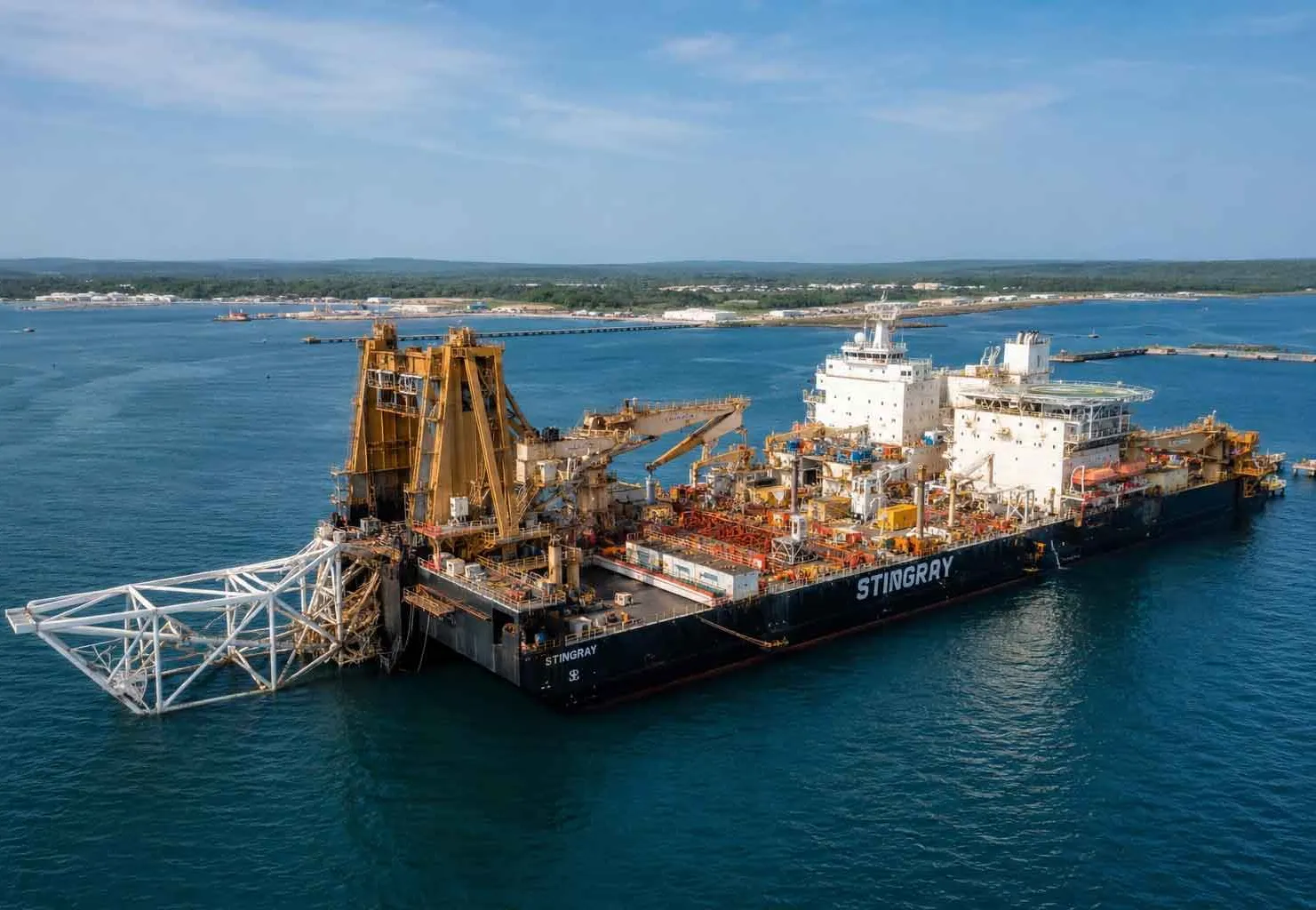
The arrival of the barge STINGRAY in Palma Bay offers one of the most visible signs that Mozambique LNG is beginning to leave behind the stage of announcements about the restart of activities and move on to actual execution on the ground.
The vessel, which specialises in pipeline installation, was unloaded on 5 August 2026, paving the way for the laying of five pipelines intended to link the offshore gas development to the onshore infrastructure.
For investors, however, the significance of this operation goes beyond yet another construction milestone. The pipelines form part of the essential infrastructure for carrying gas from the Area 1 fields to the coast. Their installation thus brings Mozambique closer to a long-awaited goal: turning its vast offshore reserves into commercial exports of liquefied natural gas (LNG).
Mozambique LNG enters the execution phase
Area 1, operated by TotalEnergies, now enters a period in which the physical progress of the works is expected to carry growing weight in market confidence.
After years marked by interruptions, investors are beginning to find concrete signs on the ground: contractors, equipment and specialised vessels are returning to Cabo Delgado, while important construction packages are progressively moving forward.
The mobilisation of the STINGRAY is another piece of this process.
The vessel's journey was far from simple. The STINGRAY and its support fleet were stranded in the United Arab Emirates following the closure of the Strait of Hormuz in early 2026. The fleet was eventually transferred through Oman before continuing to Mozambique.
Now, with the vessel in Palma, an important component of the offshore programme can finally move ahead.
The link to the global LNG market
The STINGRAY's mission will be to install five pipelines and two support umbilicals along a 17.7-kilometre corridor in Palma Bay.
In practice, this infrastructure will help to establish the physical link between the gas resources off the Mozambican coast and the LNG facilities being developed onshore.
The shallow-water works will later be followed by the deepwater campaign, scheduled to begin in the second quarter of 2027.
Together, these two stages will make it possible to progressively connect the offshore fields to the LNG plant. For investors, each completed phase also means one more portion of the risk associated with executing the project has been removed.
And that factor is decisive.
Major LNG projects are not assessed solely by the size of the reserves in the subsoil or the billions of dollars committed in investment. The real test lies in the ability to turn reserves, infrastructure and capital into reliable production and, finally, into regular exports to the international market.
What is at stake for Mozambique
Mozambique LNG is the largest investment ever made in the country.
Successful delivery of the project could profoundly change the profile of Mozambican exports, increase foreign currency earnings and, in time, provide significant revenue for the State.
But the economic effects begin long before the first LNG export.
The construction itself creates opportunities in logistics, transport, engineering, accommodation, maintenance and local supply chains, broadening the economic impact of the operations associated with the project.
On the international stage, the project could also strengthen Mozambique's position in the global LNG market, at a time when buyers in Asia and Europe continue to seek diversified sources capable of securing long-term supplies.
It is in this context that the arrival of the STINGRAY takes on an importance that goes beyond the vessel itself.
Mozambique LNG has taken one more step towards the goal.
A considerable volume of offshore and onshore work remains to be done, but the narrative around the project is beginning to change. The question posed by the market is progressively ceasing to be whether Mozambique LNG will be able to fully resume activities and is turning to another unknown: how effectively will it be able to deliver what is planned?
In the coming months, investors will be watching closely the progress of the offshore works, the development of the onshore facilities and the preparations for the deepwater campaign planned for 2027.
The five pipelines that will cross Palma Bay represent only a small part of a much larger undertaking.
But they carry an important signal for the market: the largest natural gas project developed in Mozambique to date has regained strength — and the route that is to carry gas from the offshore reserves of Cabo Delgado to world markets is becoming ever more concrete.


